


Effect of stacking insecticidal cry and herbicide tolerance epsps transgenes on transgenic maize proteome
- PMID: 25490888
- PMCID: PMC4273480
- DOI: 10.1186/s12870-014-0346-8
Effect of stacking insecticidal cry and herbicide tolerance epsps transgenes on transgenic maize proteome
Abstract
Background: The safe use of stacked transgenic crops in agriculture requires their environmental and health risk assessment, through which unintended adverse effects are examined prior to their release in the environment. Molecular profiling techniques can be considered useful tools to address emerging biosafety gaps. Here we report the first results of a proteomic profiling coupled to transgene transcript expression analysis of a stacked commercial maize hybrid containing insecticidal and herbicide tolerant traits in comparison to the single event hybrids in the same genetic background.
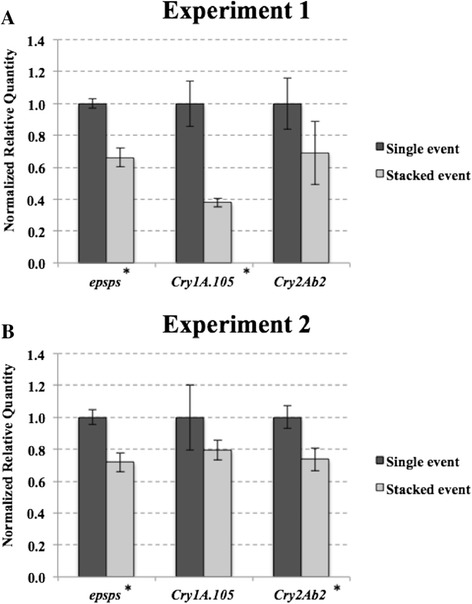
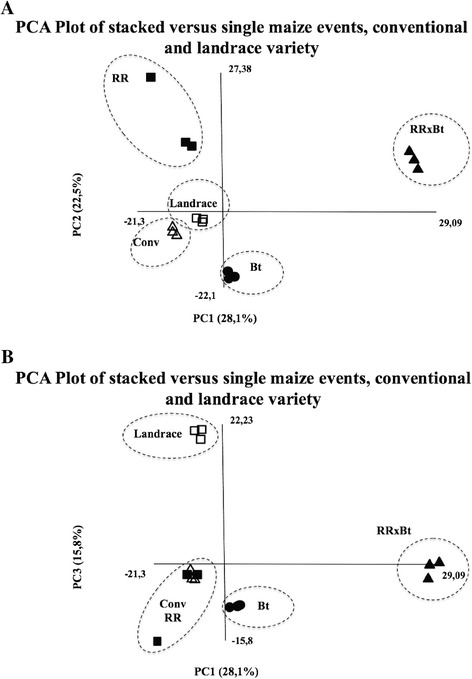
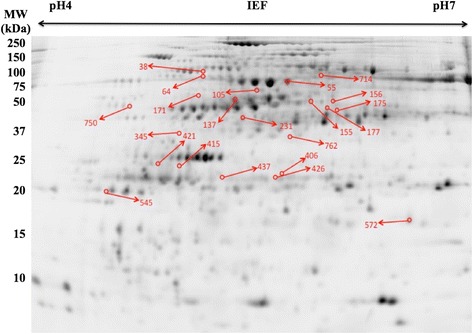
Results: Our results show that stacked genetically modified (GM) genotypes were clustered together and distant from other genotypes analyzed by PCA. Twenty-two proteins were shown to be differentially modulated in stacked and single GM events versus non-GM isogenic maize and a landrace variety with Brazilian genetic background. Enrichment analysis of these proteins provided insight into two major metabolic pathway alterations: energy/carbohydrate and detoxification metabolism. Furthermore, stacked transgene transcript levels had a significant reduction of about 34% when compared to single event hybrid varieties.
Conclusions: Stacking two transgenic inserts into the genome of one GM maize hybrid variety may impact the overall expression of endogenous genes. Observed protein changes differ significantly from those of single event lines and a conventional counterpart. Some of the protein modulation did not fall within the range of the natural variability for the landrace used in this study. Higher expression levels of proteins related to the energy/carbohydrate metabolism suggest that the energetic homeostasis in stacked versus single event hybrid varieties also differ. Upcoming global databases on outputs from "omics" analyses could provide a highly desirable benchmark for the safety assessment of stacked transgenic crop events. Accordingly, further studies should be conducted in order to address the biological relevance and implications of such changes.
Figures
References
-
- James C. Global Status of Commercialized Biotech/GM Crops: 2013. ISAAA Brief No. 46. Ithaca: ISAAA Press; 2013.
-
- De Schrijver A, Devos Y, Van den Bulcke M, Cadot P, De Loosed M, Reheul D, Sneyers M. Risk assessment of GM stacked events obtained from crosses between GM events. Trends Food Sci Tech. 2007;18:101–109. doi: 10.1016/j.tifs.2006.09.002. - DOI
-
- Comissão Técnica Nacional de Biossegurança: Normative Resolution No. 08 of July 3th, 2009. 2009. [http://www.ctnbio.gov.br/index.php/content/view/13863.html]
Publication types
MeSH terms
Substances
LinkOut - more resources
Full Text Sources
Other Literature Sources
