


Gender differences on effectiveness of a school-based physical activity intervention for reducing cardiometabolic risk: a cluster randomized trial
- PMID: 25491026
- PMCID: PMC4295398
- DOI: 10.1186/s12966-014-0154-4
Gender differences on effectiveness of a school-based physical activity intervention for reducing cardiometabolic risk: a cluster randomized trial
Abstract
Background: Studies that have examined the impact of a physical activity intervention on cardiometabolic risk factors have yielded conflicting results. The objective of this study was to assess the impact of a standardized physical activity program on adiposity and cardiometabolic risk factors in schoolchildren.
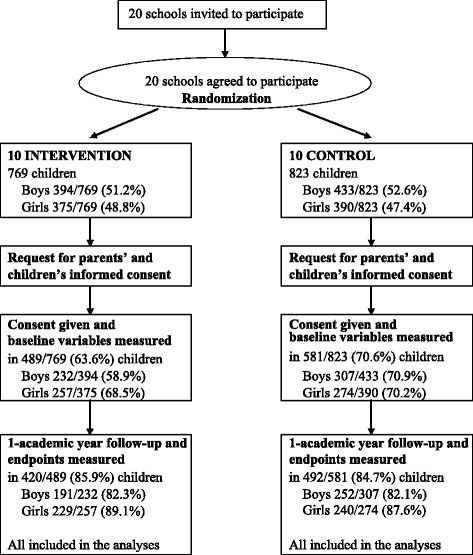
Methods: Cluster randomized trial study of 712 schoolchildren, 8-10 years, from 20 public schools in the Province of Cuenca, Spain. The intervention (MOVI-2) consisted of play-based and non-competitive activities. MOVI-2 was conducted during two 90-minute sessions on weekdays and one 150-minute session on Saturday mornings every week between September 2010 and May 2011. We measured changes in adiposity (overweight/obesity prevalence, body mass index [BMI], triceps skinfold thickness [TST], body fat %, fat-free mass, waist circumference) and other cardiometabolic risk factors (LDL-cholesterol, triglycerides/HDL-cholesterol ratio, insulin, C-reactive protein and blood pressure). The analyses used mixed regression models to adjust for baseline covariates under cluster randomization.
Results: Among girls, we found a reduction of adiposity in intervention versus control schools, with a decrease in TST (-1.1 mm; 95% confidence interval [CI] -2.3 to -0.7), body fat % (-0.9%; 95% CI -1.3 to -0.4), waist circumference (-2.7 cm; 95% CI -4.5 to -0.9), and an increase in fat-free mass (0.3 kg; 95% CI 0.01 to 0.6). The intervention also led to lower serum LDL-cholesterol and insulin levels. Among boys, a reduction in waist circumference (-1.4 cm; 95% CI -2.6 to -0.1; P = 0.03), and an increase in fat-free mass (0.5 kg; 95% CI 0.2 to 0.9; P = 0.003) was associated with the intervention versus control schools. The prevalence of overweight/obesity or underweight, BMI, and other cardiometabolic risk factors was not modified by the intervention. No important adverse events were registered.
Conclusions: An extracurricular intervention of non-competitive physical activity during an academic year, targeting all schoolchildren regardless of body weight, is a safe and effective measure to reduce adiposity in both genders and to improve cardiometabolic risk profile in girls.
Trial registration: Clinical trials NCT01277224.
Figures
References
-
- Martínez-Vizcaíno V, Sánchez López M, Moya Martínez P, Solera Martinez M, Notario Pacheco B, Salcedo Aguilar F, Rodriguez-Artalejo F. Trends in excess weight and thinness among Spanish schoolchildren in the period 1992–2004: the Cuenca study. Public Health Nutr. 2009;12:1015–1018. doi: 10.1017/S1368980008003571. - DOI - PubMed
-
- Brug J, van Stralen MM, Te Velde SJ, Chinapaw MJ, De Bourdeaudhuij I, Lien N, Bere E, Maskini V, Singh AS, Maes L, Moreno L, Jan N, Kovacs E, Lobstein T, Manios Y. Differences in weight status and energy-balance related behaviors among schoolchildren across Europe: the ENERGY-Project. PLoS One. 2012;7(4):e34742. doi: 10.1371/journal.pone.0034742. - DOI - PMC - PubMed
Publication types
MeSH terms
Substances
Associated data
LinkOut - more resources
Full Text Sources
Other Literature Sources
Medical
Research Materials
