Review
. 2015 Jun;27(6):378-88.
doi: 10.1111/jne.12247.

The importance of biological oscillators for hypothalamic-pituitary-adrenal activity and tissue glucocorticoid response: coordinating stress and neurobehavioural adaptation

Affiliations
Review

The importance of biological oscillators for hypothalamic-pituitary-adrenal activity and tissue glucocorticoid response: coordinating stress and neurobehavioural adaptation

G M Russell et al. J Neuroendocrinol. 2015 Jun.

Abstract

The hypothalamic-pituitary-adrenal (HPA) axis is critical for life. It has a circadian rhythm that anticipates the metabolic, immunoregulatory and cognitive needs of the active portion of the day, and retains an ability to react rapidly to perceived stressful stimuli. The circadian variation in glucocorticoids is very 'noisy' because it is made up from an underlying approximately hourly ultradian rhythm of glucocorticoid pulses, which increase in amplitude at the peak of circadian secretion. We have shown that these pulses emerge as a consequence of the feedforward-feedback relationship between the actions of corticotrophin hormone (ACTH) on the adrenal cortex and of endogenous glucocorticoids on pituitary corticotrophs. The adrenal gland itself has adapted to respond preferentially to a digital signal of ACTH and has its own feedforward-feedback system that effectively amplifies the pulsatile characteristics of the incoming signal. Glucocorticoid receptor signalling in the body is also adapted to respond in a tissue-specific manner to oscillating signals of glucocorticoids, and gene transcriptional and behavioural responses depend on the pattern (i.e. constant or pulsatile) of glucocorticoid presentation. During major stressful activation of the HPA, there is a marked remodelling of the pituitary-adrenal interaction. The link between ACTH and glucocorticoid pulses is maintained, although there is a massive increase in the adrenal responsiveness to the ACTH signals.

Keywords: glucocorticoids; hypothalamic-pituitary-adrenal axis; pulsatility; ultradian rhythm.


Figures

Fig. 1
Fig. 1
The principal regulatory mechanisms that underlie hypothalamic-pituitary-adrenal (HPA) activity. Corticotrophin-releasing hormone (CRH) released from the paraventricular nucleus (PVN) of the hypothalamus reaches the anterior pituitary through the hypophyseal portal circulation, and stimulates corticotrophs to release corticotrophin (ACTH), which in turn reaches the adrenal gland through the systemic circulation and promotes the cortical synthesis and secretion of glucocorticoids (CORT). CORT, in turn, exerts an auto-inhibitory effect on their production by acting on at least three different levels: anterior pituitary, hypothalamus and hippocampus (displayed as part of corticolimbic system). CORT also affects extensive corticolimbic regions of the brain, which in turn modulate, primarily via indirect projections, the mode of HPA axis activity. (1) CORT pulsatility emerges as a consequence of the feedforward–feedback with a built-in delays relationship between the actions of ACTH on the adrenal cortex and endogenous CORT on the pituitary corticotrophs. (2) Physiological CRH drive creates the variability in the amplitude and duration of each CORT pulse throughout the day, which enables the gradual increase of CORT levels during the most active parts of the day (darker parts of the blue arrow) and their gradual fall during the less active parts of the day (lighter parts of the blue arrow). (3) An acute stressor, leading to a substantial raise in the hypothalamic CRH secretion, results in increased CORT levels characterised by a dampened oscillatory profile, and eventually resets the phase of the ultradian rhythm. Green arrows, stimulatory effect; red arrows, inhibitory effect; grey arrows, mixed effect.
Fig. 2
Fig. 2
Glucocorticoids (CORT) are secreted in a pulsatile manner from the adrenal cortex to systemic circulation, where they predominantly interact with corticosteroid-binding globulin and, to a lesser extent, with albumin. Only the free fraction of CORT (approximately 5%) is biologically active, and this fraction oscillates synchronously between the blood and the brain (blue curves). In the latter, and particularly within the hippocampus, free CORT pulsatility induces ‘gene pulsing’; 15 min after a CORT pulse, GR maximises its translocation to the cellular nucleus and its binding to corresponding DNA sites (yellow curve) and, approximately 15 min later, CORT-sensitive genes such as period 1 reach a peak in their transcriptional levels [heteronuclear RNA (hnRNA) levels]. Thirty minutes later, corresponding mRNA accumulation also reaches its maximum. GR, glucocorticoid receptor.
Fig. 3
Fig. 3
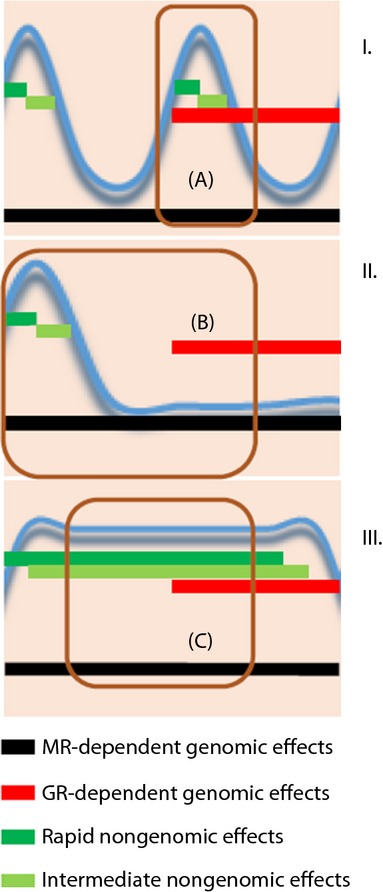
Theoretical approach of the varying interactions among genomic and nongenomic glucocorticoid effects under differential patterns of exposure; (I) glucocorticoid pulses (blue curve) characterised by physiological interpulse intervals (mean duration of approximately 90 min) lead to a short-lasting association between their rapid/intermediate and delayed effects (a), whereas (II) glucocorticoid pulses (blue curve) characterised by prolonged interpulse intervals (over 4–5 h) lead to a complete dissociation between their rapid/intermediate and delayed effects (b). (III) Finally, acute stress conditions (blue curve = prolonged high glucocorticoid levels, diminished or no pulsatility) could result in a prolonged interplay between genomic and nongenomic effects (c). Different patterns of glucocorticoid exposure have been related to changing phenotypes in various neuronal functions, such as long-term potentiation (LTP) induction. Black lines, period of delayed/genomic mineralocorticoid receptor (MR)-dependent effects; red lines, period of delayed/genomic GR-dependent effects; dark green lines, rapid, nongenomic effects; light green lines, intermediate, nongenomic effects. GR, glucocorticoid receptor.

References

    1. Selye H. Stress and the general adaptation syndrome. Br Med J. 1950;1:1383–1392. - PMC - PubMed
    1. De Kloet ER, Vreugdenhil E, Oitzl MS, Joels M. Brain corticosteroid receptor balance in health and disease. Endocr Rev. 1998;19:269–301. - PubMed
    1. Sorrells SF, Sapolsky RM. An inflammatory review of glucocorticoid actions in the CNS. Brain Behav Immun. 2007;21:259–272. - PMC - PubMed
    1. Plaschke K, Muller D, Hoyer S. Effect of adrenalectomy and corticosterone substitution on glucose and glycogen metabolism in rat brain. J Neural Transm. 1996;103:89–100. - PubMed
    1. Abraham IM, Meerlo P, Luiten PG. Concentration dependent actions of glucocorticoids on neuronal viability and survival. Dose Response. 2006;4:38–54. - PMC - PubMed

Publication types

Substances