


Natural attack rate of influenza in unvaccinated children and adults: a meta-regression analysis
- PMID: 25495228
- PMCID: PMC4272519
- DOI: 10.1186/s12879-014-0670-5
Natural attack rate of influenza in unvaccinated children and adults: a meta-regression analysis
Abstract
Background: The natural (i.e. unvaccinated population) attack rate of an infectious disease is an important parameter required for understanding disease transmission. As such, it is an input parameter in infectious disease mathematical models. Influenza is an infectious disease that poses a major health concern worldwide and the natural attack rate of this disease is crucial in determining the effectiveness and cost-effectiveness of public health interventions and informing surveillance program design. We estimated age-stratified, strain-specific natural attack rates of laboratory-confirmed influenza in unvaccinated individuals.
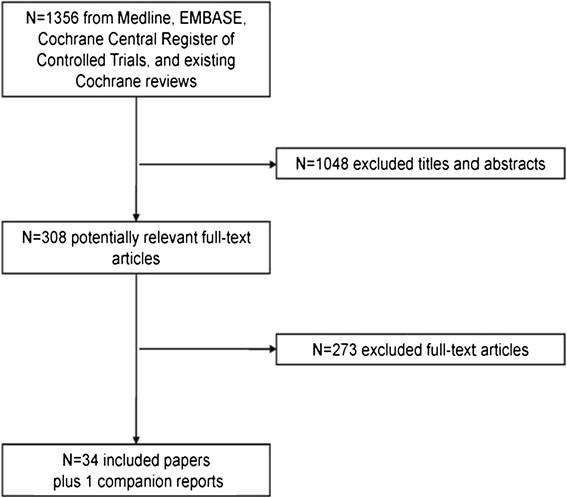
Methods: Utilizing an existing systematic review, we calculated the attack rates in the trial placebo arms using a random effects model and a meta-regression analysis (GSK study identifier: 117102).
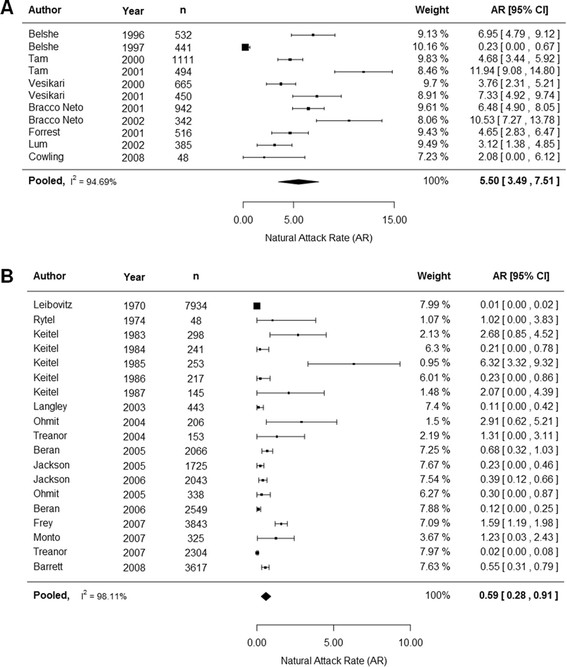
Results: This post-hoc analysis included 34 RCTs (Randomized Control Trials) contributing to 47 influenza seasons from 1970 to 2009. Meta-regression analyses showed that age and type of influenza were important covariates. The attack rates (95% CI (Confidence Interval)) in adults for all influenza, type A and type B were 3.50% (2.30%, 4.60%), 2.32% (1.47%, 3.17%) and 0.59% (0.28%, 0.91%) respectively. For children, they were 15.20% (11.40%, 18.90%), 12.27% (8.56%, 15.97%) and 5.50% (3.49%, 7.51%) respectively.
Conclusions: This analysis demonstrated that unvaccinated children have considerably higher exposure risk than adults and influenza A can cause more disease than influenza B. Moreover, a higher ratio of influenza B:A in children than adults was observed. This study provides a new, stratified and up to-date natural attack rates that can be used in influenza infectious disease models and are consistent with previous published work in the field.
Figures

References
-
- Keeling MJ, Rohani P: Modeling Infectious Diseases in Humans and Animals. Princeton University Press; 2007
-
- Vynnycky E, White R: An Introduction to Infectious Disease Modelling. Oxford University Press; 2010
Publication types
MeSH terms
Grants and funding
LinkOut - more resources
Full Text Sources
Other Literature Sources
Medical
Research Materials
