


Persistently high glucose levels in young children with type 1 diabetes
- PMID: 25496062
- PMCID: PMC4465416
- DOI: 10.1111/pedi.12248
Persistently high glucose levels in young children with type 1 diabetes
Abstract
Objectives: The aim of the study was to characterize glucose levels and variability in young children with type 1 diabetes (T1D).
Methods: A total of 144 children of 4-10 yr old diagnosed with T1D prior to age 8 were recruited at five DirecNet centers. Participants used a continuous glucose monitor (CGM) every 3 months during an 18-month study. Among the 144 participants, 135 (mean age 7.0 yr, 47% female) had a minimum of 48 h of CGM data at more than five of seven visits and were included in analyses. CGM metrics for different times of day were analyzed.
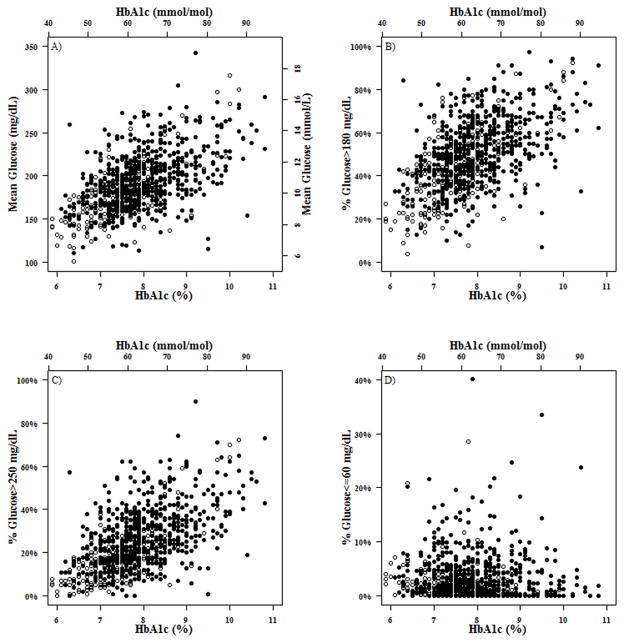
Results: Mean hemoglobin A1c (HbA1c) at the beginning and end of the study was 7.9% (63 mmol/mol). Fifty percent of participants had glucose levels >180 mg/dL (10.0 mmol/L) for >12 h/d and >250 mg/dL (13.9 mmol/L) for >6 h/d. Median time <70 mg/dL (3.9 mmol/L) was 66 min/d and <60 mg/dL (3.3 mmol/L) was 39 min/d. Mean amplitude of glycemic excursions (MAGE) was lowest overnight (00:00-06:00 hours). The percent of CGM values 71-180 mg/dL (3.9-10.0 mmol/L) and the overall mean glucose correlated with HbA1c at all visits. There were no differences in CGM mean glucose or coefficient of variation between the age groups of 4 and <6, 6 and <8, and 8 and <10.
Conclusions: Suboptimal glycemic control is common in young children with T1D as reflected by glucose levels in the hyperglycemic range for much of the day. New approaches to reduce postprandial glycemic excursions and increase time in the normal range for glucose in young children with T1D are critically needed. Glycemic targets in this age range should be revisited.
Keywords: continuous glucose monitoring; pediatric; type 1 diabetes.
© 2014 John Wiley & Sons A/S. Published by John Wiley & Sons Ltd.
Figures
References
-
- Bober E, Buyukgebiz A, Verrotti A, Chiarelli F. Hypoglycemia, hypoglycemia unawareness and counterregulation in children and adolescents with type 1 diabetes mellitus. J Pediatr Endocrinol Metab. 2005;18:831–41. - PubMed
-
- American Diabetes A. Standards of Medical Care in Diabetes 2014. Diabetes Care. 2014;37:S14–S80. - PubMed
Publication types
MeSH terms
Substances
Grants and funding
- U10 HD041906/HD/NICHD NIH HHS/United States
- U01 HD41890/HD/NICHD NIH HHS/United States
- UL1 RR024992/RR/NCRR NIH HHS/United States
- U10 HD056526/HD/NICHD NIH HHS/United States
- HD41915/HD/NICHD NIH HHS/United States
- U01 HD041890/HD/NICHD NIH HHS/United States
- U10 HD041915/HD/NICHD NIH HHS/United States
- HD41908/HD/NICHD NIH HHS/United States
- UL1 TR000448/TR/NCATS NIH HHS/United States
- R01 HD078463/HD/NICHD NIH HHS/United States
- UL1 TR002345/TR/NCATS NIH HHS/United States
- U10 HD041918/HD/NICHD NIH HHS/United States
- HD41918/HD/NICHD NIH HHS/United States
- U10 HD041908/HD/NICHD NIH HHS/United States
- P30 DK045735/DK/NIDDK NIH HHS/United States
- HD56526/HD/NICHD NIH HHS/United States
- HD41906/HD/NICHD NIH HHS/United States
LinkOut - more resources
Full Text Sources
Other Literature Sources
Medical
