


Functional lung avoidance for individualized radiotherapy (FLAIR): study protocol for a randomized, double-blind clinical trial
- PMID: 25496482
- PMCID: PMC4364501
- DOI: 10.1186/1471-2407-14-934
Functional lung avoidance for individualized radiotherapy (FLAIR): study protocol for a randomized, double-blind clinical trial
Abstract
Background: Although radiotherapy is a key component of curative-intent treatment for locally advanced, unresectable non-small cell lung cancer (NSCLC), it can be associated with substantial pulmonary toxicity in some patients. Current radiotherapy planning techniques aim to minimize the radiation dose to the lungs, without accounting for regional variations in lung function. Many patients, particularly smokers, can have substantial regional differences in pulmonary ventilation patterns, and it has been hypothesized that preferential avoidance of functional lung during radiotherapy may reduce toxicity. Although several investigators have shown that functional lung can be identified using advanced imaging techniques and/or demonstrated the feasibility and theoretical advantages of avoiding functional lung during radiotherapy, to our knowledge this premise has never been tested via a prospective randomized clinical trial.
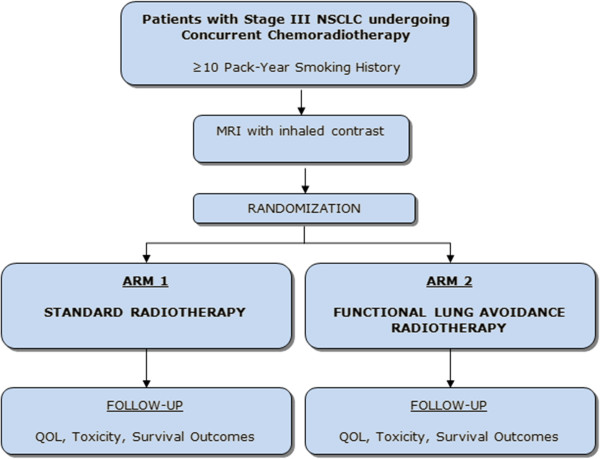
Methods/design: Eligible patients will have Stage III NSCLC with intent to receive concurrent chemoradiotherapy (CRT). Every patient will undergo a pre-treatment functional lung imaging study using hyperpolarized 3He MRI in order to identify the spatial distribution of normally-ventilated lung. Before randomization, two clinically-approved radiotherapy plans will be devised for all patients on trial, termed standard and avoidance. The standard plan will be designed without reference to the functional state of the lung, while the avoidance plan will be optimized such that dose to functional lung is as low as reasonably achievable. Patients will then be randomized in a 1:1 ratio to receive either the standard or the avoidance plan, with both the physician and the patient blinded to the randomization results. This study aims to accrue a total of 64 patients within two years. The primary endpoint will be a pulmonary quality of life (QOL) assessment at 3 months post-treatment, measured using the functional assessment of cancer therapy-lung cancer subscale. Secondary endpoints include: pulmonary QOL at other time-points, provider-reported toxicity, overall survival, progression-free survival, and quality-adjusted survival.
Discussion: This randomized, double-blind trial will comprehensively assess the impact of functional lung avoidance on pulmonary toxicity and quality of life in patients receiving concurrent CRT for locally advanced NSCLC.
Trial registration: Clinicaltrials.gov identifier: NCT02002052.
Figures
References
-
- Ferlay J, Soerjomataram I, Ervik M, Dikshit R, Eser S, Mathers C, Rebelo M, Parkin DM, Forman D, Bray F. GLOBOCAN 2012 v1.0, Cancer Incidence and Mortality Worldwide: IARC CancerBase No. 11. Lyon, France: International Agency for Research on Cancer; 2013.
-
- Albain KS, Swann RS, Rusch VW, Turrisi AT, 3rd, Shepherd FA, Smith C, Chen Y, Livingston RB, Feins RH, Gandara DR, Fry WA, Darling G, Johson DH, Green MR, Miller RC, Ley J, Sause WT, Cox JD. Radiotherapy plus chemotherapy with or without surgical resection for stage III non-small-cell lung cancer: a phase III randomised controlled trial. Lancet. 2009;374(9687):379–386. doi: 10.1016/S0140-6736(09)60737-6. - DOI - PMC - PubMed
-
- van Meerbeeck JP, Kramer GW, Van Schil PE, Legrand C, Smit EF, Schramel F, Tjan-Heijnen VC, Biesma B, Debruyne C, van Zandwijk N, Splinter TA, Giacconne G, European Organisation for Research and Treatment of Cancer-Lung Cancer Group Randomized controlled trial of resection versus radiotherapy after induction chemotherapy in stage IIIA-N2 non-small-cell lung cancer. J Natl Cancer Inst. 2007;99(6):442–450. doi: 10.1093/jnci/djk093. - DOI - PubMed
-
- Curran WJ, Jr, Paulus R, Langer CJ, Komaki R, Lee JS, Hauser S, Movsas B, Wasserman T, Rosenthal SA, Gore E, Machtay M, Sause W, Cox JD. Sequential vs. concurrent chemoradiation for stage III non-small cell lung cancer: randomized phase III trial RTOG 9410. J Natl Cancer Inst. 2011;103(19):1452–1460. doi: 10.1093/jnci/djr325. - DOI - PMC - PubMed
Pre-publication history
-
- The pre-publication history for this paper can be accessed here: http://www.biomedcentral.com/1471-2407/14/934/prepub
Publication types
MeSH terms
Associated data
LinkOut - more resources
Full Text Sources
Other Literature Sources
Medical
Research Materials
