. 2014 Dec 12:9:135.
doi: 10.1186/s13018-014-0135-y.

Investigating the biological response of human mesenchymal stem cells to titanium surfaces

Affiliations

Investigating the biological response of human mesenchymal stem cells to titanium surfaces

Matthew J German et al. J Orthop Surg Res. .

Abstract

Background: We have investigated the behaviour of a newly characterised population of haemarthrosis fluid-derived human mesenchymal stem cells (HF-hMSCs) with titanium (Ti) surfaces.

Methods: HF-hMSCs were seeded onto round cannulated interference (RCI; Smith and Nephew) screws or control Ti discs and cultured under pro-osteogenic conditions.

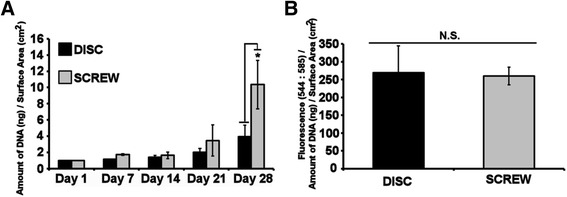
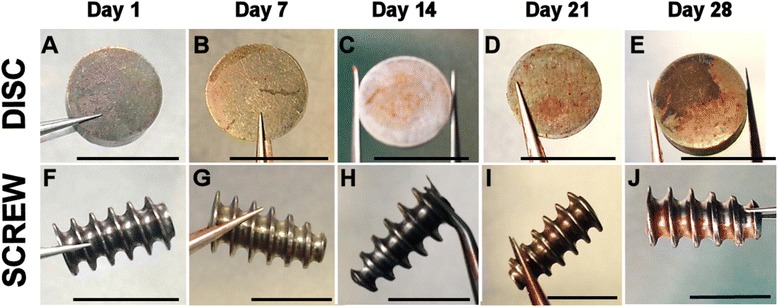
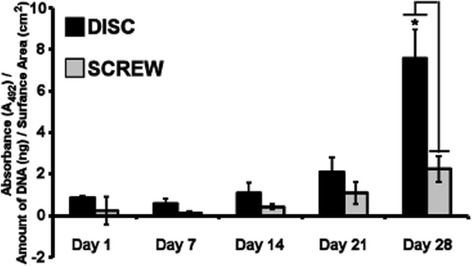
Results: Electron microscopy showed the attachment and spreading of HF-hMSCs across both Ti surfaces during the early stages of osteogenic culture; however, cells were exclusively localised to the basal regions within the vertex of the Ti screws. In the later stages of culture, an osteoid matrix was deposited on the Ti surfaces with progressive culture expansion and matrix deposition up the sides and the top of the Ti Screws. Quantification of cellular content revealed a significantly higher number of cells within the Ti screw cultures; however, there was no difference in the cellular health. Conversely, alizarin red staining used as both a qualitative and quantitative measure of matrix calcification was significantly increased in Ti disc cultures compared to those of Ti screws.

Conclusions: Our results suggest that the gross topography of the metal implant is able to create microenvironment niches that have an influence on cellular behaviour. These results have implications for the design of advanced tissue engineering strategies that seek to use cellular material to enhance biological remodelling and healing following tissue reconstruction.


Figures
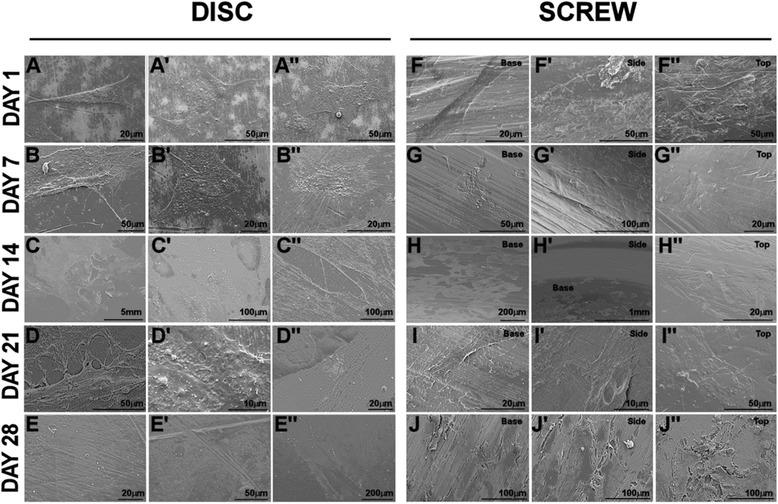
Figure 1
Figure 1
Electron microscopy of HF-hMSC populations during osteogenic culture on titanium discs and screws. HF-hMSC populations were seeded onto either Ti discs (A-E) or Ti screws (F-J) and cultured for up to 28 days in osteogenic medium. Representative images of three fields of view are presented for each time point at days 1, 7, 14, 21 and 28 post-seeding. Note at day 14, the restricted localisation of the cells to the core surface of the screw during expansion of the population.
Figure 2
Figure 2
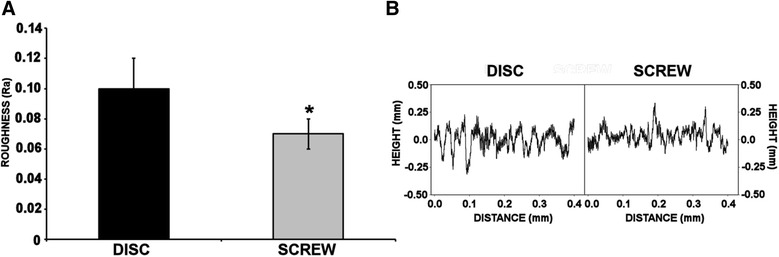
Measurement of Ti surface roughness of disc and screw. Roughness measurements were conducted using a stylus profilometer (Mitutoyo Surftest SV-2000 Mitutoyo, Halifax, UK) with dedicated analysis software (Surfpak- SV V1.600). (A) Average surface roughness analysed with a contact force of 4 mN and a maximum height range of 800 μm and an evaluation length of 0.4 mm. Values represent means ± S.E.M; N = 5; normalised data analysed by Student t-test; asterisk denotes P < 0.0007. (B) Example of a trace generated for the Ti disc and Ti screw.
Figure 3
Figure 3
Analysis of DNA content and cell vitality of HF-hMSC populations during osteogenic culture on titanium discs and screws. HF-hMSC populations were seeded onto Ti discs and Ti screws and cultured for up to 28 days. (A) The amount of DNA within cultures was analysed using Picogreen® as a measure of cellular content, and results are presented as amount of DNA normalised to the surface area of the disc or screw. (B) Metabolic activity was analysed at day 28 using alamarBlue® as a measure of cellular vitality/health. Results are presented as resorufin fluorescence (Ex: 544/Em: 585) normalised to the amount of DNA per surface area of the disc or screw. Values represent means ± S.E.M; Data sets were not normally distributed and analysed by Kruskal-Wallis H test; N = 3 biological replicates where the average of each biological replicate was performed in technical replicates of three; asterisk denotes P < 0.05; N.S.: not significant.
Figure 4
Figure 4
Analysis of alizarin red staining during osteogenic culture of HF-hMSCs on Ti discs and Ti screws. HF-hMSC populations were seeded onto Ti discs or Ti screws and cultured for up to 28 days in osteogenic medium. Matrix mineralisation on Ti surfaces was assessed by staining with alizarin red at days 1, 7, 14, 21 and 28 post-seeding. Scale bars = 1 cm.
Figure 5
Figure 5
Quantification of alizarin red staining during osteogenic cultures of HF-hMSCs on Ti discs and Ti screws. HF-hMSC populations were seeded onto Ti discs or Ti screws and cultured for up to 28 days in osteogenic medium. Matrix, which had been stained with alizarin red, was solubilised. Quantification results are presented as the absorbance at A492 normalised to the amount of DNA per surface area of the Ti disc or Ti screw. Values represent means ± S.E.M; Data sets were not normally distributed and analysed by Kruskal-Wallis H test; N = 3 biological replicates where the average of each biological replicate was performed in technical replicates of three; asterisk denotes P < 0.05.

References

    1. Holzapfel BM, Reichert JC, Schantz JT, Gbureck U, Rackwitz L, Nöth U, Jakob F, Rudert M, Groll J, Hutmacher DW. How smart do biomaterials need to be? A translational science and clinical point of view. Adv Drug Deliv Rev. 2013;65:581–603. doi: 10.1016/j.addr.2012.07.009. - DOI - PubMed
    1. Sumner DR, Turner TM, Igloria R, Urban RM, Galante JO. Functional adaptation and ingrowth of bone vary as a function of hip implant stiffness. J Biomech. 1998;31:909–917. doi: 10.1016/S0021-9290(98)00096-7. - DOI - PubMed
    1. Geetha M, Singh AK, Asokamani A, Gogia AK. Ti based biomaterials, the ultimate choice for orthopaedic implants — a review. Prog Mater Sci. 2009;54:397–425. doi: 10.1016/j.pmatsci.2008.06.004. - DOI
    1. Steinemann SG. Titanium—the material of choice? Periodontol. 1998;17:7–21. doi: 10.1111/j.1600-0757.1998.tb00119.x. - DOI - PubMed
    1. Eisenbarth E, Velten D, Muller M, Thull R, Breme J. Biocompatibility of beta-stabilizing elements of titanium alloys. Biomaterials. 2004;25:5705–5713. doi: 10.1016/j.biomaterials.2004.01.021. - DOI - PubMed

Publication types