


A cost-effectiveness analysis of the first federally funded antismoking campaign
- PMID: 25498550
- PMCID: PMC4603744
- DOI: 10.1016/j.amepre.2014.10.011
A cost-effectiveness analysis of the first federally funded antismoking campaign
Abstract
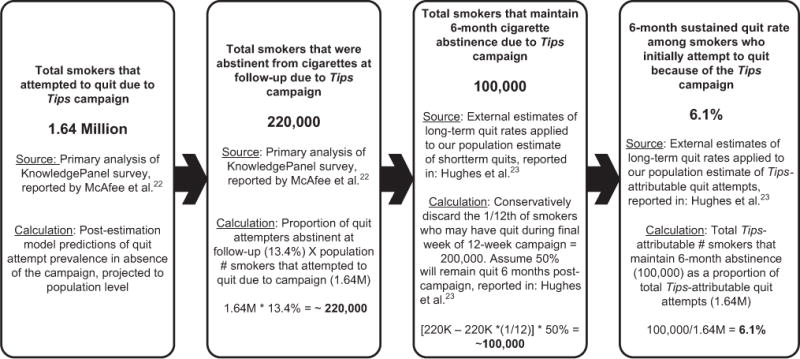
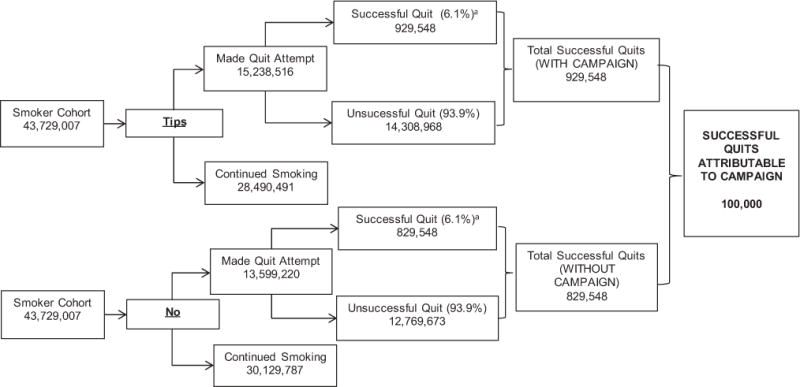
Background: In 2012, CDC launched the first federally funded national mass media antismoking campaign. The Tips From Former Smokers (Tips) campaign resulted in a 12% relative increase in population-level quit attempts.
Purpose: Cost-effectiveness analysis was conducted in 2013 to evaluate Tips from a funding agency's perspective.
Methods: Estimates of sustained cessations; premature deaths averted; undiscounted life years (LYs) saved; and quality-adjusted life years (QALYs) gained by Tips were estimated.
Results: Tips saved about 179,099 QALYs and prevented 17,109 premature deaths in the U.S. With the campaign cost of roughly $48 million, Tips spent approximately $480 per quitter, $2,819 per premature death averted, $393 per LY saved, and $268 per QALY gained.
Conclusions: Tips was not only successful at reducing smoking-attributable morbidity and mortality but also was a highly cost-effective mass media intervention.
Published by Elsevier Inc.
Conflict of interest statement
None of the authors have conflicts of interest
Figures
References
-
- USDHHS. How tobacco smoke causes disease: the biology and behavioral basis for smoking-attributable disease: a report of the Surgeon General. Atlanta GA: USDHHS; 2010. - PubMed
-
- CDC. Smoking-attributable mortality, years of potential life lost, and productivity losses—United States, 2000–2004. MMWR Morb Mortal Wkly Rep. 2008;57(45):1226–8. - PubMed
-
- Durkin S, Brennan E, Wakefield M. Mass media campaigns to promote smoking cessation among adults: an integrative review. Tob Control. 2012;21(2):127–38. - PubMed
-
- Zaza S, Briss PA, Harris KW, editors. Tobacco. Atlanta GA: Oxford University Press; 2005. Task Force on Community Preventive Services.
-
- Hopkins DP, Briss PA, Ricard CJ, et al. Reviews of evidence regarding interventions to reduce tobacco use and exposure to environmental tobacco smoke. Am J Prev Med. 2001;20(2S):16–66. - PubMed
MeSH terms
Grants and funding
LinkOut - more resources
Full Text Sources
Other Literature Sources
Medical
