


Predictors of outpatient kidney function recovery among patients who initiate hemodialysis in the hospital
- PMID: 25500361
- PMCID: PMC4630340
- DOI: 10.1053/j.ajkd.2014.10.015
Predictors of outpatient kidney function recovery among patients who initiate hemodialysis in the hospital
Abstract
Background: Recent policy clarifications by the Centers for Medicare & Medicaid Services have changed access to outpatient dialysis care at end-stage renal disease (ESRD) facilities for individuals with acute kidney injury in the United States. Tools to predict "ESRD" and "acute" status in terms of kidney function recovery among patients who previously initiated dialysis therapy in the hospital could help inform patient management decisions.
Study design: Historical cohort study.
Setting & participants: Incident hemodialysis patients in the Mayo Clinic Health System who initiated in-hospital renal replacement therapy (RRT) and continued outpatient dialysis following hospital dismissal (2006 through 2009).
Predictor: Baseline estimated glomerular filtration rate (eGFR), acute tubular necrosis from sepsis or surgery, heart failure, intensive care unit, and dialysis access.
Outcomes: Kidney function recovery defined as sufficient kidney function for outpatient hemodialysis therapy discontinuation.
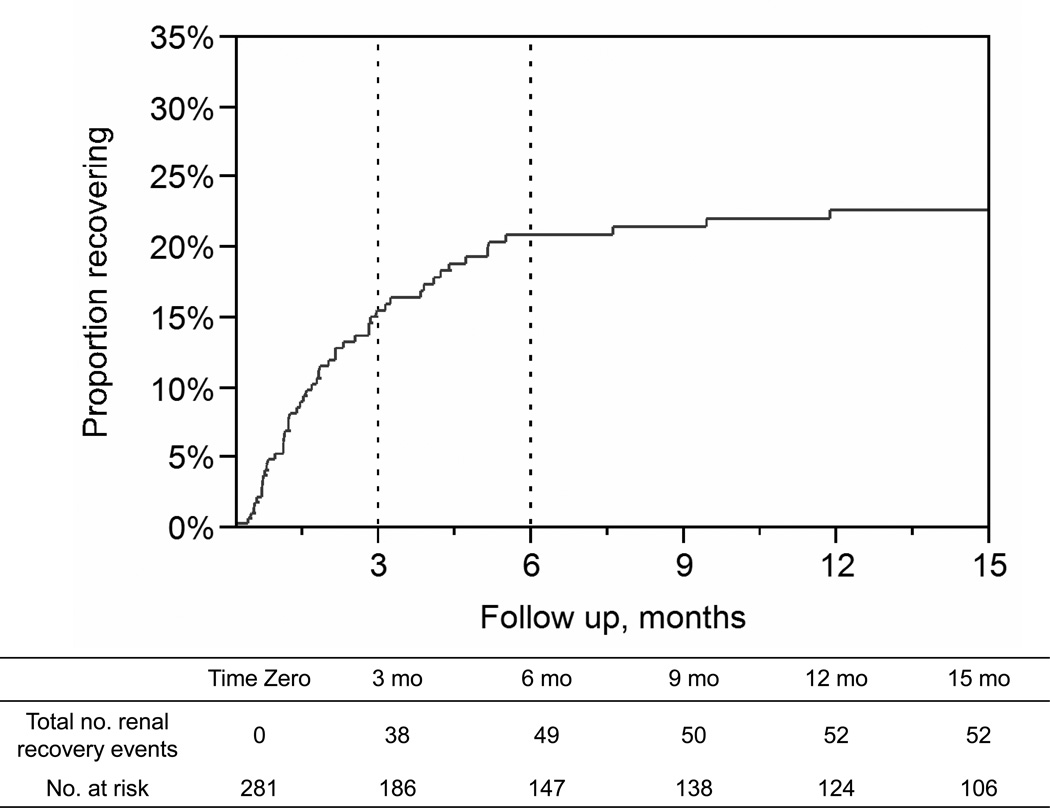
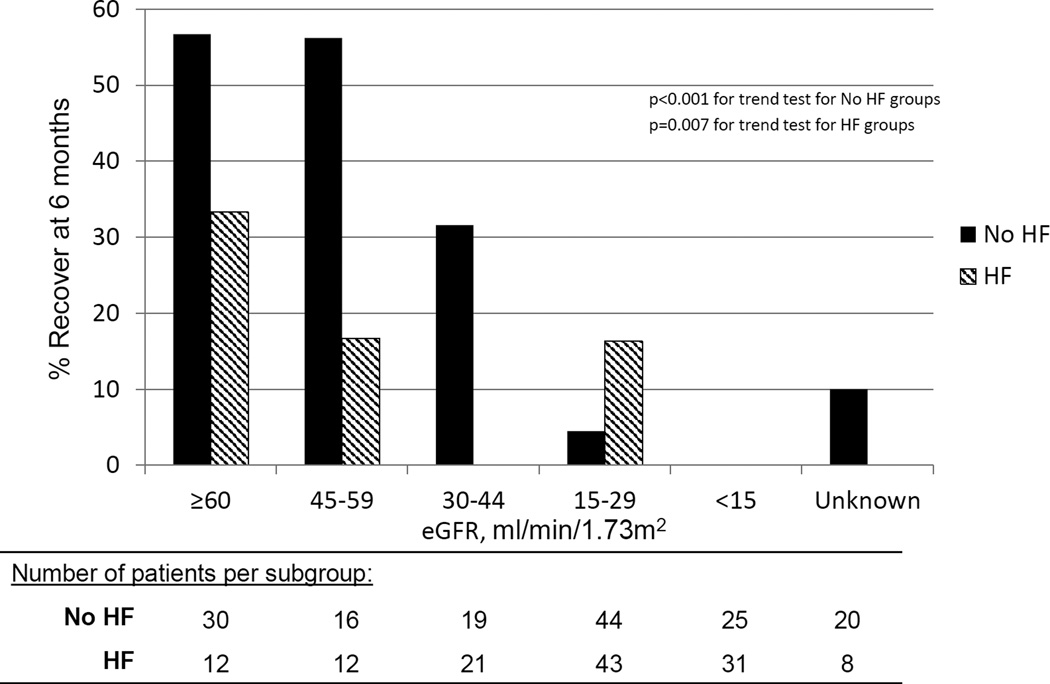
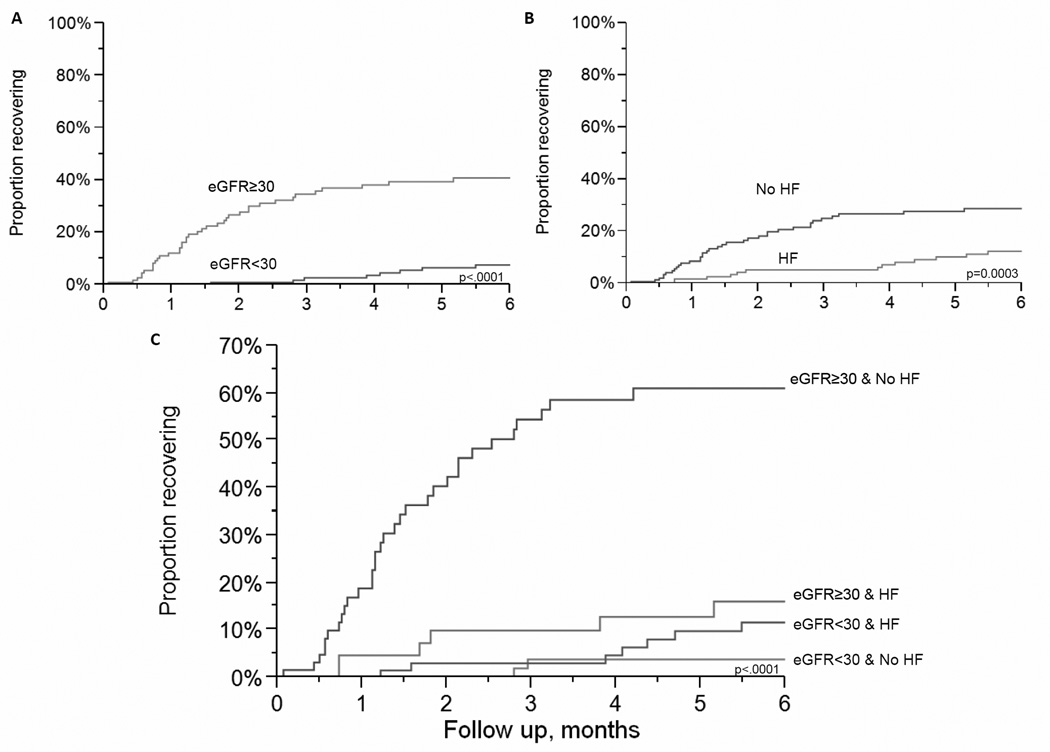
Results: Cohort consisted of 281 patients with a mean age of 64 years, 63% men, 45% with heart failure, and baseline eGFR≥30mL/min/1.73m(2) in 46%. During a median of 8 months, 52 (19%) recovered, most (94%) within 6 months. Higher baseline eGFR (HR per 10-mL/min/1.73m(2) increase eGFR, 1.27; 95% CI, 1.16-1.39; P<0.001), acute tubular necrosis from sepsis or surgery (HR, 3.34; 95% CI, 1.83-6.24; P<0.001), and heart failure (HR, 0.40; 95% CI, 0.19-0.78, P=0.007) were independent predictors of recovery within 6 months, whereas first RRT in the intensive care unit and catheter dialysis access were not. There was a positive interaction between absence of heart failure and eGFR≥30mL/min/1.73m(2) for predicting kidney function recovery (P<0.001).
Limitations: Sample size.
Conclusions: Kidney function recovery in the outpatient hemodialysis unit following in-hospital RRT initiation is not rare. As expected, higher baseline eGFR is an important determinant of recovery. However, patients with heart failure are less likely to recover even with a higher baseline eGFR. Consideration of these factors at hospital discharge informs decisions on ESRD status designation and long-term hemodialysis care.
Keywords: Acute kidney injury (AKI); acute on chronic kidney disease; discontinuation of dialysis; end-stage renal disease (ESRD); heart failure; hospitalization; kidney function prognosis; renal recovery; renal replacement therapy (RRT); reversible renal injury; risk factors; transition to outpatient dialysis.
Copyright © 2015 National Kidney Foundation, Inc. Published by Elsevier Inc. All rights reserved.
Conflict of interest statement
The authors have no conflict of interest to disclose.
Figures
Comment in
-
Recovery from acute kidney injury: predicting outcomes.Am J Kidney Dis. 2015 Apr;65(4):528-9. doi: 10.1053/j.ajkd.2015.02.316. Am J Kidney Dis. 2015. PMID: 25791960 No abstract available.
References
-
- Fang Y, Ding X, Zhong Y, et al. Acute kidney injury in a Chinese hospitalized population. Blood Purif. 2010;30(2):120–126. - PubMed
-
- Lafrance JP, Miller DR. Defining acute kidney injury in database studies: the effects of varying the baseline kidney function assessment period and considering CKD status. Am J Kidney Dis. 2010 Oct;56(4):651–660. - PubMed
-
- Uchino S, Bellomo R, Goldsmith D, Bates S, Ronco C. An assessment of the RIFLE criteria for acute renal failure in hospitalized patients. Crit Care Med. 2006 Jul;34(7):1913–1917. - PubMed
-
- Thakar CV, Christianson A, Freyberg R, Almenoff P, Render ML. Incidence and outcomes of acute kidney injury in intensive care units: a Veterans Administration study. Crit Care Med. 2009 Sep;37(9):2552–2558. - PubMed
Publication types
MeSH terms
Grants and funding
LinkOut - more resources
Full Text Sources
Other Literature Sources
Medical
Research Materials
Miscellaneous
