


Synchronous turnover of flora, fauna, and climate at the Eocene-Oligocene Boundary in Asia
- PMID: 25501388
- PMCID: PMC4264005
- DOI: 10.1038/srep07463
Synchronous turnover of flora, fauna, and climate at the Eocene-Oligocene Boundary in Asia
Abstract
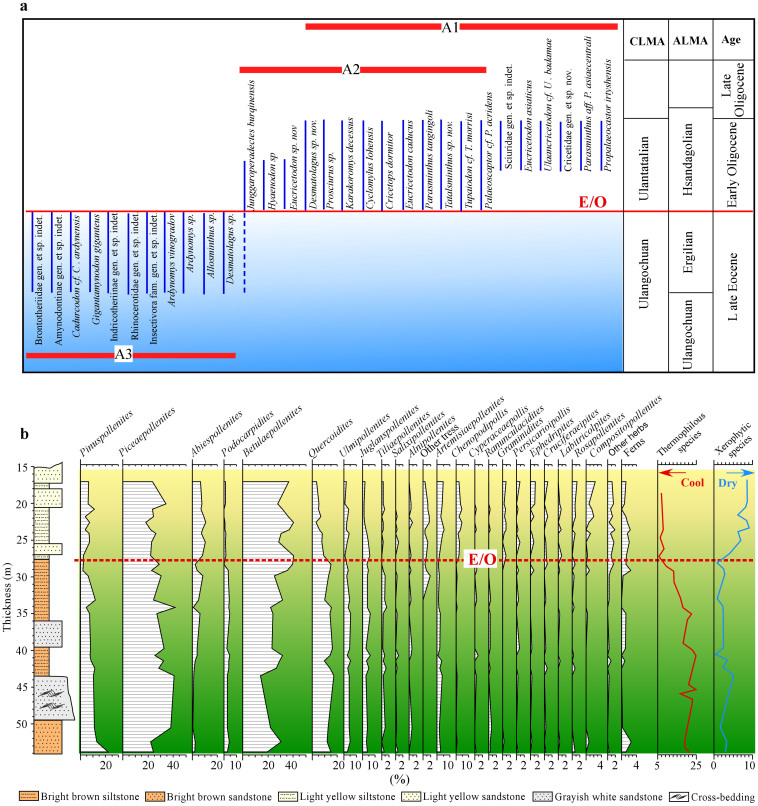
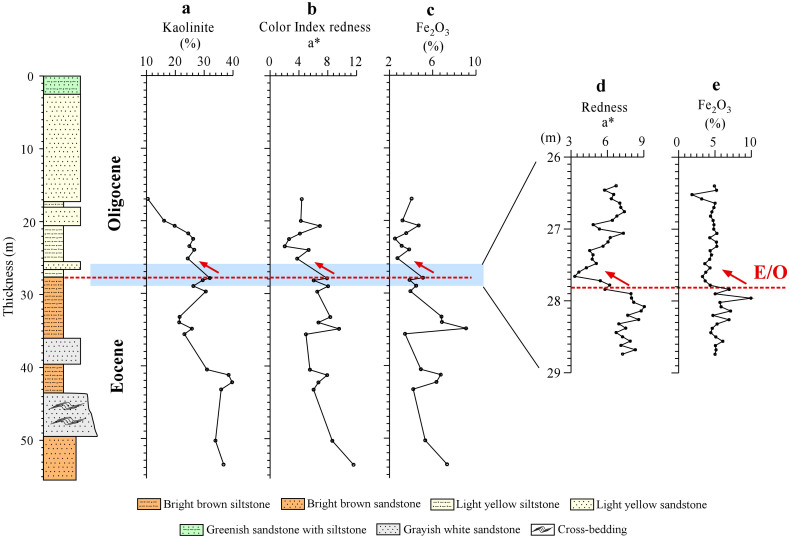
The Eocene-Oligocene Boundary (~34 million years ago) marks one of the largest extinctions of marine invertebrates in the world oceans and of mammalian fauna in Europe and Asia in the Cenozoic era. A shift to a cooler climate across this boundary has been suggested as the cause of this extinction in the marine environment, but there is no manifold evidence for a synchronous turnover of flora, fauna and climate at the Eocene-Oligocene Boundary in a single terrestrial site in Asia to support this hypothesis. Here we report new data of magnetostratigraphy, pollen and climatic proxies in the Asian interior across the Eocene-Oligocene Boundary; our results show that climate change forced a turnover of flora and fauna, suggesting there was a change from large-size perissodactyl-dominant fauna in forests under a warm-temperate climate to small rodent/lagomorph-dominant fauna in forest-steppe in a dry-temperate climate across the Eocene-Oligocene Boundary. These data provide a new terrestrial record for this significant Cenozoic environmental event.
Figures
References
-
- Miller K. G., Fairbanks R. G. & Mountain G. S. Tertiary oxygen isotope synthesis, sea level history, and continental margin erosion. Paleoceanogr. 2, 1–19 (1987).
-
- Prothero D. R. & Heaton T. H. Faunal stability during the early Oligocene climatic crash. Palaeogeogr. Palaeoclimatol. Palaeoecol. 127, 257–283 (1996).
-
- Houben A. J. P. et al. Reorganization of Southern Ocean Plankton Ecosystem at the Onset of Antarctic Glaciation. Science 340, 341–344 (2013). - PubMed
-
- Stehlen H. G. Remarques sur les faunules de Mammifères des couches eocenes et oligocenes du Bassin de Paris. Bull. Soc. Geol. Fr. 9, 488–520 (1909).
-
- Meng J. & McKenna M. C. Faunal turnovers of Palaeogene mammals from the Mongolian Plateau. Nature 394, 364–367 (1998).
Publication types
MeSH terms
LinkOut - more resources
Full Text Sources
Other Literature Sources
Medical
