


Review
doi: 10.1158/1078-0432.CCR-14-1860.
Epub 2014 Dec 12.
Immune escape mechanisms as a guide for cancer immunotherapy
Affiliations
- PMID: 25501578
- PMCID: PMC4334715
- DOI: 10.1158/1078-0432.CCR-14-1860
Item in Clipboard
Review
Immune escape mechanisms as a guide for cancer immunotherapy
Clin Cancer Res.
.
Abstract
Immunotherapy has demonstrated impressive outcomes for some patients with cancer. However, selecting patients who are most likely to respond to immunotherapy remains a clinical challenge. Here, we discuss immune escape mechanisms exploited by cancer and present strategies for applying this knowledge to improving the efficacy of cancer immunotherapy.
©2014 American Association for Cancer Research.
Conflict of interest statement
Disclosure of potential conflicts of interest: G.L.B declares receipt of research funding from Novartis. The authors have no additional financial interests.
Figures
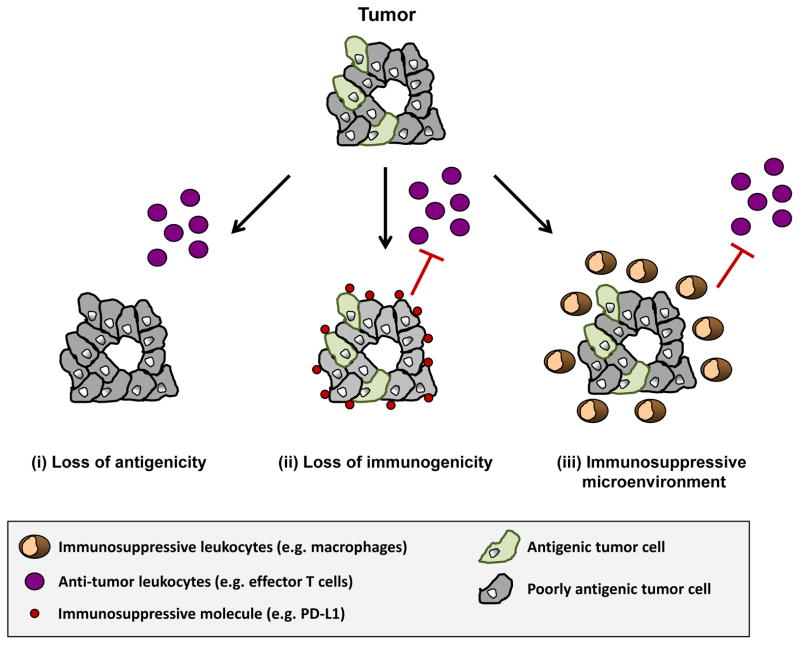
Clinically apparent tumors must evolve mechanisms to evade immune elimination. During this process, nascent transformed cells may be selected for based on (i) a loss of antigenicity and/or (ii) a loss of immunogenicity. Loss of antigenicity may be achieved through the acquisition of defects in antigen processing and presentation or through the loss of immunogenic tumor antigens leading to a lack of immunogenic peptides presented in the context of a peptide/MHC complex. Although a loss of antigenicity is also associated with a loss of immunogenicity, malignant cells can gain additional immunosuppressive properties, such as expression of PD-L1 or secretion of suppressive cytokines (e.g. IL-10, TGF-β), which further reduces their immunogenicity. (iii) Tumors may also escape immune elimination by orchestrating an immunosuppressive microenvironment. Malignant transformation induced by alterations in oncogenes and tumor suppressor genes can lead to the recruitment of an immune response that suppresses anti-tumor immunity.
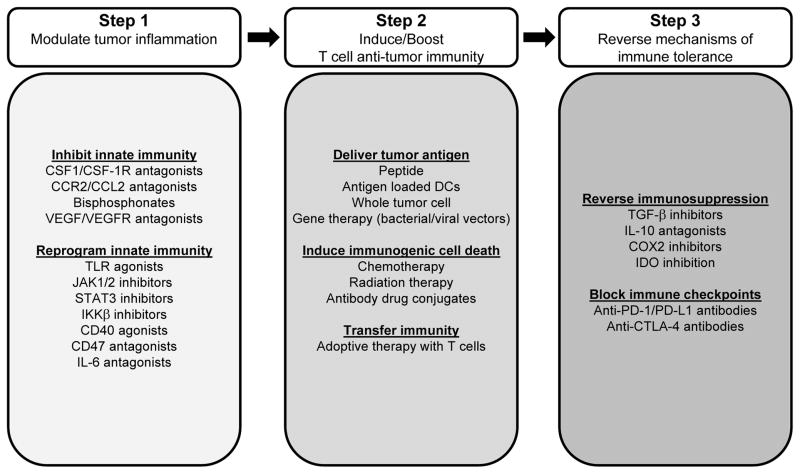
A three-step process is proposed for restoring productive immunosurveillance in cancer. In Step 1, the tumor microenvironment is targeted by inhibiting pro-tumor signaling pathways engaged by tumor-associated leukocytes or by polarizing tumor-associated leukocytes with anti-tumor properties. The goal of this step is to establish an environment that is conducive to T cell priming, trafficking, and activation. In Step 2, T cell anti-tumor immunity is established by delivering tumor antigen in the form of a vaccine, by inducing immunogenic cell death or by transferring immunity with ex vivo activated tumor reactive lymphocytes. In Step 3, immunosuppressive mechanisms that restrain T cell effector function are reversed including blocking immune checkpoints that are involved in maintaining peripheral T cell tolerance. The selection of strategies from each ‘Step’ may vary for individual tumors and may be influenced by tumor antigenicity, tumor immunogenicity and the immune profile of the tumor microenvironment.
References
-
- Burnet FM. The concept of immunological surveillance. Prog Exp Tumor Res. 1970;13:1–27. - PubMed
