. 2015 Feb;67(2):73-84.
doi: 10.1007/s00251-014-0819-9. Epub 2014 Dec 12.

Different binding motifs of the celiac disease-associated HLA molecules DQ2.5, DQ2.2, and DQ7.5 revealed by relative quantitative proteomics of endogenous peptide repertoires

Affiliations

Different binding motifs of the celiac disease-associated HLA molecules DQ2.5, DQ2.2, and DQ7.5 revealed by relative quantitative proteomics of endogenous peptide repertoires

Elin Bergseng et al. Immunogenetics. 2015 Feb.

Abstract

Celiac disease is caused by intolerance to cereal gluten proteins, and HLA-DQ molecules are involved in the disease pathogenesis by presentation of gluten peptides to CD4(+) T cells. The α- or β-chain sharing HLA molecules DQ2.5, DQ2.2, and DQ7.5 display different risks for the disease. It was recently demonstrated that T cells of DQ2.5 and DQ2.2 patients recognize distinct sets of gluten epitopes, suggesting that these two DQ2 variants select different peptides for display. To explore whether this is the case, we performed a comprehensive comparison of the endogenous self-peptides bound to HLA-DQ molecules of B-lymphoblastoid cell lines. Peptides were eluted from affinity-purified HLA molecules of nine cell lines and subjected to quadrupole orbitrap mass spectrometry and MaxQuant software analysis. Altogether, 12,712 endogenous peptides were identified at very different relative abundances. Hierarchical clustering of normalized quantitative data demonstrated significant differences in repertoires of peptides between the three DQ variant molecules. The neural network-based method, NNAlign, was used to identify peptide-binding motifs. The binding motifs of DQ2.5 and DQ7.5 concurred with previously established binding motifs. The binding motif of DQ2.2 was strikingly different from that of DQ2.5 with position P3 being a major anchor having a preference for threonine and serine. This is notable as three recently identified epitopes of gluten recognized by T cells of DQ2.2 celiac patients harbor serine at position P3. This study demonstrates that relative quantitative comparison of endogenous peptides sampled from our protein metabolism by HLA molecules provides clues to understand HLA association with disease.


Figures
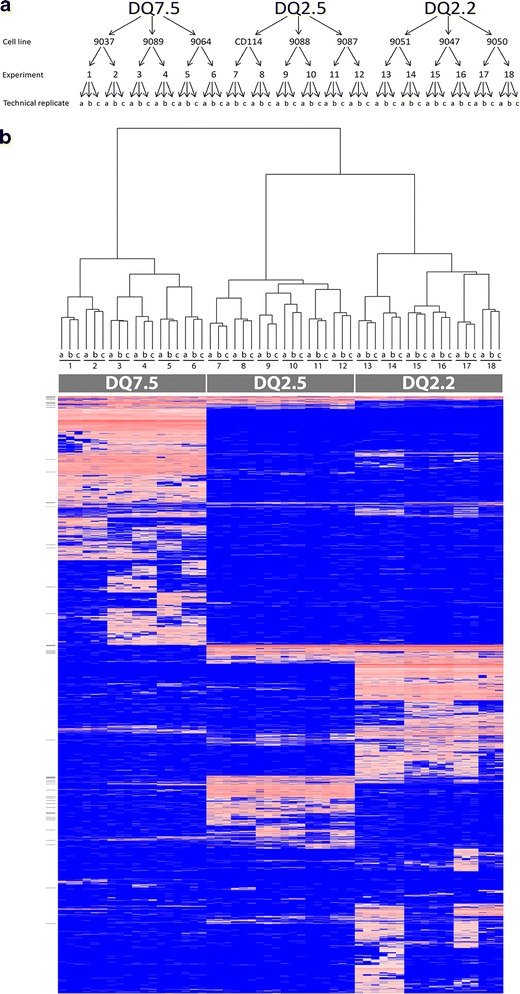
Fig. 1
Fig. 1
Peptide elution from nine cell lines carrying DQ2.5, DQ2.2, and DQ7.5. a Experimental setup of peptide elution experiments. b Heatmap and dendrogram of eluted peptides from the nine cell lines carrying DQ7.5, DQ2.5, and DQ2.2. Peptides were eluted from three cell lines expressing DQ7.5, three cell lines expressing DQ2.5, and three cell lines expressing DQ2.2. Two biological replicates of each cell line and three technical replicates for each of these were run. Normalized ion peak volumes were log transformed. The heatmap and dendrogram were created with the statistical software R. The CLIP peptides are indicated with short lines on the left side of the heatmap. Blue = absent. Red = log-transformed ion peak volumes
Fig. 2
Fig. 2
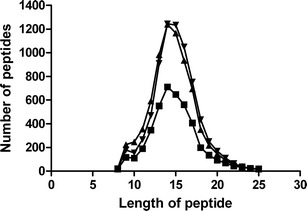
Length distribution of eluted peptides. The number of eluted peptides from DQ2.5 (■), DQ2.2 (▲), and DQ7.5 (▼), and their length distribution are given
Fig. 3
Fig. 3
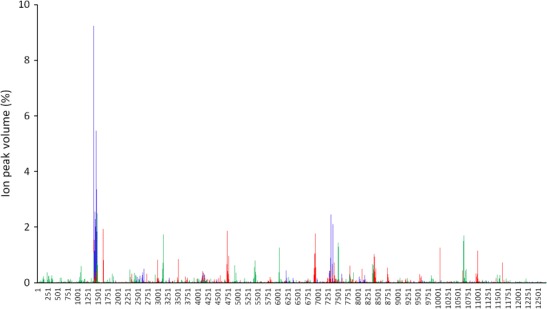
Normalized ion peak volumes of eluted peptides from DQ2.5 (blue), DQ2.2 (red), and DQ7.5 (green). The peptides are presented according to number and sequences as given in Supplemental Table 2. The ion peak volumes were normalized against total ion peak volumes of all eluted peptides for each technical replicate and are shown in percentage (%). The average ion peak volume of all samples for each HLA type is shown
Fig. 4
Fig. 4
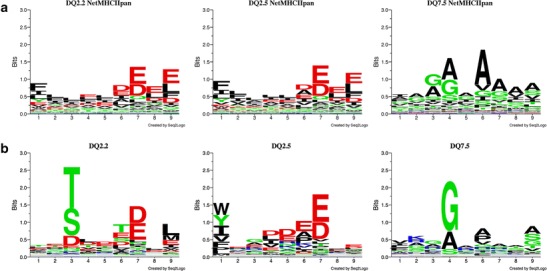
Sequence logos showing the peptide-binding motifs of DQ2.2, DQ2.5, and DQ7.5. a Sequence logos defined by NetMHCIIpan-3.0. The sequence logos of DQ2.5 and DQ7.5 are based on previously published experimental data of peptide binding whereas the sequence logo of DQ2.2 is a prediction based on extrapolation from other MHC class II molecules characterized by experimental peptide-binding data. b Sequence logos defined by NNAlign using quantitative elution data as listed in Supplemental Table 2 excluding CLIP-peptides (entries 1395–1515). Logos were made using Seq2Logo as described in the text
Fig. 5
Fig. 5
Binding of peptides to DQ2.5 and DQ2.2. Peptide binding of two DQ2.2 gluten epitopes and one DQ2.5 self-peptide with P3 substitutes was assessed in a competitive-binding assay. The two DQ2.2 gluten epitopes were tested with Ser to Ala susbstitutions at position P3, while the DQ2.5-binding peptide was tested with Gly to Ser substitution at position P3. The binding register of this peptide was predicted by the NNAlign method, and to avoid a register shift that could confound binding assay results, a Lys residue was introduced at position P5. Two independent 4-fold titration experiments were performed. The results shown are from one representative experiment

References

    1. Andreatta M, Schafer-Nielsen C, Lund O, Buus S, Nielsen M. NNAlign: a web-based prediction method allowing non-expert end-user discovery of sequence motifs in quantitative peptide data. PLoS ONE. 2011;6:e26781. doi: 10.1371/journal.pone.0026781. - DOI - PMC - PubMed
    1. Bodd M, Kim CY, Lundin KE, Sollid LM. T-cell response to gluten in patients with HLA-DQ2.2 reveals requirement of peptide-MHC stability in celiac disease. Gastroenterol. 2012;142:552–561. doi: 10.1053/j.gastro.2011.11.021. - DOI - PubMed
    1. Chicz RM, Urban RG, Gorga JC, Vignali DA, Lane WS, Strominger JL. Specificity and promiscuity among naturally processed peptides bound to HLA-DR alleles. J Exp Med. 1993;178:27–47. doi: 10.1084/jem.178.1.27. - DOI - PMC - PubMed
    1. Dorum S, Bodd M, Fallang LE, Bergseng E, Christophersen A, Johannesen MK, Qiao SW, Stamnaes J, de Souza GA, Sollid LM. HLA-DQ molecules as affinity matrix for identification of gluten T cell epitopes. J Immunol. 2014;193:4497–506. doi: 10.4049/jimmunol.1301466. - DOI - PubMed
    1. Efron B. Size, power and false discovery rates. Ann Stat. 2007;35:1351–1377. doi: 10.1214/009053606000001460. - DOI

Publication types

MeSH terms