


Review
doi: 10.1007/s00005-014-0324-8.
Epub 2014 Dec 12.
Transmission-Blocking Vaccines: Focus on Anti-Vector Vaccines against Tick-Borne Diseases
Affiliations
- PMID: 25503555
- PMCID: PMC4429137
- DOI: 10.1007/s00005-014-0324-8
Item in Clipboard
Review
Transmission-Blocking Vaccines: Focus on Anti-Vector Vaccines against Tick-Borne Diseases
Arch Immunol Ther Exp (Warsz).
2015 Jun.
Abstract
Tick-borne diseases are a potential threat that account for significant morbidity and mortality in human population worldwide. Vaccines are not available to treat several of the tick-borne diseases. With the emergence and resurgence of several tick-borne diseases, emphasis on the development of transmission-blocking vaccines remains increasing. In this review, we provide a snap shot on some of the potential candidates for the development of anti-vector vaccines (a form of transmission-blocking vaccines) against wide range of hard and soft ticks that include Ixodes, Haemaphysalis, Dermacentor, Amblyomma, Rhipicephalus and Ornithodoros species.
Figures
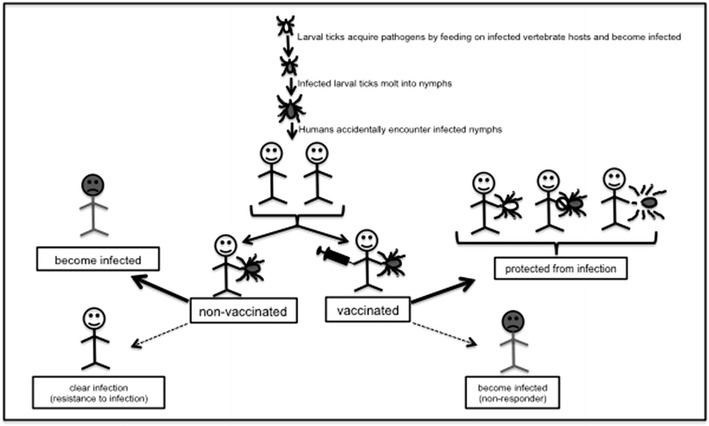
Anti-vector vaccines. Schematic representation of the proposed strategy on the effect of anti-tick vaccination in humans is shown. Larval ticks become infected by feeding on infected vertebrate hosts and molt into nymphs. Nymphs transmit pathogens to humans. Several scenarios might be envisioned with regard to the effect of anti-tick vaccine administration in natural human population. Non-vaccinated humans bitten by infected ticks may become infected and develop disease symptoms or remain uninfected by natural resistance. On the other hand, vaccinated individuals might be protected from infection or may still become infected due to poor responsiveness to the vaccine. As shown in the illustration, three types of vaccine strategies can be considered. First, anti-vector vaccine can be designed to degrade pathogens inside ticks. Second, anti-vector vaccine can be designed to target vector molecules to prevent pathogen transmission. Third, anti-vector vaccine can be designed to target vector molecules to degrade or affect physiology and survival of ticks
Similar articles
-
Ticks of Poland. Review of contemporary issues and latest research.Ann Parasitol. 2012;58(3):125-55. Ann Parasitol. 2012. PMID: 23444797 Review.
-
Tick vaccines and the transmission of tick-borne pathogens.Vet Res Commun. 2007 Aug;31 Suppl 1:85-90. doi: 10.1007/s11259-007-0069-5. Vet Res Commun. 2007. PMID: 17682852 Review.
-
Development of vaccines against Ornithodoros soft ticks: An update.Ticks Tick Borne Dis. 2015 Apr;6(3):211-20. doi: 10.1016/j.ttbdis.2015.03.006. Epub 2015 Mar 14. Ticks Tick Borne Dis. 2015. PMID: 25802033 Review.
-
Molecular survey of hard ticks in endemic areas of tick-borne diseases in China.Ticks Tick Borne Dis. 2013 Jun;4(4):288-96. doi: 10.1016/j.ttbdis.2013.01.003. Epub 2013 Mar 26. Ticks Tick Borne Dis. 2013. PMID: 23538111
-
Prevalence of tick-borne pathogens in adult Dermacentor spp. ticks from nine collection sites in France.Vector Borne Zoonotic Dis. 2013 Apr;13(4):226-36. doi: 10.1089/vbz.2011.0933. Epub 2013 Feb 19. Vector Borne Zoonotic Dis. 2013. PMID: 23421886
Cited by
-
Discovery of Exosomes From Tick Saliva and Salivary Glands Reveals Therapeutic Roles for CXCL12 and IL-8 in Wound Healing at the Tick-Human Skin Interface.Front Cell Dev Biol. 2020 Jul 16;8:554. doi: 10.3389/fcell.2020.00554. eCollection 2020. Front Cell Dev Biol. 2020. PMID: 32766239 Free PMC article.
-
Universal Tick Vaccines: Candidates and Remaining Challenges.Animals (Basel). 2023 Jun 19;13(12):2031. doi: 10.3390/ani13122031. Animals (Basel). 2023. PMID: 37370541 Free PMC article. Review.
-
An Experimental Murine Model to Study Acquisition Dynamics of Tick-Borne Langat Virus in Ixodes scapularis.Front Microbiol. 2022 Apr 14;13:849313. doi: 10.3389/fmicb.2022.849313. eCollection 2022. Front Microbiol. 2022. PMID: 35495703 Free PMC article.
-
RNA activation in ticks.Sci Rep. 2023 Jun 8;13(1):9341. doi: 10.1038/s41598-023-36523-4. Sci Rep. 2023. PMID: 37291173 Free PMC article.
-
Alterations in arthropod and neuronal exosomes reduce virus transmission and replication in recipient cells.Extracell Vesicles Circ Nucl Acids. 2022;3(3):247-279. doi: 10.20517/evcna.2022.30. Epub 2022 Aug 31. Extracell Vesicles Circ Nucl Acids. 2022. PMID: 36939419 Free PMC article.
References
Publication types
MeSH terms
Substances
Grants and funding
LinkOut - more resources
Full Text Sources
Other Literature Sources
Medical
