


Prognostic factors and scoring system for death from visceral leishmaniasis: an historical cohort study in Brazil
- PMID: 25503575
- PMCID: PMC4263605
- DOI: 10.1371/journal.pntd.0003374
Prognostic factors and scoring system for death from visceral leishmaniasis: an historical cohort study in Brazil
Abstract
Background: In Brazil, case-fatality rates attributable to visceral leishmaniasis (VL) are high and knowledge of the risk factors associated with death may help reduce mortality. The aim of this study was to construct and validate a scoring system for prognosis of death from VL by using all cases reported in Brazil from 2007 to 2011.
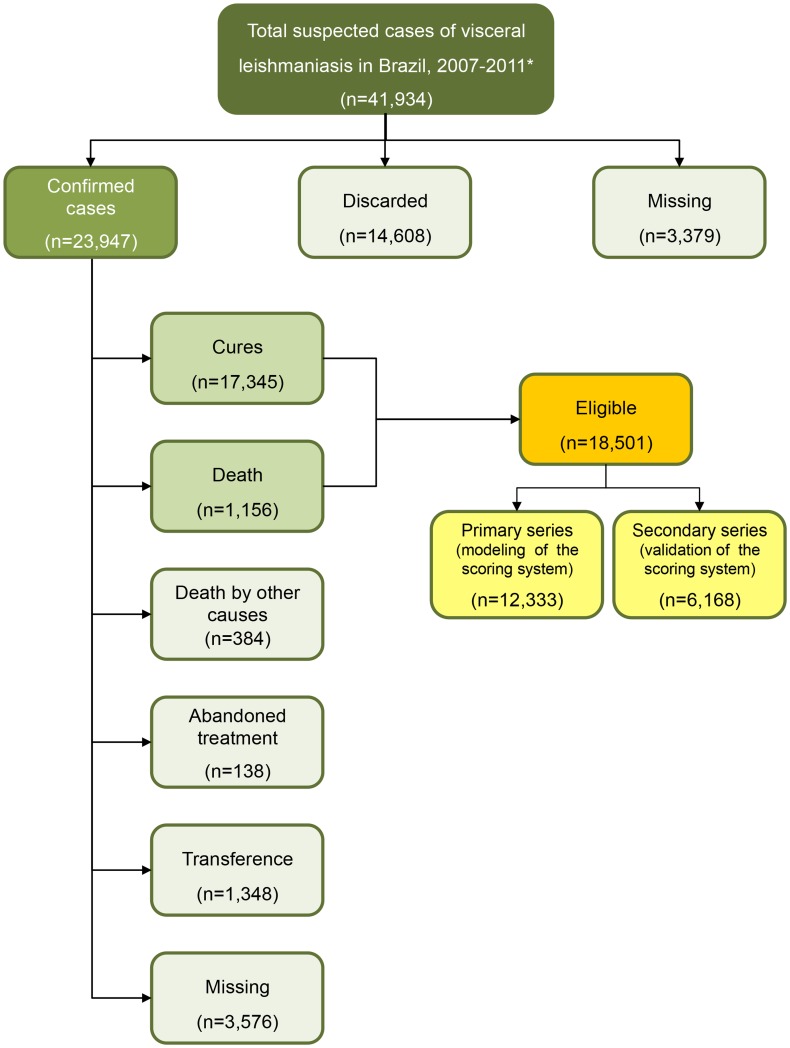
Methodology: In this historical cohort study, 18,501 VL cases were analyzed; of these, 17,345 cases were cured and 1,156 cases caused death. The database was divided into two series: primary (two-thirds of cases), to develop the model score, and secondary (one-third of cases), to validate the scoring system. Multivariate logistic regression models were performed to identify factors associated with death from VL, and these were included in the scoring system.
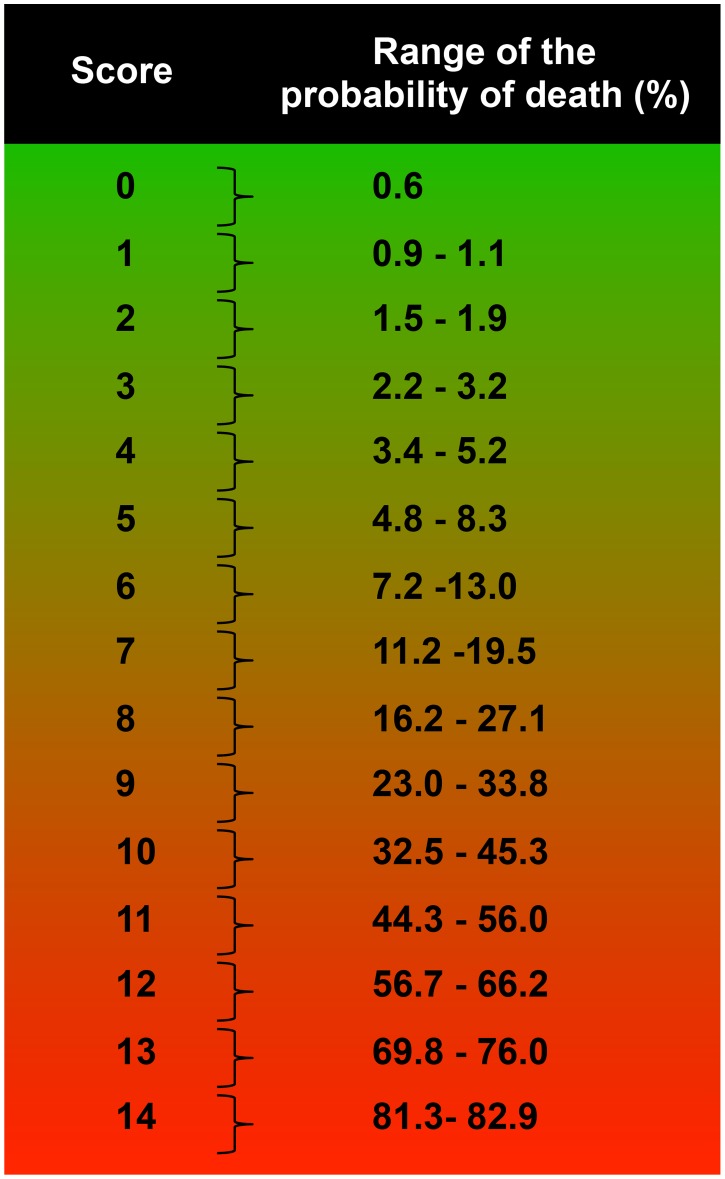
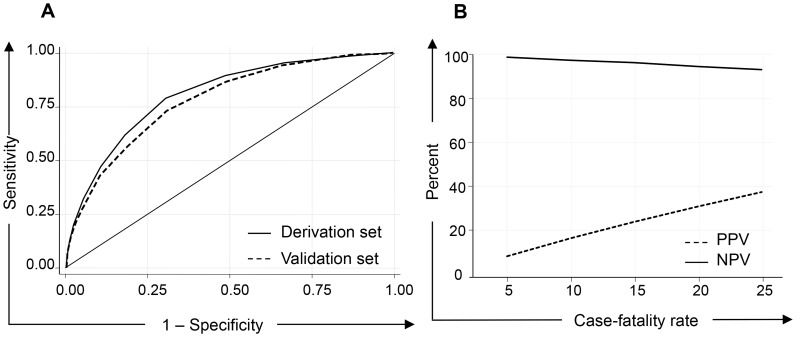
Principal findings: The factors associated with death from VL were: bleeding (score 3); splenomegaly (score 1); edema (score 1); weakness (score 1); jaundice (score 1); Leishmania-HIV co-infection (score 1); bacterial infection (score 1); and age (≤0.5 years [score 5]; >0.5 and ≤1 [score 2]; >19 and ≤50 [score 2]; >50 and <65 [score 3]; ≥65 [score 5]). It was observed that patients with a score of 4 had a probability of death of approximately 4.5% and had a worse prognosis. The sensitivity, specificity, and accuracy of this score were 89.4, 51.2, and 53.5, respectively.
Conclusions/significance: The scoring system based on risk factors for death showed good performance in identifying patients with signs of severity at the time of clinical suspicion of VL and can contribute to improving the surveillance system for reducing case fatalities. The classification of patients according to their prognosis for death may assist decision-making regarding the transfer of the patients to hospitals more capable of handling their condition, admission to the intensive care unit, and adequate support and specific treatment.
Conflict of interest statement
The authors have declared that no competing interests exist.
Figures
References
-
- Desjeux P (2004) Leishmaniasis: current situation and new perspectives. Comp Immunol Microbiol Infect Dis 27: 305–318. - PubMed
-
- Killick-Kendrick R (1999) The biology and control of phlebotomine sand flies. Clin Dermatol 17: 279–289. - PubMed
-
- Murray HW, Berman JD, Davies CR, Saravia NG (2005) Advances in leishmaniasis. Lancet 366: 1561–1577. - PubMed
-
- Lomtadze ML, Khochava MA, Shalamberidze IA, Kharaishvili VI, Vorob'eva EO (2005) [Study of intravascular coagulation activation markers in patients with visceral leishmaniasis]. Georgian Med News 47–50. - PubMed
Publication types
MeSH terms
LinkOut - more resources
Full Text Sources
Other Literature Sources
