


State laws prohibiting sales to minors and indoor use of electronic nicotine delivery systems--United States, November 2014
- PMID: 25503916
- PMCID: PMC4584536
State laws prohibiting sales to minors and indoor use of electronic nicotine delivery systems--United States, November 2014
Erratum in
- MMWR Morb Mortal Wkly Rep. 2014 Dec 19;63(50):1212
Abstract
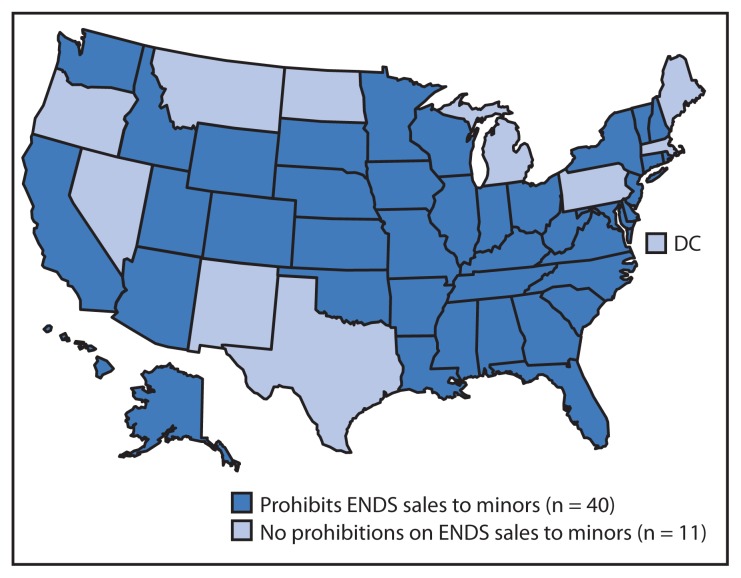
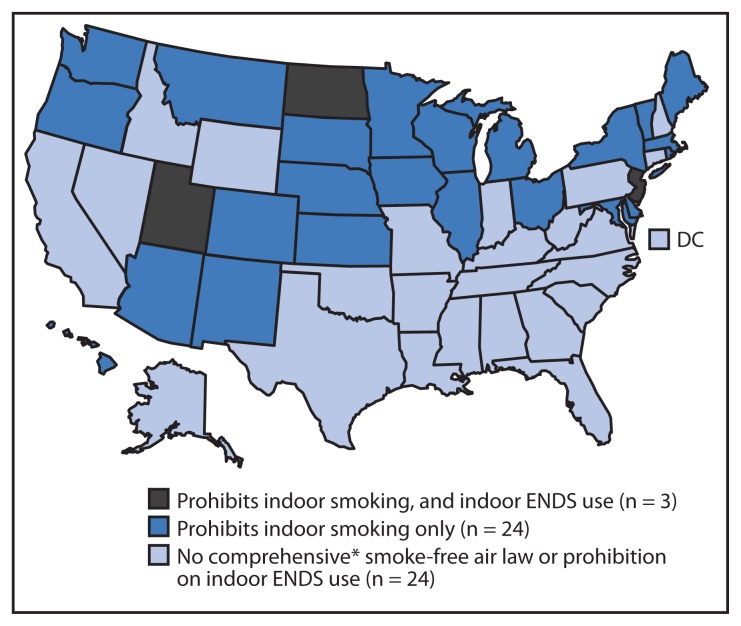
Electronic nicotine delivery systems (ENDS), including electronic cigarettes (e-cigarettes) and other devices such as electronic hookahs, electronic cigars, and vape pens, are battery-powered devices capable of delivering aerosolized nicotine and additives to the user. Experimentation with and current use of e-cigarettes has risen sharply among youths and adults in the United States. Youth access to and use of ENDS is of particular concern given the potential adverse effects of nicotine on adolescent brain development. Additionally, ENDS use in public indoor areas might passively expose bystanders (e.g., children, pregnant women, and other nontobacco users) to nicotine and other potentially harmful constituents. ENDS use could have the potential to renormalize tobacco use and complicate enforcement of smoke-free policies. State governments can regulate the sales of ENDS and their use in indoor areas where nonusers might be involuntarily exposed to secondhand aerosol. To learn the current status of state laws regulating the sales and use of ENDS, CDC assessed state laws that prohibit ENDS sales to minors and laws that include ENDS use in conventional smoking prohibitions in indoor areas of private worksites, restaurants, and bars. Findings indicate that as of November 30, 2014, 40 states prohibited ENDS sales to minors, but only three states prohibited ENDS use in private worksites, restaurants, and bars. Of the 40 states that prohibited ENDS sales to minors, 21 did not prohibit ENDS use or conventional smoking in private worksites, restaurants, and bars. Three states had no statewide laws prohibiting ENDS sales to minors and no statewide laws prohibiting ENDS use or conventional smoking in private worksites, restaurants, and bars. According to the Surgeon General, ENDS have the potential for public health harm or public health benefit. The possibility of public health benefit from ENDS could arise only if 1) current smokers use these devices to switch completely from combustible tobacco products and 2) the availability and use of combustible tobacco products are rapidly reduced. Therefore, when addressing potential public health harms associated with ENDS, it is important to simultaneously uphold and accelerate strategies found by the Surgeon General to prevent and reduce combustible tobacco use, including tobacco price increases, comprehensive smoke-free laws, high-impact media campaigns, barrier-free cessation treatment and services, and comprehensive statewide tobacco control programs.
Figures
References
-
- US Department of Health and Human Services. The health consequences of smoking—50 years of progress: a report of the Surgeon General. Atlanta, GA: US Department of Health and Human Services, CDC; 2014.
-
- Goniewicz ML, Kuma T, Gawron M, Knysak J, Kosmider L. Nicotine levels in electronic cigarettes. Nicotine Tob Res. 2013;15:158–66. - PubMed
-
- Schripp T, Markewitz D, Uhde E, Salthammer T. Does e-cigarette consumption cause passive vaping? Indoor Air. 2013;23:25–31. - PubMed
MeSH terms
Substances
LinkOut - more resources
Full Text Sources
Medical
