Randomized Controlled Trial
. 2014 Dec 12;9(12):e113937.
doi: 10.1371/journal.pone.0113937. eCollection 2014.

Pre-treatment whole blood gene expression is associated with 14-week response assessed by dynamic contrast enhanced magnetic resonance imaging in infliximab-treated rheumatoid arthritis patients

Affiliations
Randomized Controlled Trial

Pre-treatment whole blood gene expression is associated with 14-week response assessed by dynamic contrast enhanced magnetic resonance imaging in infliximab-treated rheumatoid arthritis patients

Kenzie D MacIsaac et al. PLoS One. .

Abstract

Approximately 30% of rheumatoid arthritis patients achieve inadequate response to anti-TNF biologics. Attempts to identify molecular biomarkers predicting response have met with mixed success. This may be attributable, in part, to the variable and subjective disease assessment endpoints with large placebo effects typically used to classify patient response. Sixty-one patients with active RA despite methotrexate treatment, and with MRI-documented synovitis, were randomized to receive infliximab or placebo. Blood was collected at baseline and genome-wide transcription in whole blood was measured using microarrays. The primary endpoint in this study was determined by measuring the transfer rate constant (Ktrans) of a gadolinium-based contrast agent from plasma to synovium using MRI. Secondary endpoints included repeated clinical assessments with DAS28(CRP), and assessments of osteitis and synovitis by the RAMRIS method. Infliximab showed greater decrease from baseline in DCE-MRI Ktrans of wrist and MCP at all visits compared with placebo (P<0.001). Statistical analysis was performed to identify genes associated with treatment-specific 14-week change in Ktrans. The 256 genes identified were used to derive a gene signature score by averaging their log expression within each patient. The resulting score correlated with improvement of Ktrans in infliximab-treated patients and with deterioration of Ktrans in placebo-treated subjects. Poor responders showed high expression of activated B-cell genes whereas good responders exhibited a gene expression pattern consistent with mobilization of neutrophils and monocytes and high levels of reticulated platelets. This gene signature was significantly associated with clinical response in two previously published whole blood gene expression studies using anti-TNF therapies. These data provide support for the hypothesis that anti-TNF inadequate responders comprise a distinct molecular subtype of RA characterized by differences in pre-treatment blood mRNA expression. They also highlight the importance of placebo controls and robust, objective endpoints in biomarker discovery.

Trial registration: ClinicalTrials.gov NCT01313520.


Conflict of interest statement

Competing Interests: The authors of this manuscript have the following competing interests: K. MacIsaac, J. Kang, A. Loboda, C. Beals, R. Baumgartner, are currently (or were at the time the study was conducted) employees of Merck Sharp & Dohme Corp., a subsidiary of Merck & Co., Inc., Whitehouse Station, NJ, who may own stock and/or hold stock options in Merck. C. Peterfy and J. DiCarlo are employees of Spire Sciences LLC, employed by the study sponsor Merck to analyze study results; J. Riek is an employee of VirtualScopics, Inc, employed by the study sponsor Merck to analyze study results. This does not alter the authors' adherence to PLOS ONE policies on sharing data and materials.

Figures

Figure 1
Figure 1. Gene expression is associated with change in disease activity measured by DCE-MRI.
(A) High signature score correlates with Ktrans improvement in the treatment arm and Ktrans deterioration in the placebo arm. Scatter plots show baseline and treatment adjusted 14-week change in log Ktrans vs. signature score in both the treatment and placebo arms at weeks 2, 4, and 14. Linear models including terms for baseline Ktrans, treatment allocation, signature score, and the interaction between signature and treatment were fit to log Ktrans change from baseline at each week. At both week 4 and 14, the signature score main effect and interaction with treatment were significant at p<0.05. (B) Whole blood gene expression improves prediction of week 14 change in Ktrans. In ten repeated rounds of random subsampling, 40 patients were selected and their whole blood gene expression data was used to identify genes associated with treatment response measured by Ktrans, DAS28(CRP), and RAMRIS. A linear model including terms for baseline disease activity, treatment allocation, signature score, and the interaction between signature and treatment was fit to week 14 data and used to predict week 14 changes for held out subjects. The distribution of mean squared prediction errors (MSE) minus the MSE achieved by a model excluding signature score terms is plotted for each endpoint. For Ktrans, but not DAS28(CRP), or RAMRIS, incorporation of baseline blood gene expression consistently improved prediction performance (p = 0.015, t-test).
Figure 2
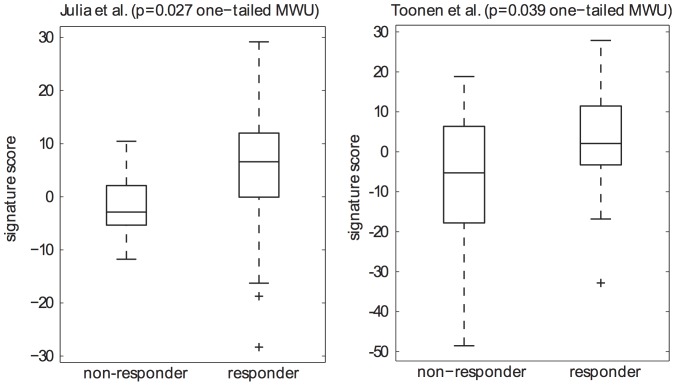
Figure 2. Gene signature score is higher in EULAR responders than non-responders in two independent studies.
The predictive signature is associated with clinical response in two additional whole blood gene expression studies. The distribution of predictive signature scores was compared in responder and non-responder groups in the studies of Julia et al. and Toonen et al. In both cases, a one-tailed t-test identified statistically significant (p<0.05) differences.

References

    1. Hyrich KL, Watson KD, Silman AJ, Symmons DPM (2006) Predictors of response to anti-TNF-alpha therapy among patients with rheumatoid arthritis: results from the British Society for Rheumatology Biologics Register. Rheumatology (Oxford) 45:1558–1565. - PubMed
    1. Bienkowska JR, Dalgin GS, Batliwalla F, Allaire N, Roubenoff R, et al. (2009) Convergent Random Forest predictor: methodology for predicting drug response from genome-scale data applied to anti-TNF response. Genomics 94:423–432. - PMC - PubMed
    1. Julià A, Erra A, Palacio C, Tomas C, Sans X, et al. (2009) An eight-gene blood expression profile predicts the response to infliximab in rheumatoid arthritis. PLoS One 4. - PMC - PubMed
    1. Koczan D, Drynda S, Hecker M, Drynda A, Guthke R, et al. (2008) Molecular discrimination of responders and nonresponders to anti-TNF alpha therapy in rheumatoid arthritis by etanercept. Arthritis Res Ther 10. - PMC - PubMed
    1. Lequerre T, Gauthier-Jauneau A-C, Bansard C, Derambure C, Hiron M, et al. (2006) Gene profiling in white blood cells predicts infliximab responsiveness in rheumatoid arthritis. Arthritis Res Ther 8. - PMC - PubMed

Publication types

MeSH terms

Associated data