


Surfactant for meconium aspiration syndrome in term and late preterm infants
- PMID: 25504256
- PMCID: PMC7027383
- DOI: 10.1002/14651858.CD002054.pub3
Surfactant for meconium aspiration syndrome in term and late preterm infants
Abstract
Background: Surfactant replacement therapy has been proven beneficial in the prevention and treatment of neonatal respiratory distress syndrome (RDS). The deficiency of surfactant or surfactant dysfunction may contribute to respiratory failure in a broader group of disorders, including meconium aspiration syndrome (MAS).
Objectives: To evaluate the effect of surfactant administration in the treatment of late preterm and term infants with meconium aspiration syndrome.
Search methods: We searched The Cochrane Library (Issue 4, 2006), MEDLINE and EMBASE (1985 to December 2006), previous reviews including cross-references, abstracts, conference and symposia proceedings, expert informants, and journal handsearching, without language restrictions. We contacted study authors for additional data.We ran an updated search in November 2014 and searched the following sites for ongoing or recently completed trials: www.clinicaltrials.gov; www.controlled-trials.com; and www.who.int/ictrp.
Selection criteria: Randomised controlled trials which evaluated the effect of surfactant administration in late preterm and term infants with meconium aspiration syndrome are included in the analyses.
Data collection and analysis: We extracted data on clinical outcomes including mortality, treatment with extracorporeal membrane oxygenation (ECMO), pneumothorax, duration of assisted ventilation, duration of supplemental oxygen, intraventricular haemorrhage (any grade and severe IVH), and chronic lung disease. We conducted data analyses in accordance with the standards of the Cochrane Neonatal Review Group.
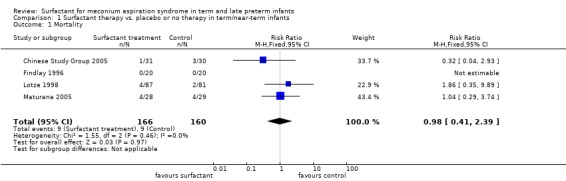
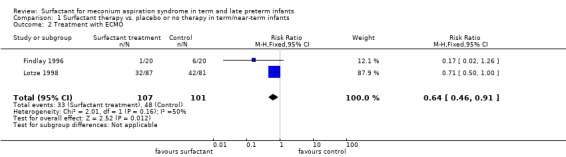
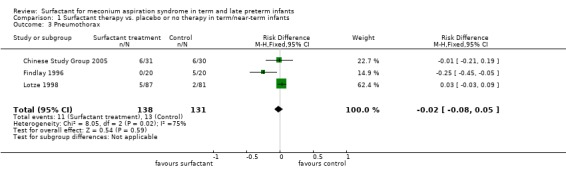
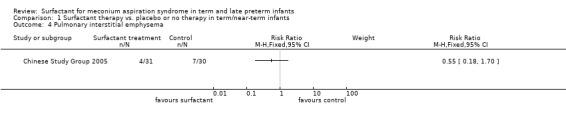
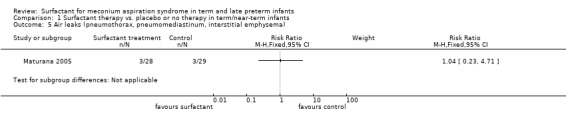
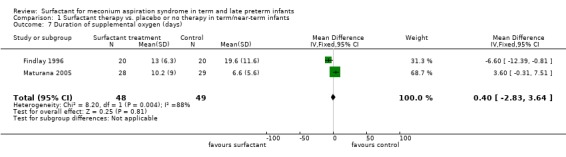
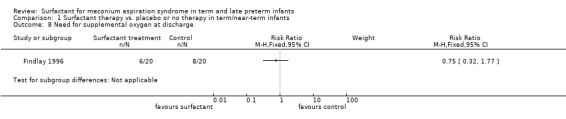
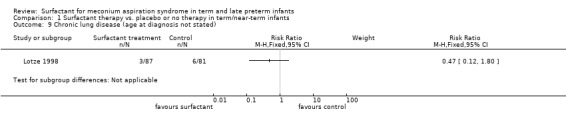
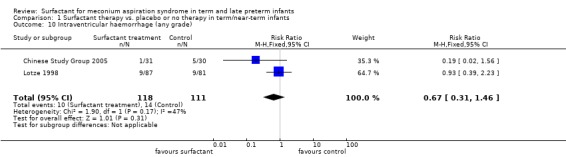
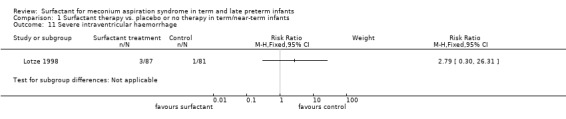
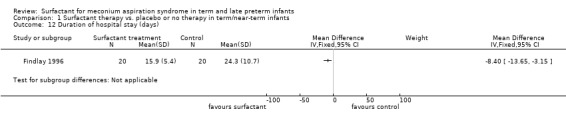
Main results: Four randomised controlled trials met our inclusion criteria. The meta-analysis of four trials (326 infants) showed no statistically significant effect on mortality [typical risk ratio (RR) 0.98, 95% confidence interval (CI) 0.41 to 2.39; typical risk difference (RD) -0.00, 95% CI -0.05 to 0.05]. There was no heterogeneity for this outcome (I² = 0% for both RR and RD). The risk of requiring extracorporeal membrane oxygenation was significantly reduced in a meta-analysis of two trials (n = 208); [typical RR 0.64, 95% CI 0.46 to 0.91; typical RD -0.17, 95% CI -0.30 to -0.04; number needed to treat for an additional beneficial outcome (NNTB) 6, 95% CI 3 to 25]. There was no heterogeneity for RR (1² = 0%) but moderate heterogeneity for RD (I² = 50%). One trial (n = 40) reported a statistically significant reduction in the length of hospital stay (mean difference -8 days, 95% CI -14 to -3 days; test for heterogeneity not applicable). There were no statistically significant reductions in any other outcomes studied (duration of assisted ventilation, duration of supplemental oxygen, pneumothorax, pulmonary interstitial emphysema, air leaks, chronic lung disease, need for oxygen at discharge or intraventricular haemorrhage).
Authors' conclusions: In infants with MAS, surfactant administration may reduce the severity of respiratory illness and decrease the number of infants with progressive respiratory failure requiring support with ECMO. The relative efficacy of surfactant therapy compared to, or in conjunction with, other approaches to treatment including inhaled nitric oxide, liquid ventilation, surfactant lavage and high frequency ventilation remains to be tested.
Conflict of interest statement
Dr R. Soll has acted as a consultant and invited speaker for several of the pharmaceutical companies which manufacture or distribute surfactant preparations (Abbott Laboratories, Ross Laboratories, Chiesi Pharmaceuticals, Dey Laboratories, Burroughs Wellcome) but has not done so for over 6 years. Dr P. Dargaville has received support for basic science research in surfactant lavage studies from Abbott Australasia. Neither Dr El Shahed nor Dr Ohlsson have conflicts of interest to disclose.
Figures

Update of
-
Surfactant for meconium aspiration syndrome in full term/near term infants.Cochrane Database Syst Rev. 2007 Jul 18;(3):CD002054. doi: 10.1002/14651858.CD002054.pub2. Cochrane Database Syst Rev. 2007. Update in: Cochrane Database Syst Rev. 2014 Dec 14;(12):CD002054. doi: 10.1002/14651858.CD002054.pub3. PMID: 17636695 Updated.
References
References to studies included in this review
Chinese Study Group 2005 {published data only}
-
- Chinese Collaborative Study Group for Neonatal Respiratory Diseases. Treatment of severe meconium aspiration with porcine surfactant: a multicentre, randomized, controlled trial. Acta Paediatrica 2005;94(7):896‐902. - PubMed
Findlay 1996 {published data only}
-
- Findlay RD, Taeusch HW, Walther FJ. Surfactant replacement therapy for meconium aspiration syndrome. Pediatrics 1996;97(1):48‐52. - PubMed
Lotze 1998 {published data only}
-
- Lotze A, Mitchell BR, Bulas DI, Zola EM, Shalwitz RA, Gunkel HJ, et al. Multicenter study of surfactant (beractant) use in the treatment of term infants with severe respiratory failure. Journal of Pediatrics 1998;132(1):40‐7. - PubMed
Maturana 2005 {unpublished data only}
-
- Maturana A, Torres‐Pereyra J, Salinas R, Astudillo P, Moya FR, The Chile Surf Group. A randomized trial of natural surfactant for moderate to severe meconium aspiration syndrome. Pediatric Academic Societies. 2005; Vol. 57:1545.
References to studies excluded from this review
Auten 1991 {published data only}
-
- Auten RL, Notter RH, Kendig, JW, Davis JM, Shapiro DL. Surfactant treatment of full‐term newborns with respiratory failure. Pediatrics 1991;87(1):101‐7. - PubMed
Blanke 1993 {published data only}
-
- Blanke JG, Jorch G. Surfactant therapy in severe neonatal respiratory failure ‐ multicenter study ‐ II. Surfactant therapy in 10 newborn infants with meconium aspiration syndrome [Surfactanttherapie bei 10 Neugeborenem mit Mekoniumaspirationssyndrom]. Klinische Padiatrie 1993;205(2):75‐8. - PubMed
Chang 2003 {published data only}
-
- Chang HY, Hsu CH, Kao HA, Hung HY, Chang JH, Peng CC, Jim WT. Treatment of severe meconium aspiration syndrome with dilute surfactant lavage. Journal of the Formosan Medical Association 2003;102(5):326‐30. - PubMed
Dargaville 2011 {published data only}
-
- Dargaville PA, Copnell B, Mills JF, Haron I, Lee JK, Tingay DG, et al. lessMAS Trial Study Group. Randomized controlled trial of lung lavage with dilute surfactant for meconium aspiration syndrome. Journal of Pediatrics 2011;158(3):383‐9. - PubMed
Diniz 1995 {published data only}
-
- Diniz EMA, Fiori RM. Curosurf therapy in severe meconium aspiration (MAS). Biology of the Neonate 1995;67:86.
Gadzinowski 2008 {published data only}
-
- Gadzinowski J, Kowalska K, Vidyasagar D. Treatment of MAS with PPHN using combined therapy: SLL, bolus surfactant and iNO. Journal of Perinatology 2008;28(Suppl 3):S56‐66. - PubMed
Halliday 1996 {published data only}
-
- Halliday HL, Speer CP, Robertson B. Treatment of severe meconium aspiration syndrome with porcine surfactant. European Journal of Pediatrics 1996;155(12):1047‐51. - PubMed
Hung 2006 {published data only}
-
- Hung HY, Jim WT, Hsu CH, Chang JH, Peng CC, Shih SL, et al. Small versus large volume dilute surfactant lavage for meconium aspiration syndrome.. Acta Paediatrica Taiwan 2006;47(4):181‐6. - PubMed
Ibara 1995 {published data only}
-
- Ibara S, Ikenoue T, Murata Y, Sakamoto H, Saito T, Nakamura Y, et al. Management of meconium aspiration syndrome by tracheobronchial lavage and replacement of surfactant ‐TA. Acta Paediatrica Japonica 1995;37(1):64‐7. - PubMed
Khammash 1993 {published data only}
-
- Khammash H, Perlman M, Wojtulewicz J, Dunn M. Surfactant therapy in full‐term neonates with severe respiratory failure. Pediatrics 1993;92(1):135‐9. - PubMed
Lam 1999 {published data only}
-
- Lam BCC, Yeung CY. Surfactant lavage for meconium aspiration syndrome: a pilot study. Pediatrics 1999;103:1014‐8. - PubMed
Lin 2014 {published data only}
-
- Lin XZ, Lai JD, Lan ZY, Lin YY. [Clinical effect of endotracheal lavage with porcine pulmonary surfactant in term neonates with severe meconium aspiration syndrome]. Zhongguo Dang Dai Er Ke Za Zhi (Chinese Journal of Contemporary Pediatrics) 2014;16(7):709‐13. [PUBMED: 25008878] - PubMed
Lista 2006 {published data only}
-
- Lista G, Bianchi S, Castoldi F, Fontana P, Cavigioli F. Bronchoalveolar lavage with diluted porcine surfactant in mechanically ventilated term infants with meconium aspiration syndrome. Clinical Drug Investigation 2006;26(1):13‐9. - PubMed
Ogawa 1996 {published data only}
-
- Ogawa Y, Ohara Y, Itakura Y, et al. Bronchial lavage with surfactant solution for the treatment of meconium aspiration syndrome. J Jpn Med Soc Biol Interface 1996;26(Suppl):179‐87.
Wiswell 2002 {published data only}
-
- Wiswell TE, Knight GR, Finer NN, Donn SM, Desai H, Walsh WF, et al. A multicenter, randomized, controlled trial comparing surfaxin (lucinactant) lavage with standard care for treatment of meconium aspiration syndrome. Pediatrics 2002;109(6):1081‐7. - PubMed
Additional references
Aaltonen 2007
-
- Aaltonen M, Soukka H, Halkola L, Jalonen J, Kalimo H, Holopainen IE. Inhaled nitric oxide treatment inhibits neuronal injury after meconium aspiration in piglets. Early Human Development 2007;83(2):77‐85. - PubMed
AAP 2006
-
- American Academy of Pediatrics, American Heart Association. Textbook of neonatal resuscitation. 5th Edition. Elk Grove Village: American Academy of Pediatrics, American Heart Association, 2006.
Abdel‐Latif 2011a
Abdel‐Latif 2011b
Abdel‐Latif 2012
Aziz 2012
Bahadue 2012
Chen 1985
-
- Chen CT, Toung TJK, Rogers MC. Effect of intra‐alveolar meconium on pulmonary surface tension properties. Critical Care Medicine 1985;13(4):233‐6. - PubMed
Christou 2000
-
- Christou H, Marter LJ, Wessel DL, Allred EN, Kane JW, Thompson JE. Inhaled nitric oxide reduces the need for extracorporeal membrane oxygenation in infants with persistent pulmonary hypertension of the newborn. Critical Care Medicine 2000;28(11):3722‐7. - PubMed
Clark 1987
-
- Clark DA, Nieman GF, Thompson JE, Paskanik AM, Rokhar JE, Bredenberg CE. Surfactant displacement by meconium free fatty acids: An alternative explanation for atelectasis in meconium aspiration syndrome. Journal of Pediatrics 1987;110(5):765‐70. - PubMed
Clark 2000
-
- Clark RH, Kueser TJ, Walker MW, Southgate WM, Huckaby JL, Perez JA, et al. Low‐dose nitric oxide therapy for persistent pulmonary hypertension of the newborn. New England Journal of Medicine 2000;342(7):469‐74. - PubMed
Fakioglu 2005
-
- Fakioglu H, Totapally BR, Torbati D, Raszynski A, Sussmane JB, Wolfsdorf J. Hypoxic respiratory failure in term newborns: clinical indicators for inhaled nitric oxide and extracorporeal membrane oxygenation therapy. Journal of Critical Care 2005;20(3):288‐93. - PubMed
Finer 2000
-
- Finer NN, Barrington KJ. Nitric oxide therapy for the newborn infant. Seminars in Perinatology 2000;24(1):59‐65. - PubMed
Hahn 2013
Higgins 2003
Higgins 2011
-
- Higgins JPT, Green S (editors). Cochrane Handbook for Systematic Reviews of Interventions Version 5.1.0 [updated March 2011]. The Cochrane Collaboration, 2011. Available from www.cochrane‐handbook.org.
Hofmeyr 2010
Hsieh 2004
-
- Hsieh TK, Su BH, Chen AC, Lin TW, Tsai CH, Lin HC. Risk factors of meconium aspiration syndrome developing into persistent pulmonary hypertension of newborn. Acta Paediatrica Taiwan 2004;45(4):203‐7. - PubMed
Moses 1991
-
- Moses D, Holm BA, Spitale P, Liu M, Enhorning G. Inhibition of pulmonary surfactant function by meconium. American Journal of Obstetrics and Gynecology 1991;164(2):477‐81. - PubMed
Neonatal iNO 1997
-
- The Neonatal Inhaled Nitric Oxide Study Group. Inhaled nitric oxide in full‐term and nearly full‐term infants with hypoxic respiratory failure. New England Journal of Medicine 1997;336:597‐604. - PubMed
Pfister 2007
Pfister 2009
RevMan 2014 [Computer program]
-
- The Nordic Cochrane Centre, The Cochrane Collaboration. Review Manager (RevMan). Version 5.3. Copenhagen: The Nordic Cochrane Centre, The Cochrane Collaboration, 2014.
Rojas‐Reyes 2012
Seger 2009
Sinclair 1992
-
- Sinclair J, Bracken M. Effective Care of the Newborn. Oxford University Press, 1992.
Singh 2011
-
- Singh N, Hawley KL, Viswanathan K. Efficacy of porcine versus bovine surfactants for preterm newborns with respiratory distress syndrome: systematic review and meta‐analysis. Pediatrics 2011; Vol. 128, issue 6:e1588‐95. - PubMed
Soll 1992
-
- Soll RF, McQueen MC. Respiratory Distress Syndrome. In: Sinclair JC, Bracken MB editor(s). Effective Care of the Newborn Infant. Oxford: Oxford University Press, 1992.
Soll 1997
Soll 1998
Soll 2001
Soll 2009
Soll 2010
Soukka 1998
-
- Soukka H, Jalonen J, Kero P, Kaapa P. Endothelin‐1, arterial natriuretic peptide and pathophysiology of pulmonary hypertension in porcine meconium aspiration. Acta Paediatrica 1998;87(4):424‐8. - PubMed
Stevens 2007
-
- Stevens TP, Harrington EW, Blennow M, Soll RF. Early surfactant administration with brief ventilation vs. selective surfactant and continued mechanical ventilation for preterm infants with or at risk for respiratory distress syndrome. Cochrane Database of Systematic Reviews 2007, Issue 4. [DOI: 10.1002/14651858.CD003063.pub3] - DOI - PMC - PubMed
Sun 1993
-
- Sun B, Curstedt T, Song GW, Robertson B. Surfactant improves lung function and morphology in newborn rabbits with meconium aspiration. Biolology of the Neonate 1993;63(2):96‐104. - PubMed
Tan 2012
Tran 1980
-
- Tran N, Lowe C, Sivieri EM, Shaffer TH. Sequential effects of acute meconium obstruction on pulmonary function. Pediatric Research 1980;14(1):34‐8. - PubMed
Tyler 1978
-
- Tyler DC, Murphy J, Cheney FW. Mechanical and chemical damage to lung tissue caused by meconium aspiration. Pediatrics 1978;62(4):454‐9. - PubMed
UK Collab 1996
-
- UK Collaborative ECMO Trial Group. UK collaborative randomized trial of neonatal extracorporeal membrane oxygenation. Lancet 1996;348(9020):75‐82. - PubMed
Vain 2004
-
- Vain NE, Szyld EG, Prudent LM, Wiswell TE, Aguilar AM, Vivas NI. Oropharyngeal and nasopharyngeal suctioning of meconium‐stained neonates before delivery of their shoulders: multicentre, randomised controlled trial. Lancet 2004;364(9434):597‐602. - PubMed
Van Meurs 2003
-
- Meurs K, Rhine WD, Benitz WE. Meconium staining and the meconium aspiration syndrome. Fetal and neonatal brain injury. Mechanisms, management and the risks of practice. Cambridge University Press, 2003:636‐62.
Walia 1999
-
- Walia R, Ohlsson A. Differences between information provided in abstracts of randomized controlled trials in neonates submitted to the Annual Meeting of the American Pediatric Society and the Society for Pediatric Research (APS/SPR) and final publications ‐ implications for meta‐analyses. 7th Annual Cochrane Colloquium Abstracts. 1999.
References to other published versions of this review
El Shahed 2007
Publication types
MeSH terms
Substances
LinkOut - more resources
Full Text Sources
Other Literature Sources
Miscellaneous
