


JEPEG: a summary statistics based tool for gene-level joint testing of functional variants
- PMID: 25505091
- PMCID: PMC4393522
- DOI: 10.1093/bioinformatics/btu816
JEPEG: a summary statistics based tool for gene-level joint testing of functional variants
Abstract
Motivation: Gene expression is influenced by variants commonly known as expression quantitative trait loci (eQTL). On the basis of this fact, researchers proposed to use eQTL/functional information univariately for prioritizing single nucleotide polymorphisms (SNPs) signals from genome-wide association studies (GWAS). However, most genes are influenced by multiple eQTLs which, thus, jointly affect any downstream phenotype. Therefore, when compared with the univariate prioritization approach, a joint modeling of eQTL action on phenotypes has the potential to substantially increase signal detection power. Nonetheless, a joint eQTL analysis is impeded by (i) not measuring all eQTLs in a gene and/or (ii) lack of access to individual genotypes.
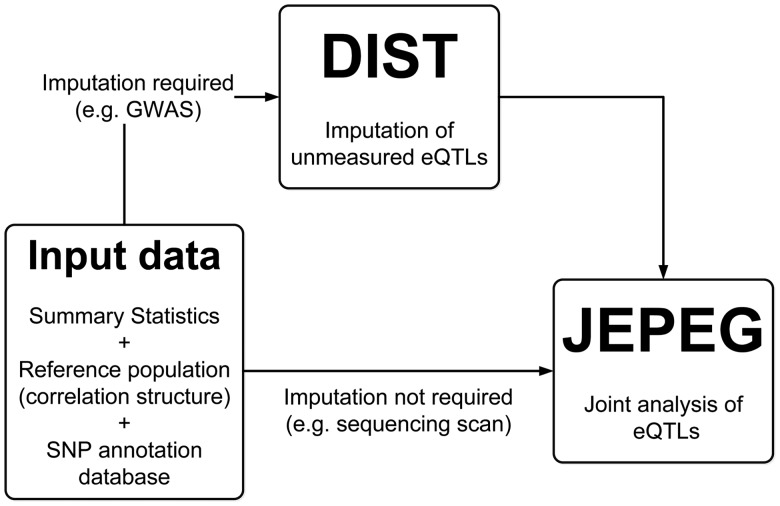
Results: We propose joint effect on phenotype of eQTL/functional SNPs associated with a gene (JEPEG), a novel software tool which uses only GWAS summary statistics to (i) impute the summary statistics at unmeasured eQTLs and (ii) test for the joint effect of all measured and imputed eQTLs in a gene. We illustrate the behavior/performance of the developed tool by analysing the GWAS meta-analysis summary statistics from the Psychiatric Genomics Consortium Stage 1 and the Genetic Consortium for Anorexia Nervosa.
Conclusions: Applied analyses results suggest that JEPEG complements commonly used univariate GWAS tools by: (i) increasing signal detection power via uncovering (a) novel genes or (b) known associated genes in smaller cohorts and (ii) assisting in fine-mapping of challenging regions, e.g. major histocompatibility complex for schizophrenia.
Availability and implementation: JEPEG, its associated database of eQTL SNPs and usage examples are publicly available at http://code.google.com/p/jepeg/.
Contact: dlee4@vcu.edu
Supplementary information: Supplementary data are available at Bioinformatics online.
© The Author 2014. Published by Oxford University Press.
Figures
References
-
- Bacanu S.A., et al. (2008) Comparison of association methods for dense marker data. Genet. Epidemiol., 32, 791–799. - PubMed
Publication types
MeSH terms
Substances
Grants and funding
LinkOut - more resources
Full Text Sources
Other Literature Sources
