. 2014 Dec 10;34(50):16821-34.
doi: 10.1523/JNEUROSCI.1940-14.2014.

Independent premotor encoding of the sequence and structure of birdsong in avian cortex

Affiliations

Independent premotor encoding of the sequence and structure of birdsong in avian cortex

Mark J Basista et al. J Neurosci. .

Abstract

How the brain coordinates rapid sequences of learned behavior, such as human speech, remains a fundamental problem in neuroscience. Birdsong is a model of such behavior, which is learned and controlled by a neural circuit that spans avian cortex, basal ganglia, and thalamus. The songs of adult male zebra finches (Taeniopygia guttata), produced as rapid sequences of vocal gestures (syllables), are encoded by the cortical premotor region HVC (proper name). While the motor encoding of song within HVC has traditionally been viewed as unitary and distributed, we used an ablation technique to ask whether the sequence and structure of song are processed independently within HVC. Results revealed a functional topography across the medial-lateral axis of HVC. Bilateral ablation of medial HVC induced a positive disruption of song (increase in atypical syllable sequences), whereas bilateral ablation of lateral HVC induced a negative disruption (omission of individual syllables). Bilateral ablation of central HVC either had no effect on song or induced syllable omission, similar to lateral HVC ablation. We then investigated HVC connectivity and found parallel afferent and efferent pathways that transit medial and lateral HVC and converge at vocal motor cortex. In light of recent evidence that syntactic and lexical components of human speech are processed independently by neighboring regions of cortex (Menenti et al., 2012), our demonstration of anatomically distinct pathways that differentially process the sequence and structure of birdsong in parallel suggests that the vertebrate brain relies on a common approach to encode rapid sequences of vocal gestures.

Keywords: ablation; motor encoding; parallel processing; serial-order behavior; tract-tracing; zebra finch.


Figures

Figure 1.
Figure 1.
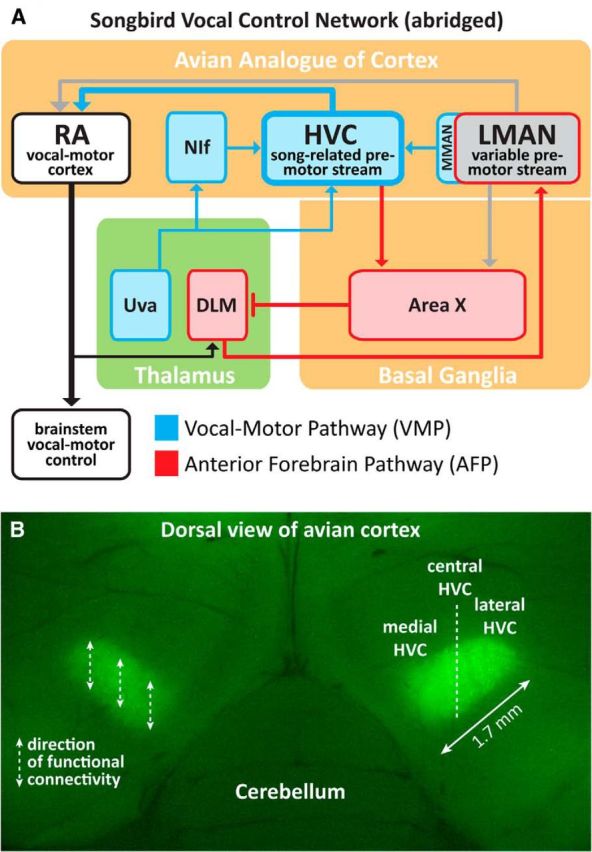
Sagittal schematic of the zebra finch vocal control network and an image of HVC (proper name), the premotor cortical region under study. A, The learned song of adult birds is an integration of dual premotor streams: HVC encodes the temporal structure of adult song (Long and Fee, 2008; Goldin et al., 2013), whereas LMAN contributes adaptive variability into the vocal-motor stream that is important during juvenile learning (Aronov et al., 2008; Elliott et al., 2014) and in adulthood (Kao and Brainard, 2006; Thompson et al., 2011). Weakening of one premotor stream shifts the character of vocal production in favor of the other (Thompson et al., 2007, 2011). For this reason, LMAN was ablated in all birds (unless otherwise specified) to isolate HVC premotor drive on song. B, The dorsal location of HVC is ideal for experimental manipulation; left and right HVC visualized via retrograde transport of DiO. Dashed lines over left HVC indicate the rostral–caudal functional organization of HVC (Stauffer et al., 2012). Because the motor encoding of song is distributed across left and right HVC (Ashmore et al., 2008; Long and Fee, 2008; Wang et al., 2008), all reported findings are the result of bilateral manipulations to medial, central, or lateral HVC.
Figure 2.
Figure 2.
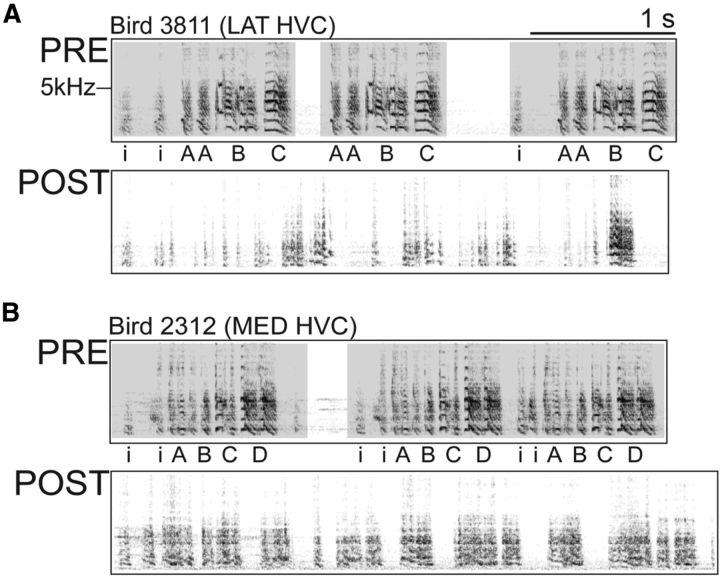
In the presence of LMAN, bilateral HVC damage produces a complete loss of song structure and sequence. Representative PRE and POST spectrograms from LMANR birds that received bilateral damage to lateral (A) or medial (B) HVC, but not LMAN ablation.
Figure 3.
Figure 3.
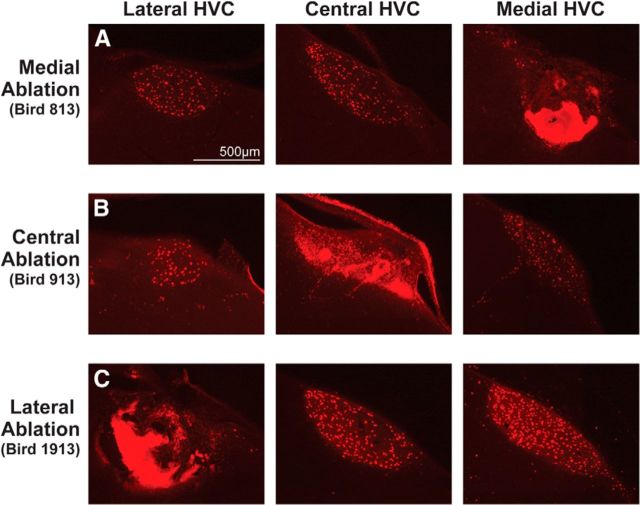
Unilateral examples of the experimental manipulations to medial (A), central (B), and lateral (C) HVC. Retrograde labeling was used for postmortem confirmation and measurement of ablation loci within HVC. Each HVC was retrogradely labeled with DiI and sectioned sagittally. The sections in each row are ∼480 μm apart from each other. In all images, dorsal is up and caudal is to the right.
Figure 4.
Figure 4.
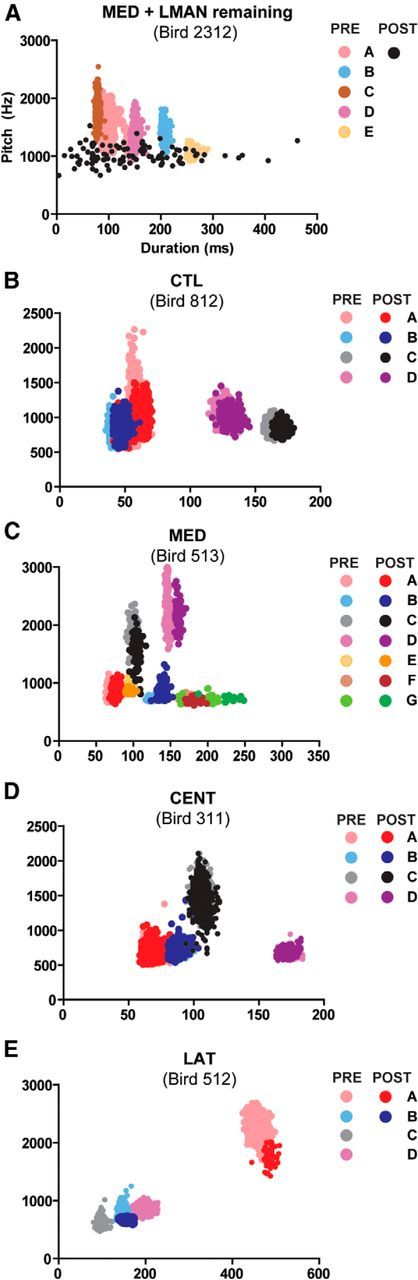
In the absence of LMAN, bilateral ablation of HVC subregions does not produce a general disruption of syllable acoustic structure. A, In the presence of LMAN, bilateral damage to medial HVC results in a complete loss of syllable acoustic structure (compare with spectrograms in Fig. 2). B, In the absence of LMAN, bilateral damage that flanks but does not include HVC has a minimal effect on syllable acoustic structure (compare with spectrograms in Fig. 6). C, In the absence of LMAN, bilateral damage to medial HVC has a minimal effect on syllable acoustic structure (compare with spectrograms in Fig. 7). D, In the absence of LMAN, bilateral damage to central HVC has a minimal effect on syllable acoustic structure. E, In the absence of LMAN, bilateral damage to lateral HVC results in omission of some syllables (C, D) but has minimal effect on the acoustic structure of remaining syllables (A, B, compare with spectrograms in Fig. 7).
Figure 5.
Figure 5.
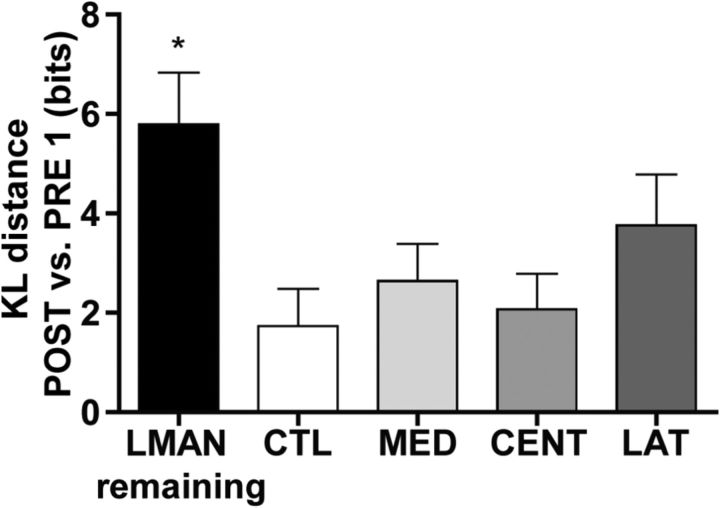
Quantification of changes in syllable acoustic features after HVC subregion ablation by group. Values are Kullback–Leibler (KL) distances of all POST singing from PRE1, calculated using a composite measure of syllable acoustic features (duration, pitch, FM, entropy, and pitch goodness). Data are the mean ± SEM of these values within groups. Only birds with LMAN remaining were significantly different from CTL birds (*p < 0.05). A nonsignificant trend is observed when LAT birds are compared with CTL birds (p = 0.15).
Figure 6.
Figure 6.
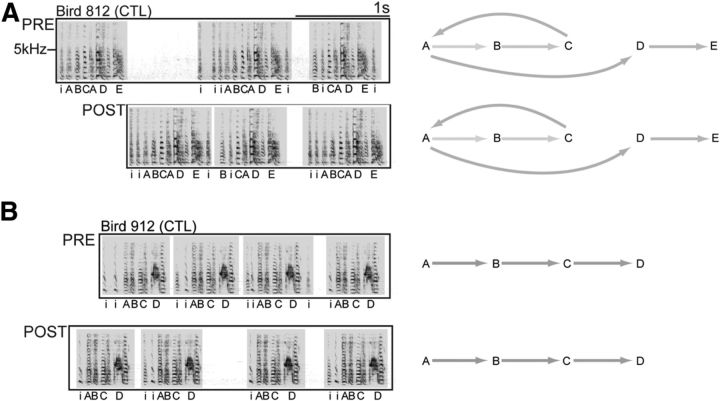
Bilateral damage that flanks HVC borders does not affect the motor encoding of song. A, B, Example spectrograms show that birds sing complete motifs at POST when bilateral damage does not include HVC. Bird 812 had damage located medial and ventral to HVC. Bird 912 had damage located ventral to the central portion of HVC. Syllable transition diagrams accompanying each spectrogram show the changes in syllable transition types associated with this deficit. Grayscale represents the relative probabilities of transitions between pairs of motif syllables.
Figure 7.
Figure 7.
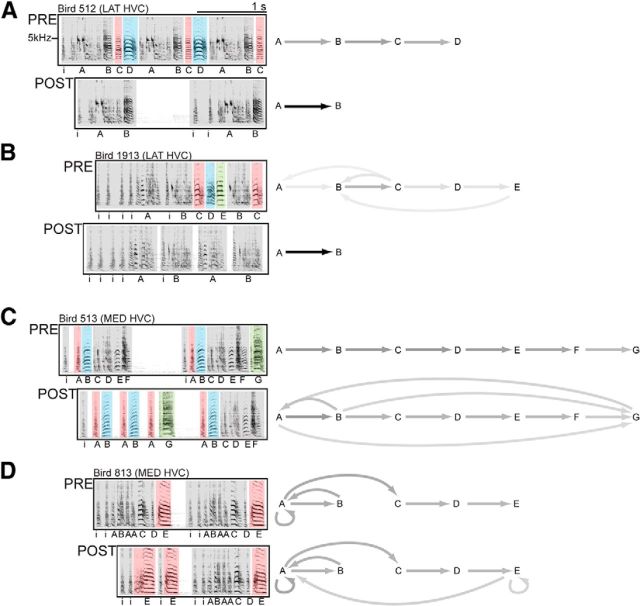
LAT and MED HVC ablations affect singing differently. A, B, Example spectrograms show that birds omit syllables at POST when LAT HVC is bilaterally damaged, resulting in incomplete motifs. Syllable transition diagrams accompanying each spectrogram show the changes in syllable transition types associated with this deficit. Grayscale represents the relative probabilities of transitions between pairs of motif syllables. At PRE, different proportions of the transitions throughout a day of singing correspond to transitions between pairs of motif syllables. At POST, all transitions now occur between syllables A and B because only those two syllables were sung by these two birds. The omission of motif syllables at POST was characteristic of birds with LAT HVC ablations and was wholesale in 3 of 5 birds in this group. C, D, Example spectrograms and syllable transition diagrams show that birds with bilateral MED HVC damage sing all of their motif syllables at POST, but they intermittently produce their motif syllables out of the canonical order observed at PRE. New and atypical transition types are present at POST (e.g., B-A and A-G at POST in C). Atypical syllable transitions were characteristic of birds with MED HVC ablations, although this deficit was never wholesale: all birds in this group retained the ability to intermittently produce their canonical PRE motif.
Figure 8.
Figure 8.
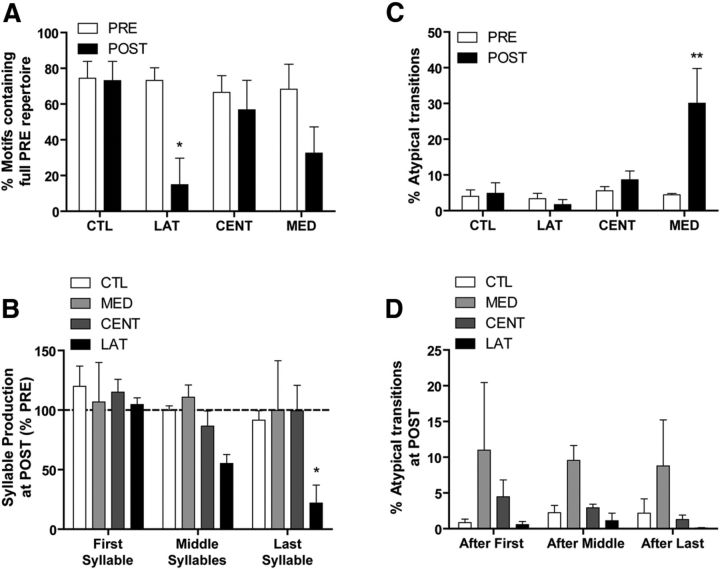
Quantification of syllable omission and atypical syllable transitions, as well as the motif position (first, middle, or last syllables) of the two types of vocal disruption. Data are mean ± SEM. A, Quantification of motif completion rates reveals which experimental groups continued to sing their full PRE repertoire after surgery. At PRE, all groups completed their motifs (i.e., the motif included the full PRE repertoire of syllables) between two-thirds and three-fourths of the time. Only the LAT HVC group showed a significant decrease in complete motifs at POST (*p < 0.05 vs PRE), indicative of the omission of motif syllables. B, During POST singing, only LAT HVC birds showed a specific pattern in syllable omission. Syllables were selectively omitted at the end of the motif. C, Quantification of atypical syllable transitions reveals which experimental groups diverged from their canonical ordering of syllables after surgery. Atypical transitions resulting from syllable omissions were not quantified here. Only the MED HVC group showed a significant increase in atypical transitions at POST (**p < 0.01). D, During post singing, no experimental group showed a pattern in atypical transitions, which even in the MED HVC group were just as likely to follow the first, middle, or last syllables of the motif.
Figure 9.
Figure 9.
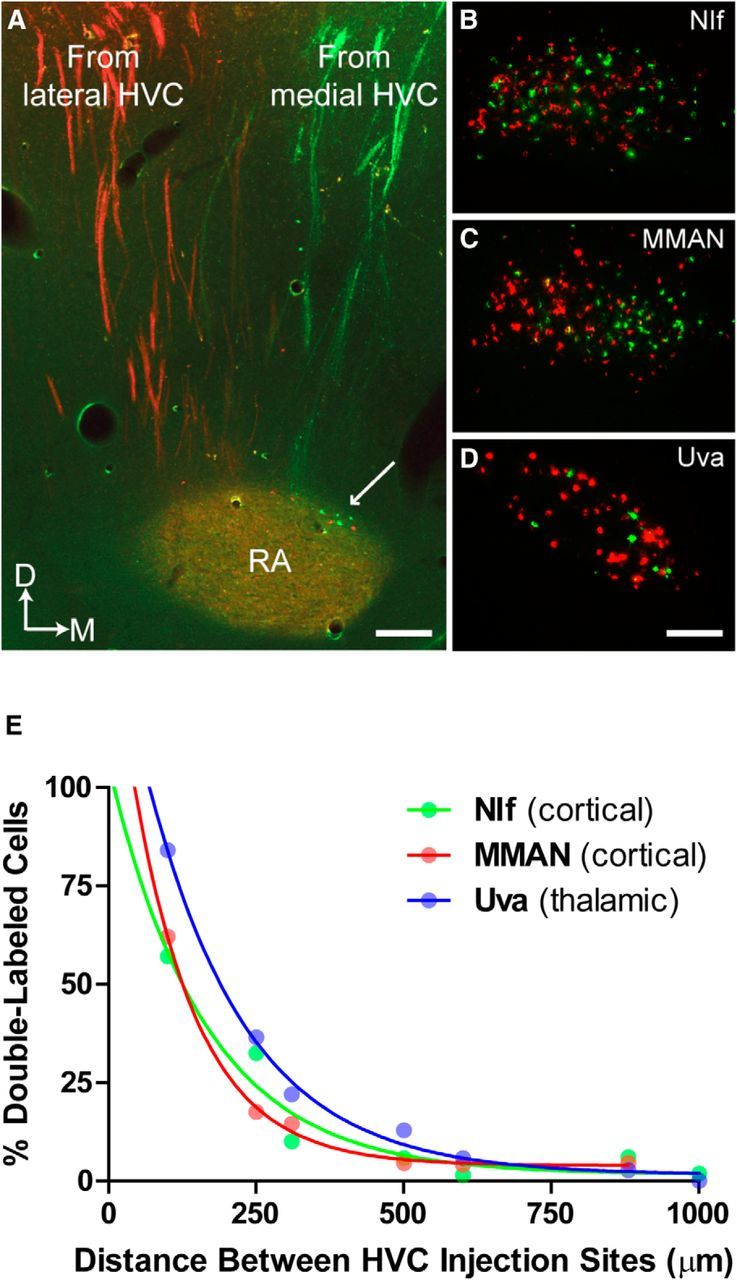
Parallel organization of HVC extrinsic connectivity. Tracer injections in medial (DiO, green) and lateral (DiI, red) HVC show that the extrinsic connectivity of HVC supports a partitioning of vocal function across medial and lateral portions of HVC. Images show that medial and lateral HVC send axons to RA in distinct pathways (A) and receive distinct sources of afferent input from NIf, MMAN, and UVA (B–D). This pattern of anterograde and retrograde labeling was observed in all birds (N = 4) that received dye injections into medial and lateral HVC. A, Arrow indicates the small population of neurons in dorsal RA that are reciprocally connected to HVC (Roberts et al., 2008). These cells were also found to project medial HVC (green) or lateral HVC (red), but not both. Scale bars: A, 165 μm; D, 120 μm. E, Demonstration of experimental control over tracer labeling. Double-labeling of neurons in HVC afferent nuclei (NIf, MMAN, Uva) is an exponential function of the medial–lateral distance between ≤40 nl DiI and DiO injections in HVC. Data are single hemisphere values from N = 7 birds. The exponential function indicates that axon terminals from NIf, MMAN, and Uva neurons are narrowly targeted to either medial or lateral HVC.
Figure 10.
Figure 10.
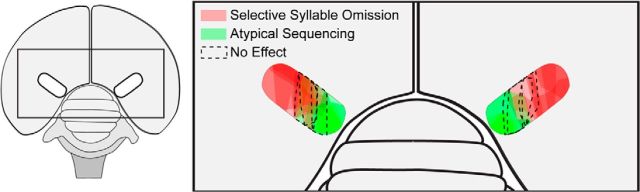
Parallel organization of the motor encoding of song in HVC. Transparent color overlays represent the positions of bilateral ablations that induced selective syllable omission (red, N = 8) or atypical syllable sequencing (green, N = 5). Dotted lines indicate the positions of bilateral ablations that did not have any effect on singing (N = 3) (compare Poole et al., 2012). Each shape represents the size and location of bilateral damage as estimated from reconstructions of HVC in each bird: color saturation occurs in regions where bilateral damage had the same effect in multiple birds. Partitioning of function across medial and lateral portions of HVC indicates that the sequence and structure of song are not encoded as a unitary construct within HVC.

References

    1. Airey DC, DeVoogd TJ. Greater song complexity is associated with augmented song system anatomy in zebra finches. Neuroreport. 2000;11:2339–2344. doi: 10.1097/00001756-200007140-00054. - DOI - PubMed
    1. Amador A, Perl YS, Mindlin GB, Margoliash D. Elemental gesture dynamics are encoded by song premotor cortical neurons. Nature. 2013;495:59–64. doi: 10.1038/nature11967. - DOI - PMC - PubMed
    1. Aronov D, Andalman AS, Fee MS. A specialized forebrain circuit for vocal babbling in the juvenile songbird. Science. 2008;320:630–634. doi: 10.1126/science.1155140. - DOI - PubMed
    1. Ashmore RC, Bourjaily M, Schmidt MF. Hemispheric coordination is necessary for song production in adult birds: implications for a dual role for forebrain nuclei in vocal motor control. J Neurophysiol. 2008;99:373–385. doi: 10.1152/jn.00830.2007. - DOI - PubMed
    1. Bertram R, Daou A, Hyson RL, Johnson F, Wu W. Two neural streams, one voice: pathways for theme and variation in the songbird brain. Neuroscience. 2014;C277:806–817. doi: 10.1016/j.neuroscience.2014.07.061. - DOI - PubMed

Publication types

LinkOut - more resources