


[Prevalence and associated factors of falls in community-dwelling elderly]
- PMID: 25510489
- PMCID: PMC6983699
- DOI: 10.1016/j.aprim.2014.07.012
[Prevalence and associated factors of falls in community-dwelling elderly]
Abstract
Objective: To estimate the prevalence of falls and to identify their associated factors in community-dwelling elderly.
Design: A descriptive, cross-sectional study.
Setting: Primary Health Care, Lleida.
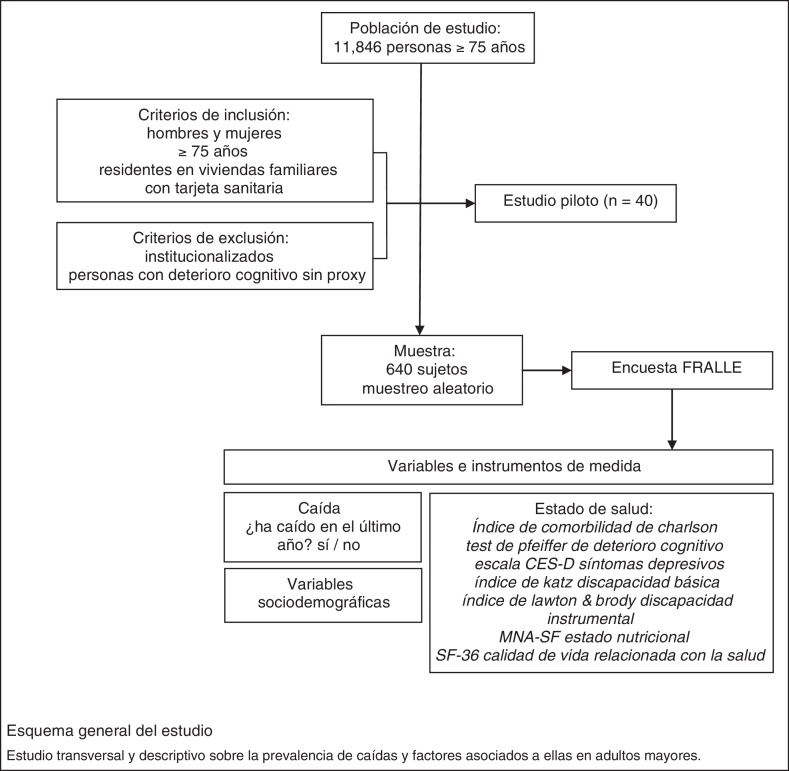
Participants: Six hundred and forty people aged 75 and older were included, in possession of a health card and living in single-family houses, through random sampling. Main measurements Data source comes from the survey of frailty in Lleida (FRALLE Survey). The variables used were the occurrence of falls, sociodemographic factors, health status, quality of life related to health and fear of falling.
Results: The prevalence of falls was 25.0% (95% CI 24.8-25.1). After multivariate analysis, basic disability (OR=2.17; 95% CI 1.32-3.58), depressive symptoms (OR=1.67; 95% CI 1.07-2.59) and fear of falling (OR=2.53; 95% CI 1.63-3.94) were the only factors independently associated with falls in the last year.
Conclusions: One out of 4 older people reported at least a fall in the last year. This study demonstrates that fear of falling, depressive symptoms and basic disability are independent variables associated with previous falls. These 3 factors can lead to a flattering spiral of falling and may be potential targets for effective functioning in the context of falls.
Objetivo: Estimar la prevalencia de caídas e identificar los factores asociados a ellas en la población mayor comunitaria.
Diseño: Estudio descriptivo, transversal.
Emplazamiento Atención Primaria de Salud, Lleida.
Participantes: Se incluyó a 640 personas de 75 o más años de edad, que disponían de tarjeta sanitaria y residían en viviendas unifamiliares, a través de un muestreo aleatorizado.
Mediciones principales: La fuente de datos proviene de la encuesta de fragilidad en Lleida (Encuesta FRALLE). Las variables utilizadas fueron la presencia de caídas en el último año, factores sociodemográficos, estado de salud, calidad de vida relacionada con la salud y miedo a caer.
Resultados: La prevalencia de caídas fue del 25,0% (IC 95% 24,8-25,1). Tras el análisis multivariado, la discapacidad básica (OR = 2,17; IC 95% 1,32-3,58), los síntomas depresivos (OR = 1,67; IC 95% 1,07-2,59) y el miedo a caer (OR = 2,53; IC 95% 1,63-3,94) fueron los únicos factores asociados de forma independiente a las caídas en el último año.
Conclusiones: Una de cada 4 personas mayores presentaron al menos una caída en el último año. Este estudio demuestra que el miedo a caer, los síntomas depresivos y la discapacidad básica son variables independientes asociadas a caídas previas. Estos 3 factores pueden dar lugar a una espiral favorecedora de caídas, pudiendo ser posibles objetivos para la actuación eficaz en el contexto de caídas.
Keywords: Anciano; Caídas; Community; Comunidad; Elderly; Factores de riesgo; Falls; Prevalence; Prevalencia; Risk factors.
Copyright © 2014 Elsevier España, S.L.U. All rights reserved.
Figures
References
-
- Da Silva Z.A., Gómez A., Sobral M. Epidemiología de caídas de ancianos en España: una revisión sistemática, 2007. Rev Esp Salud Publica. 2008;82:43–55. - PubMed
-
- Tinetti M.E., Speechley M., Ginter S.F. Risk factors for falls among elderly persons living in the community. N Engl J Med. 1988;319:1701–1707. - PubMed
-
- Vellas B.J., Wayne S.J., Garry P.J., Baumgartner R.N. A two-year longitudinal study of falls in 482 community-dwelling elderly adults. J Gerontol A Biol Sci Med Sci. 1998;53:M264–M274. - PubMed
-
- Da Silva Z.A., Gómez-Conesa A. Factores de riesgo de caídas en ancianos: revisión sistemática. Rev Saude Publica. 2008;42:946–956. - PubMed
Publication types
MeSH terms
LinkOut - more resources
Full Text Sources
Other Literature Sources
Medical
