


Attitudes, access and anguish: a qualitative interview study of staff and patients' experiences of diabetic retinopathy screening
- PMID: 25510885
- PMCID: PMC4267079
- DOI: 10.1136/bmjopen-2014-005498
Attitudes, access and anguish: a qualitative interview study of staff and patients' experiences of diabetic retinopathy screening
Abstract
Objective: To examine the experiences of patients, health professionals and screeners; their interactions with and understandings of diabetic retinopathy screening (DRS); and how these influence uptake.
Design: Purposive, qualitative design using multiperspectival, semistructured interviews and thematic analysis.
Setting: Three UK Screening Programme regions with different service-delivery modes, minority ethnic and deprivation levels across rural, urban and inner-city areas, in general practitioner practices and patients' homes.
Participants: 62 including 38 patients (22 regular-screening attenders, 16 non-regular attenders) and 24 professionals (15 primary care professionals and 9 screeners).
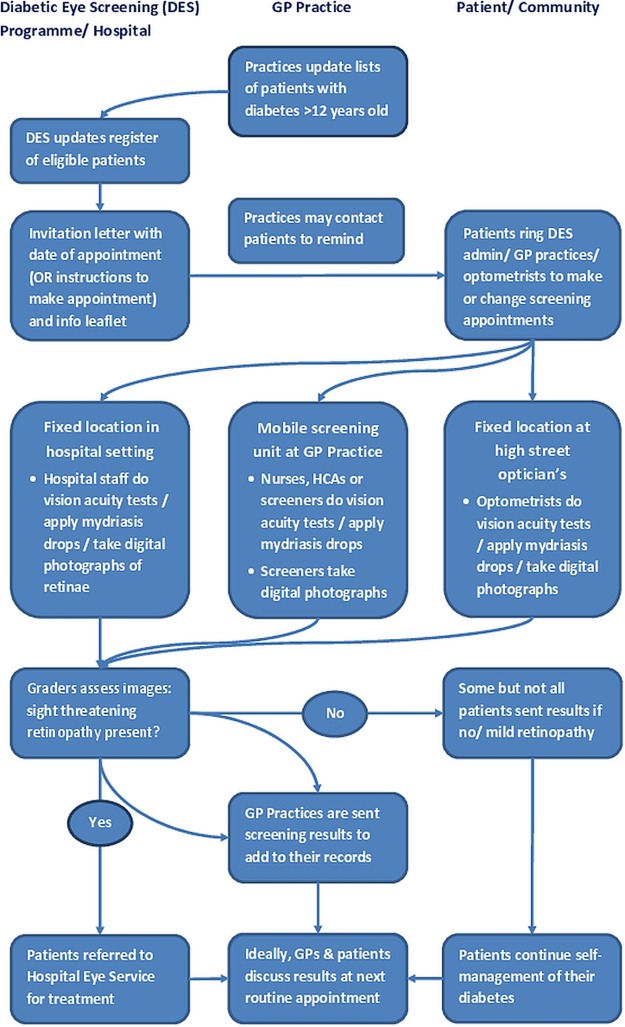
Results: Antecedents to attendance included knowledge about diabetic retinopathy and screening; antecedents to non-attendance included psychological, pragmatic and social factors. Confusion between photographs taken at routine eye tests and DRS photographs was identified. The differing regional invitation methods and screening locations were discussed, with convenience and transport safety being over-riding considerations for patients. Some patients mentioned significant pain and visual disturbance from mydriasis drops as a deterrent to attendance.
Conclusions: In this, the first study to consider multiperspectival experiential accounts, we identified that proactive coordination of care involving patients, primary care and screening programmes, prior to, during and after screening is required. Multiple factors, prior to, during and after screening, are involved in the attendance and non-attendance for DRS. Further research is needed to establish whether patient self-management educational interventions and the pharmacological reformulation of shorter acting mydriasis drops, may improve uptake of DRS. This might, in turn, reduce preventable vision loss and its associated costs to individuals and their families, and to health and social care providers, reducing current inequalities.
Keywords: PRIMARY CARE; QUALITATIVE RESEARCH; SOCIAL MEDICINE; Screening.
Published by the BMJ Publishing Group Limited. For permission to use (where not already granted under a licence) please go to http://group.bmj.com/group/rights-licensing/permissions.
Figures
References
-
- WHO. Priorities and objectives—what do we want to achieve? 3.5.8 Diabetic retinopathy. Chapter in VISION 2020: The Right to Sight? 2004.
-
- World Health Organization, ed. Prevention of blindness and visual impairment (WHA59.25). Geneva, 2006.
Publication types
MeSH terms
Substances
Grants and funding
LinkOut - more resources
Full Text Sources
Other Literature Sources
Medical
