


RNA-Seq gene expression profiling of HepG2 cells: the influence of experimental factors and comparison with liver tissue
- PMID: 25511409
- PMCID: PMC4378340
- DOI: 10.1186/1471-2164-15-1108
RNA-Seq gene expression profiling of HepG2 cells: the influence of experimental factors and comparison with liver tissue
Abstract
Background: Human hepatoma HepG2 cells are used as an in vitro model of the human liver. High-throughput transcriptomic sequencing is an advanced approach for assessing the functional state of a tissue or cell type. However, the influence of experimental factors, such as the sample preparation method and inter-laboratory variation, on the transcriptomic profile has not been evaluated.
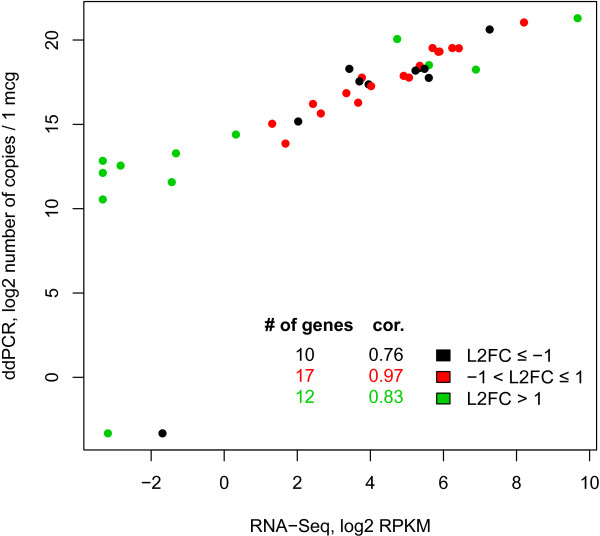
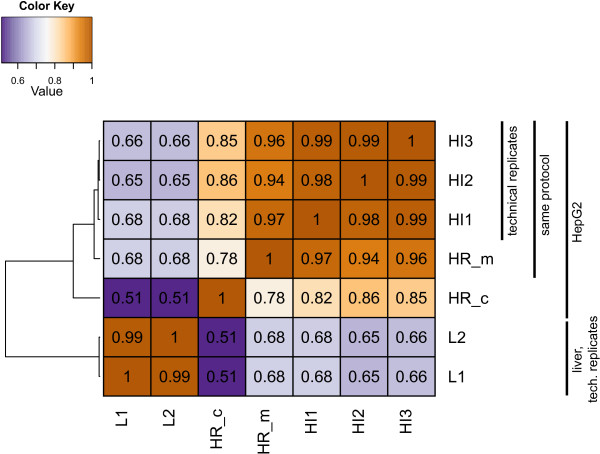
Results: The whole-transcriptome sequencing of HepG2 cells was performed using the SOLiD platform and validated using droplet digital PCR. The gene expression profile was compared to the results obtained with the same sequencing method in another laboratory and using another sample preparation method. We also compared the transcriptomic profile HepG2 cells with that of liver tissue. Comparison of the gene expression profiles between the HepG2 cell line and liver tissue revealed the highest variation, followed by HepG2 cells submitted to two different sample preparation protocols. The lowest variation was observed between HepG2 cells prepared by two different laboratories using the same protocol. The enrichment analysis of the genes that were differentially expressed between HepG2 cells and liver tissue mainly revealed the cancer-associated gene signature of HepG2 cells and the activation of the response to chemical stimuli in the liver tissue. The HepG2 transcriptome obtained with the SOLiD platform was highly correlated with the published transcriptome obtained with the Illumina and Helicos platforms, with moderate correspondence to microarrays.
Conclusions: In the present study, we assessed the influence of experimental factors on the HepG2 transcriptome and identified differences in gene expression between the HepG2 cell line and liver cells. These findings will facilitate robust experimental design in the fields of pharmacology and toxicology. Our results were supported by a comparative analysis with previous HepG2 gene expression studies.
Figures
References
-
- Knasmüller S, Mersch-Sundermann V, Kevekordes S, Darroudi F, Huber WW, Hoelzl C, Bichler J, Majer BJ. Use of human-derived liver cell lines for the detection of environmental and dietary genotoxicants; current state of knowledge. Toxicology. 2004;198:315–328. doi: 10.1016/j.tox.2004.02.008. - DOI - PubMed
-
- Mane SP, Evans C, Cooper KL, Crasta OR, Folkerts O, Hutchison SK, Harkins TT, Thierry-Mieg D, Thierry-Mieg J, Jensen RV. Transcriptome sequencing of the Microarray Quality Control (MAQC) RNA reference samples using next generation sequencing. BMC Genomics. 2009;10:264. doi: 10.1186/1471-2164-10-264. - DOI - PMC - PubMed
-
- Hindson BJ, Ness KD, Masquelier DA, Belgrader P, Heredia NJ, Makarewicz AJ, Bright IJ, Lucero MY, Hiddessen AL, Legler TC, Kitano TK, Hodel MR, Petersen JF, Wyatt PW, Steenblock ER, Shah PH, Bousse LJ, Troup CB, Mellen JC, Wittmann DK, Erndt NG, Cauley TH, Koehler RT, So AP, Dube S, Rose KA, Montesclaros L, Wang S, Stumbo DP, Hodges SP, et al. High-throughput droplet digital PCR system for absolute quantitation of DNA copy number. Anal Chem. 2011;83:8604–8610. doi: 10.1021/ac202028g. - DOI - PMC - PubMed
Publication types
MeSH terms
Substances
LinkOut - more resources
Full Text Sources
Other Literature Sources
