Review
. 2014 Dec 16;6(12):592-9.
doi: 10.4253/wjge.v6.i12.592.

Endoscopic resection of subepithelial tumors

Affiliations
Review

Endoscopic resection of subepithelial tumors

Arthur Schmidt et al. World J Gastrointest Endosc. .

Abstract

Management of subepithelial tumors (SETs) remains challenging. Endoscopic ultrasound (EUS) has improved differential diagnosis of these tumors but a definitive diagnosis on EUS findings alone can be achieved in the minority of cases. Complete endoscopic resection may provide a reasonable approach for tissue acquisition and may also be therapeutic in case of malignant lesions. Small SET restricted to the submucosa can be removed with established basic resection techniques. However, resection of SET arising from deeper layers of the gastrointestinal wall requires advanced endoscopic methods and harbours the risk of perforation. Innovative techniques such as submucosal tunneling and full thickness resection have expanded the frontiers of endoscopic therapy in the past years. This review will give an overview about endoscopic resection techniques of SET with a focus on novel methods.

Keywords: Endoscopic full thickness resection; Endoscopic resection; Gastrointestinal stromal tumors; Subepithelial tumors; Submucosal tumors.


Figures
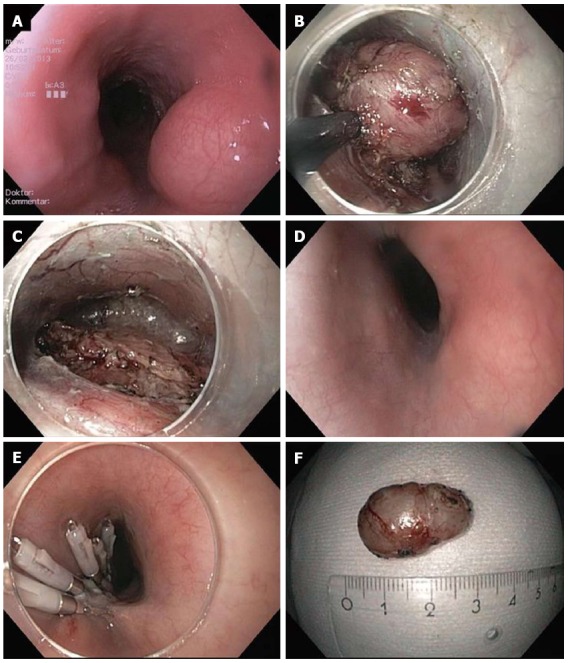
Figure 1
Figure 1
Submucosal endoscopic tumor resection/tunneling technique. A: Endoscopic image of lumen obstruction subepithelial tumor in the proximal esophagus in a 42 years old woman with dysphagia; B: After preparing the submucosal tunnel, the tumor gets visible and is enucleated in endoscopic submucosal dissection-technique with a TT knife. The tumor was arising from the muscularis propria; C: Resection site (endoscope in the submucosal tunnel). The muscularis propria is excised/perforated; D: Resection site (endoscope in the esophageal lumen. Intact mucosa completely covers the muscular perforation; E: The mucosal incision (about 5 cm proximal tot he resection site) was closed with standard clips; F: Resection specimen. Histological examination revealed a Leiomyoma, which had been R0-resected.
Figure 2
Figure 2
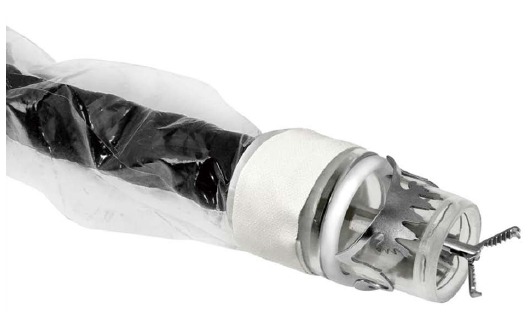
FTRD (Full Thickness Resection Device, Ovesco Endoscopy, Tübingen Germany). The device is assembled on a standard colonoscope. It consists of 14 mm modified over-the-scope clips which is mounted on a long transparent cap. A monofilament snare is preloaded in the tip of the cap. The handle of the snare runs on the outer surface of the endoscope underneath a transparent sheath. A grasping forceps or a tissue anchor can be advanced through the working channel of the endoscope.
Figure 3
Figure 3
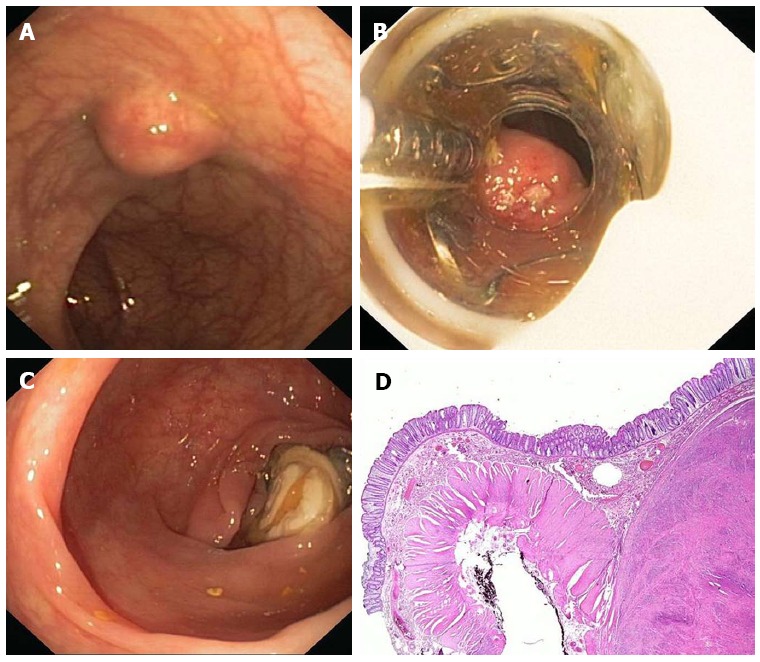
Endoscopic full thickness resection with the FTRD. A: A 75 years old woman presented with a 1.5 cm subepithelial tumor in the descending colon; B: Endoscopic view with the FTRD mounted on a standard colonoscope; C: Resection site after endoscopic full thickness resection. The over-the-scope clips secures colonic wall patency; D: Histologic image (HE-staining) of the resection specimen showing one lateral resection margin. Note the cross-sectional view of the whole colonic wall on the left side. The tumor (leiomyoma) is shown on the right.
Figure 4
Figure 4
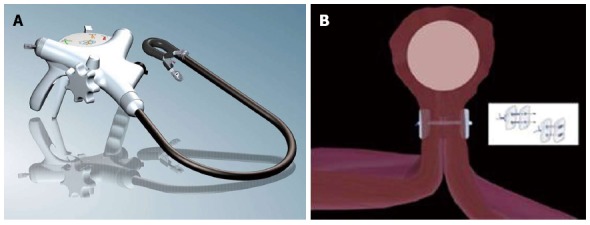
Endoscopic full thickness suturing. A: The GERDX suturing device (G-Surg, Seeon, Germany); B: Schematic illustration of full thickness suturing. Application of PTFE-pledgeted sutures underneath the tumor creates a gastric wall duplication with serosa-to-serosa apposition.
Figure 5
Figure 5
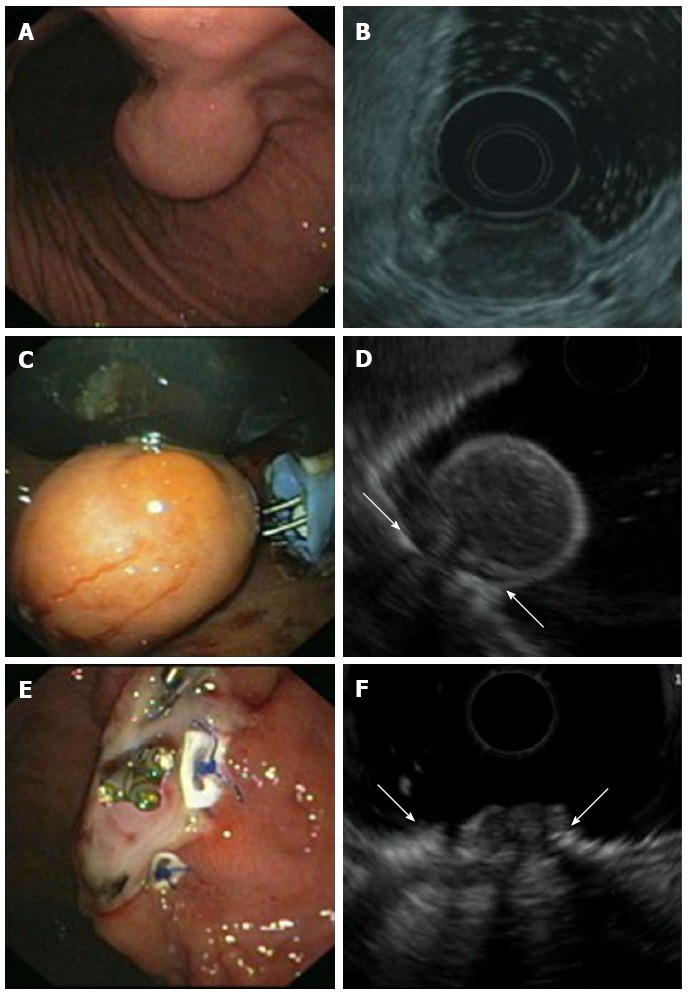
Endoscopic full thickness resection of gastric gastrointestinal stromal tumors after transmural suturing. A: Subepithelial tumor in the gastric corpus; B: Endoscopic ultrasound (EUS) showed a hypoechoic tumor originating from the muscularis propria with a maximum diameter of 27 mm; C: Two transmural sutures underneath the tumor were applied using the PlicatorTM suturing device; D: EUS image of the pseudopolyp after suturing. Arrows are indicating the sutures; E: The tumor was resected with a snare above the sutures. The transmural PTFE-pledgeted sutures are securing gastric wall patency. Resection was macroscopically complete; F: EUS image of the resection site. Arrows are indicating the sutures. There was no evidence of residual tumor.

References

    1. Kim GH. Endoscopic resection of subepithelial tumors. Clin Endosc. 2012;45:240–244. - PMC - PubMed
    1. Polkowski M. Endoscopic ultrasound and endoscopic ultrasound-guided fine-needle biopsy for the diagnosis of malignant submucosal tumors. Endoscopy. 2005;37:635–645. - PubMed
    1. Eckardt AJ, Adler A, Gomes EM, Jenssen C, Siebert C, Gottschalk U, Koch M, Röcken C, Rösch T. Endosonographic large-bore biopsy of gastric subepithelial tumors: a prospective multicenter study. Eur J Gastroenterol Hepatol. 2012;24:1135–1144. - PubMed
    1. Kim GH, Park do Y, Kim S, Kim DH, Kim DH, Choi CW, Heo J, Song GA. Is it possible to differentiate gastric GISTs from gastric leiomyomas by EUS? World J Gastroenterol. 2009;15:3376–3381. - PMC - PubMed
    1. Sepe PS, Brugge WR. A guide for the diagnosis and management of gastrointestinal stromal cell tumors. Nat Rev Gastroenterol Hepatol. 2009;6:363–371. - PubMed