Technique for minimizing and treating driveline infections
- PMID: 25512894
- PMCID: PMC4250551
- DOI: 10.3978/j.issn.2225-319X.2014.09.08
Technique for minimizing and treating driveline infections
Abstract
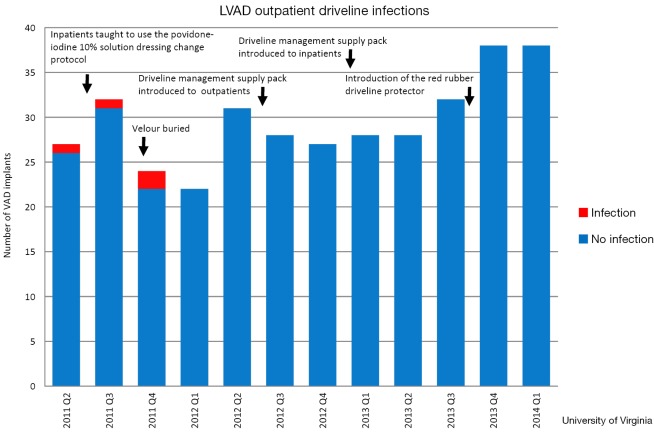
Left ventricular assist devices (LVADs) are increasingly utilized in the management of advanced heart failure. A transcutaneous driveline is necessary to power the LVAD, and although this technology has improved over the years in terms of smaller size and increased durability, driveline complications continue to develop in up to 20% of all devices implanted. Driveline infections are associated with significant morbidity and mortality. As more patients live longer with ventricular assist devices, minimizing driveline infections is paramount. A systematic, multidisciplinary approach can be used to develop a strategy to prevent, recognize and treat driveline infections. In this paper, we describe our approach to driveline management which has resulted in zero driveline infections between January 2012 and March 2014.
Keywords: Circulatory support; heart failure; perioperative care; quality care management.
Figures
References
-
- Miller LW. Left ventricular assist devices are underutilized. Circulation 2011;123:1552-8; discussion 1558. - PubMed
-
- Sharma V, Deo SV, Stulak JM, et al. Driveline infections in left ventricular assist devices: implications for destination therapy. Ann Thorac Surg 2012;94:1381-6. - PubMed
-
- CDC/NHCS. National Hospital Discharge Survey 2000-2010.
-
- Rose EA, Gelijns AC, Moskowitz AJ, et al. Long-term use of a left ventricular assist device for end-stage heart failure. N Engl J Med 2001;345:1435-43. - PubMed
-
- Miller LW, Pagani FD, Russell SD, et al. Use of a continuous-flow device in patients awaiting heart transplantation. N Engl J Med 2007;357:885-96. - PubMed
Publication types
LinkOut - more resources
Full Text Sources
Other Literature Sources
Research Materials