


Synthesis of Au/graphene oxide composites for selective and sensitive electrochemical detection of ascorbic acid
- PMID: 25515430
- PMCID: PMC4268635
- DOI: 10.1038/srep07515
Synthesis of Au/graphene oxide composites for selective and sensitive electrochemical detection of ascorbic acid
Abstract
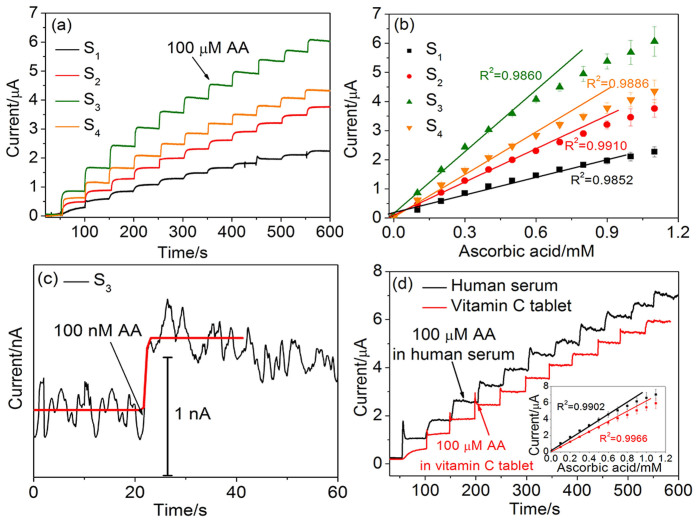
In this work, we present a novel ascorbic acid (AA) sensor applied to the detection of AA in human sera and pharmaceuticals. A series of Au nanoparticles (NPs) and graphene oxide sheets (Au NP/GO) composites were successfully synthesized by reduction of gold (III) using sodium citrate. Then the Au NP/GO composites were used to construct nonenzymatic electrodes in practical AA measurement. The electrode that has the best performance presents attractive analytical features, such as a low working potential of +0.15 V, a high sensitivity of 101.86 μA mM(-1) cm(-2) to AA, a low detection limit of 100 nM, good reproducibility and excellent selectivity. And more,it was also employed to accurately and practically detect AA in human serum and clinical vitamin C tablet with the existence of some food additive. The enhanced AA electrochemical properties of the Au NP/GO modified electrode in our work can be attributed to the improvement of electroactive surface area of Au NPs and the synergistic effect from the combination of Au NPs and GO sheets. This work shows that the Au NP/GO/GCEs hold the prospect for sensitive and selective determination of AA in practical clinical application.
Figures
References
-
- Agius F. et al. Engineering increased vitamin C levels in plants by overexpression of a D-galacturonic acid reductase. Nat. Biotechnol. 21, 177–181 (2003). - PubMed
-
- Green M. & Fry S. Vitamin C degradation in plant cells via enzymatic hydrolysis of 4-O-oxalyl-L-threonate. Nature 433, 83–87 (2005). - PubMed
-
- Padayatty S. J. et al. Vitamin C as an antioxidant: Evaluation of its role in disease prevention. J. Am. Coll. Nutr. 22, 18–35 (2003). - PubMed
-
- Yang J. J., Wu J. Z. & Qiao C. H. Expedient Synthesis of Epigoitrin from L-Ascorbic Acid. Synthetic Commun. 44, 1240–1244 (2014).
-
- Bautista-Ortega J., Cortes-Cuevas A., Ellis E. A. & Ruiz-Feria C. A. Supplemental (L)-arginine and vitamins E and C preserve xanthine oxidase activity in the lung of broiler chickens grown under hypobaric hypoxia. Poultry Sci. 93, 979–988 (2014). - PubMed
Publication types
MeSH terms
Substances
LinkOut - more resources
Full Text Sources
Other Literature Sources
Medical
Molecular Biology Databases
Miscellaneous
