


Fixed dose artesunate amodiaquine - a phase IIb, randomized comparative trial with non-fixed artesunate amodiaquine
- PMID: 25515698
- PMCID: PMC4302156
- DOI: 10.1186/1475-2875-13-498
Fixed dose artesunate amodiaquine - a phase IIb, randomized comparative trial with non-fixed artesunate amodiaquine
Abstract
Background: Pharmacokinetic (PK) and pharmacodynamic (PD) data are limited for artesunate (AS) and amodiaquine (AQ) in uncomplicated Plasmodium falciparum.
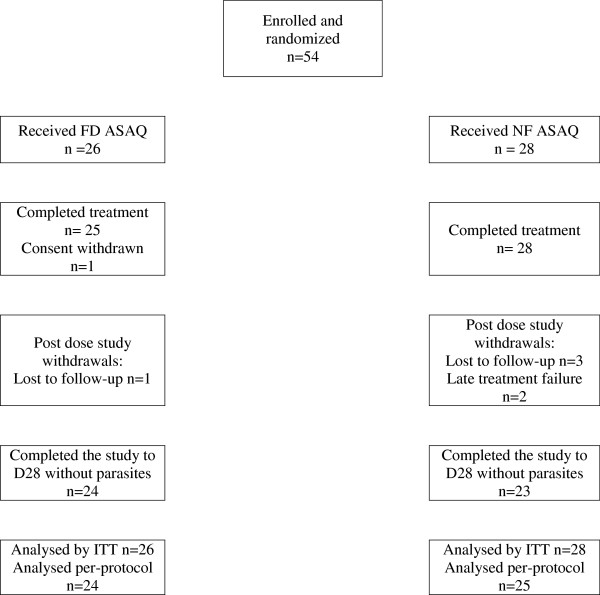
Methods: From 2007-8, 54 P. falciparum-infected, Kenyan adults were assigned randomly fixed dose (FD) ASAQ (n = 26) or non-fixed (NF) ASAQ (n = 28). Total doses were 600 mg AS (both arms) + 1,620 mg (FD) or 1,836 mg (NF)AQ. Follow-up extended over 28 days. PK data were collected for AS, dihydroartemisinin (DHA), AS + DHA combined as DHA equivalents (DHAeq), AQ, desethylamodiaquine (DAQ),and their relationships assessed against the PD collected data consisting of parasitological efficacy, adverse events (AEs), and the Bazett's corrected QTinterval (QTcB).
Results: Mean AUC 0-72 of dihydroartemisinin equivalents (DHAeq) when administered as a fixed dose (FD) compared to NF dose were similar: 24.2 ±4.6 vs 26.4±6.9 µmol*h/L (p = 0.68) Parasite clearance rates were also similar after 24 hrs: 17/25 (68%) vs 18/28(64.3%) (p = 0.86),as well as at 48 hrs: 25/8 (100%)vs 26 (92.9%)/28 (p = 0.49). Mean FD vs NF DAQ AUC0-28 were 27.6±3.19 vs 32.7±5.53 mg*h/L (p = 0.0005). Two PCR-proven new infections occurred on Day (D) 28 for estimated, in vivo, DAQ minimum inhibitory concentrations of 15.2 and 27.5 ng/mL. Combining the FD and NF arms, the mean QTcB at D2+4 hrs increased significantly (p = 0.0059) vs baseline: 420 vs410 ms (∆ = 9.02 (95% confidence interval 2.72-15.31 ms), explained by falling heart rates, increasing DAQ concentrations and female sex in a general linear mixed effects model. Ten of 108 (9.26%) AEs (5/arm) reported by 37/54 (68.5%) patients were possibly or probably drug related. Severe, asymptomatic neutropaenia developed in 2/47 (4.25%) patients on D28: 574/µL (vsD0: 5,075/µL), and 777/µL (vsD0: 3,778/µL).
Conclusions: Tolerability of both formulations was good. For QTcB, a parameter for ECG modifications, increases were modest and due to rising DAQ concentrations and falling heart rates as malaria resolved. Rapid parasite clearance rates and no resistant infections suggest effective pharmacokinetics of both formulations.
Figures
References
-
- Kiechel JR, Pecoul B. ASAQ, a breakthrough in the fight against malaria. Med Trop (Mars) 2007;67:109–110. - PubMed
-
- Taylor WR, Terlouw DJ, Olliaro PL, White NJ, Brasseur P, ter Kuile FO. Use of weight-for-age-data to optimize tablet strength and dosing regimens for a new fixed-dose artesunate-amodiaquine combination for treating falciparum malaria. Bull World Health Organ. 2006;84:956–964. doi: 10.2471/BLT.06.031492. - DOI - PMC - PubMed
-
- Faucher JF, Aubouy A, Adeothy A, Cottrell G, Doritchamou J, Gourmel B, Houze P, Kossou H, Amedome H, Massougbodji A, Cot M, Deloron P. Comparison of sulfadoxine-pyrimethamine, unsupervised artemether-lumefantrine, and unsupervised artesunate-amodiaquine fixed-dose formulation for uncomplicated Plasmodium falciparum malaria in Benin: a randomized effectiveness noninferiority trial. J Infect Dis. 2009;200:57–65. doi: 10.1086/599378. - DOI - PubMed
Publication types
MeSH terms
Substances
LinkOut - more resources
Full Text Sources
Other Literature Sources
Research Materials
