


Trends in CD4 count at presentation to care and treatment initiation in sub-Saharan Africa, 2002-2013: a meta-analysis
- PMID: 25516189
- PMCID: PMC4366582
- DOI: 10.1093/cid/ciu1137
Trends in CD4 count at presentation to care and treatment initiation in sub-Saharan Africa, 2002-2013: a meta-analysis
Abstract
Background: Both population- and individual-level benefits of antiretroviral therapy (ART) for human immunodeficiency virus (HIV) are contingent on early diagnosis and initiation of therapy. We estimated trends in disease status at presentation to care and at ART initiation in sub-Saharan Africa.
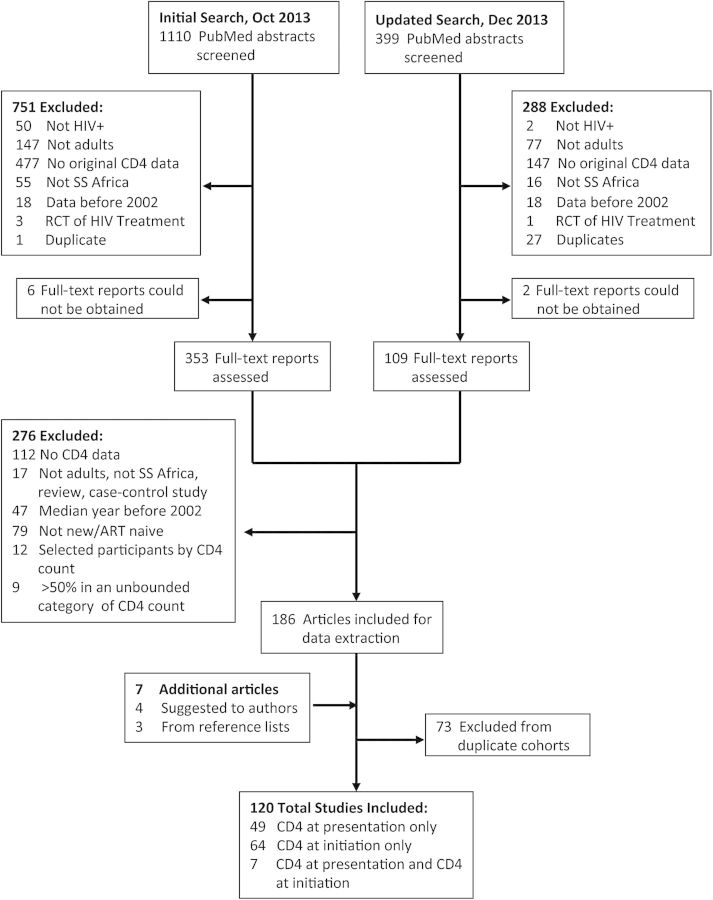
Methods: We searched PubMed for studies published January 2002-December 2013 that reported CD4 cell count at presentation or ART initiation among adults in sub-Saharan Africa. We abstracted study sample size, year(s), and mean CD4 count. A random-effects meta-regression model was used to obtain pooled estimates during each year of the observation period.
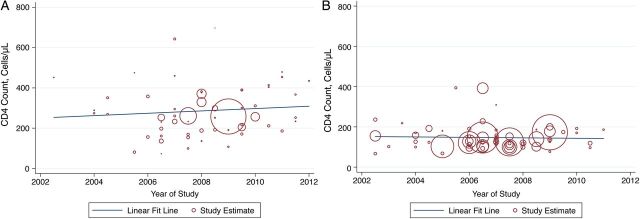
Results: We identified 56 articles reporting CD4 count at presentation (N = 295 455) and 71 articles reporting CD4 count at ART initiation (N = 549 702). The mean estimated CD4 count in 2002 was 251 cells/µL at presentation and 152 cells/µL at ART initiation. During 2002-2013, neither CD4 count at presentation (β = 5.8 cells/year; 95% confidence interval [CI], -10.7 to 22.4 cells/year), nor CD4 count at ART initiation (β = -1.1 cells/year; 95% CI, -8.4 to 6.2 cells/year) increased significantly. Excluding studies of opportunistic infections or prevention of mother-to-child transmission did not alter our findings. Among studies conducted in South Africa (N = 14), CD4 count at presentation increased by 39.9 cells/year (95% CI, 9.2-70.2 cells/year; P = .02), but CD4 count at ART initiation did not change.
Conclusions: CD4 counts at presentation to care and at ART initiation in sub-Saharan Africa have not increased over the past decade. Barriers to presentation, diagnosis, and linkage to HIV care remain major challenges that require attention to optimize population-level benefits of ART.
Keywords: HIV/AIDS; antiretroviral therapy; linkage to care; meta-analysis; sub-Saharan Africa.
© The Author 2014. Published by Oxford University Press on behalf of the Infectious Diseases Society of America. All rights reserved. For Permissions, please e-mail: journals.permissions@oup.com.
Figures
Comment in
-
Editorial commentary: immunodeficiency at start of antiretroviral therapy: the persistent problem of late presentation to care.Clin Infect Dis. 2015 Apr 1;60(7):1128-30. doi: 10.1093/cid/ciu1138. Epub 2014 Dec 16. Clin Infect Dis. 2015. PMID: 25516184 Free PMC article. No abstract available.
-
CD4 Cell Counts at Antiretroviral Therapy Initiation in Botswana Have Been Increasing.Clin Infect Dis. 2016 Mar 1;62(5):669-70. doi: 10.1093/cid/civ965. Epub 2015 Dec 13. Clin Infect Dis. 2016. PMID: 26668340 Free PMC article. No abstract available.
-
Reply to Okatch et al.Clin Infect Dis. 2016 Mar 1;62(5):670-1. doi: 10.1093/cid/civ969. Epub 2015 Dec 13. Clin Infect Dis. 2016. PMID: 26668342 Free PMC article. No abstract available.
References
-
- United Nations Joint Programme on HIV/AIDS. UNAIDS report on the global AIDS epidemic. 2013. Available at: http://www.unaids.org/en/media/unaids/contentassets/documents/epidemiolo.... Accessed 17 March 2014.
Publication types
MeSH terms
Substances
Grants and funding
LinkOut - more resources
Full Text Sources
Other Literature Sources
Medical
Research Materials
Miscellaneous
