


Re-evaluation of the immunological Big Bang
- PMID: 25517375
- PMCID: PMC4354883
- DOI: 10.1016/j.cub.2014.09.070
Re-evaluation of the immunological Big Bang
Abstract
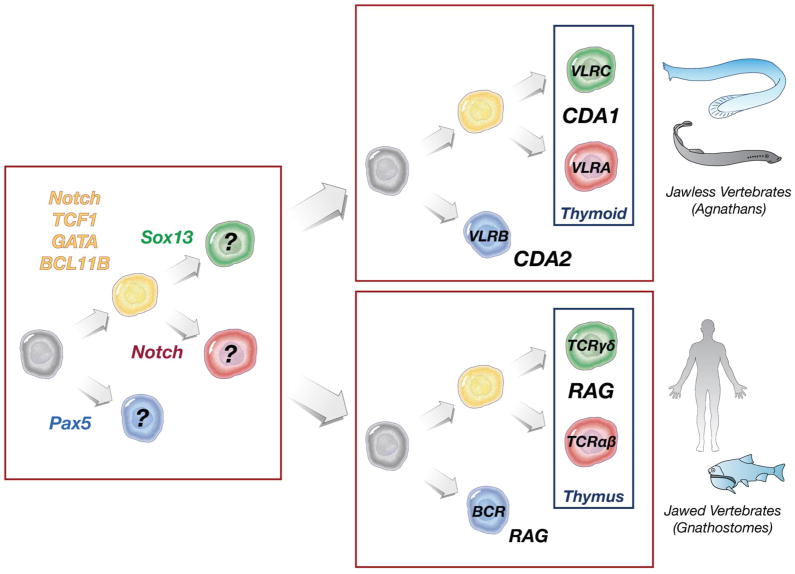
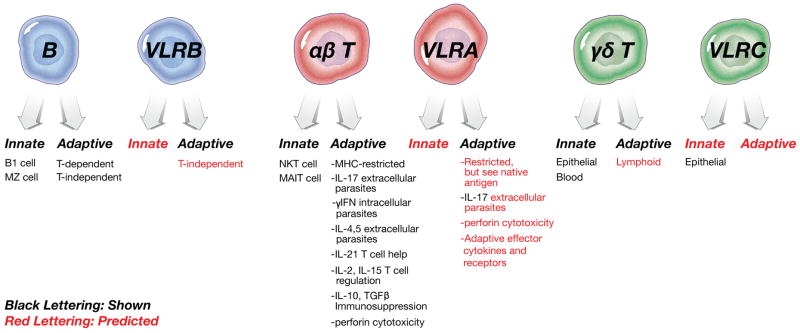
Classically the immunological 'Big Bang' of adaptive immunity was believed to have resulted from the insertion of a transposon into an immunoglobulin superfamily gene member, initiating antigen receptor gene rearrangement via the RAG recombinase in an ancestor of jawed vertebrates. However, the discovery of a second, convergent adaptive immune system in jawless fish, focused on the so-called variable lymphocyte receptors (VLRs), was arguably the most exciting finding of the past decade in immunology and has drastically changed the view of immune origins. The recent report of a new lymphocyte lineage in lampreys, defined by the antigen receptor VLRC, suggests that there were three lymphocyte lineages in the common ancestor of jawless and jawed vertebrates that co-opted different antigen receptor supertypes. The transcriptional control of these lineages during development is predicted to be remarkably similar in both the jawless (agnathan) and jawed (gnathostome) vertebrates, suggesting that an early 'division of labor' among lymphocytes was a driving force in the emergence of adaptive immunity. The recent cartilaginous fish genome project suggests that most effector cytokines and chemokines were also present in these fish, and further studies of the lamprey and hagfish genomes will determine just how explosive the Big Bang actually was.
Copyright © 2014 Elsevier Ltd. All rights reserved.
Figures
References
Publication types
MeSH terms
Grants and funding
LinkOut - more resources
Full Text Sources
Other Literature Sources
Miscellaneous
