


Comment
doi: 10.1016/j.immuni.2014.11.005.
Epub 2014 Nov 20.
Balance and imbalance in the immune system: life on the edge
Affiliations
- PMID: 25517610
- PMCID: PMC4710093
- DOI: 10.1016/j.immuni.2014.11.005
Item in Clipboard
Comment
Balance and imbalance in the immune system: life on the edge
Immunity.
.
Abstract
CTLA-4 is a key immune checkpoint in maintaining self-tolerance, which can be co-opted by cancer to evade immune attack. In Science, Kuehn et al. (2014) describe clinical manifestations from inherited heterozygous CTLA4 mutations, and some are reminiscent of immune-related consequences from anti-CTLA-4 cancer therapy.
Copyright © 2014 Elsevier Inc. All rights reserved.
Figures
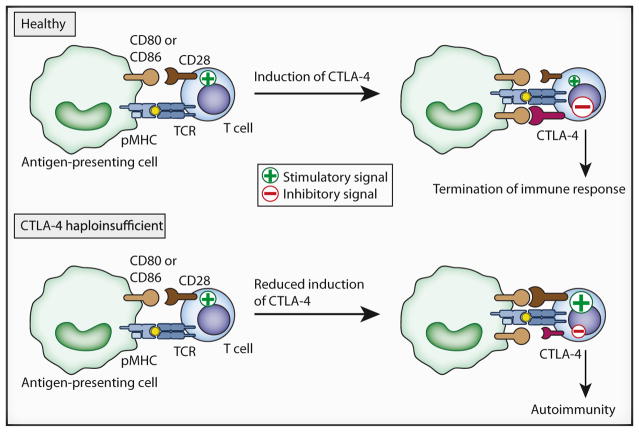
In naive T lymphocytes from healthy CTLA4+/+ individuals, TCR signaling in response to cognate antigen is accompanied by CD28 costimulation, resulting in the rapid induction of inhibitory CTLA-4 coreceptors on the cell surface. CTLA-4 has a higher affinity for the ligands CD80 and CD86 than for CD28. Therefore, a switch to negative signaling occurs to inhibit T cell activation and appropriately conclude the immune response. In contrast, CTLA-4-haploinsufficient patients express reduced levels of CTLA-4 on activated T effector cells. This alters the balance between stimulatory CD28 and inhibitory CTLA-4 signals, sustaining the activation and proliferation of antigen-specific T cells and leading to autoimmunity. pMHC, peptide major histocompatibility complex.
Comment on
-
Immune dysregulation in human subjects with heterozygous germline mutations in CTLA4.Science. 2014 Sep 26;345(6204):1623-1627. doi: 10.1126/science.1255904. Epub 2014 Sep 11. Science. 2014. PMID: 25213377 Free PMC article.
References
-
- Leach DR, Krummel MF, Allison JP. Science. 1996;271:1734–1736. - PubMed
Publication types
MeSH terms
Substances
Grants and funding
LinkOut - more resources
Full Text Sources
Other Literature Sources
Medical
