Review
. 2015;38(2):95-104.
doi: 10.14348/molcells.2015.2298. Epub 2014 Dec 16.

Are macrophages in tumors good targets for novel therapeutic approaches?

Affiliations
Review

Are macrophages in tumors good targets for novel therapeutic approaches?

Samthosh V Alahari et al. Mol Cells. 2015.

Abstract

The development of cancer has been an extensively researched topic over the past few decades. Although great strides have been made in cancer prevention, diagnosis, and treatment, there is still much to be learned about cancer's micro-environmental mechanisms that contribute to cancer formation and aggressiveness. Macrophages, lymphocytes which originate from monocytes, are involved in the inflammatory response and often dispersed to areas of infection to fight harmful antigens and mutated cells in tissues. Macrophages have a plethora of roles including tissue development and repair, immune system functions, and inflammation. We discuss various pathways by which macrophages get activated, various approaches that can regulate the function of macrophages, and how these approaches can be helpful in developing new cancer therapies.

Keywords: angiogenesis; cancer; invasion; macrophages; microenvironment; migration.


Figures
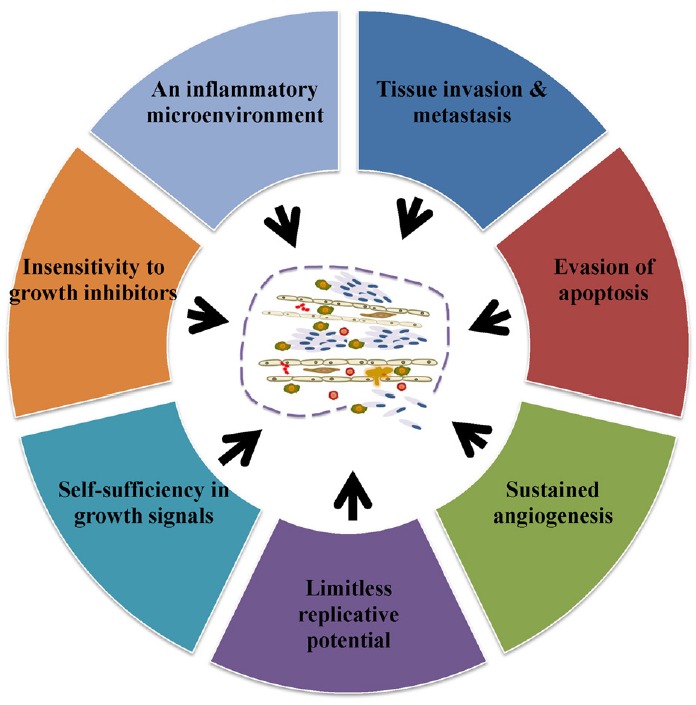
Fig. 1.
Fig. 1.
The major steps involved in cancer. This model depicts essential steps during cancer progression. These steps include continuous replication, developing new blood vessels, self- sufficiency of growth signals, insensitivity to growth inhibitors, formation of inflammatory microenvironment, promotion of tissue invasion and metastasis, and evasion of apoptosis (Adapted from Mantovani, 2009).
Fig. 2.
Fig. 2.
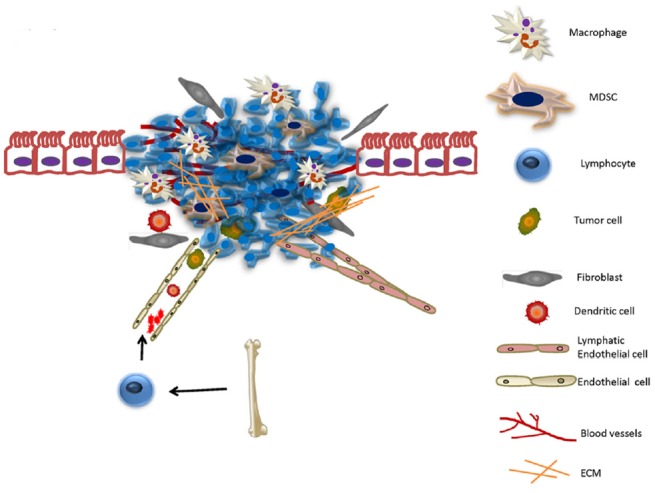
The tumor microenvironment. It is created the moment the tumor becomes attached to a site and encompasses the extracellular matrix surrounding the tumor cell and any non-cancerous cells. This microenvironment is composed of endothelial cells, stromal cells, bone marrow derived cells, macrophages and TIE2-expressing monocytes and myeloid derived suppressor cells.
Fig. 3.
Fig. 3.
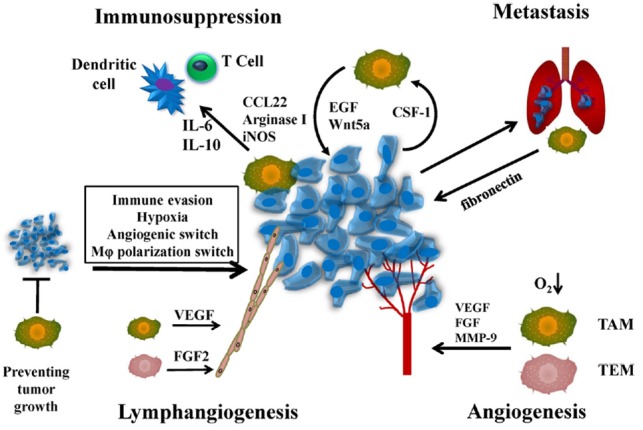
Macrophage functions in the tumor microenvironment with special emphasis on immunosuppression, metastasis, lymphangiogenesis and angiogenesis. During immunosuppression, TAM generated molecules prevent the accumulation of cytotoxic T cells (anti-tumorigenic cells). During metastasis, tumor cells secrete soluble factors that prime specific cells such as macrophages that help in seeding tumor cells at distant locations. In hypoxic areas, TAMs and TEMs (Tie2-expressing monocytes) upregulate several angiogenic factors that promote angiogenesis. During lymphangiogenesis, TAMs secrete various factors that initiate the formation of lymphatics.
Fig. 4.
Fig. 4.
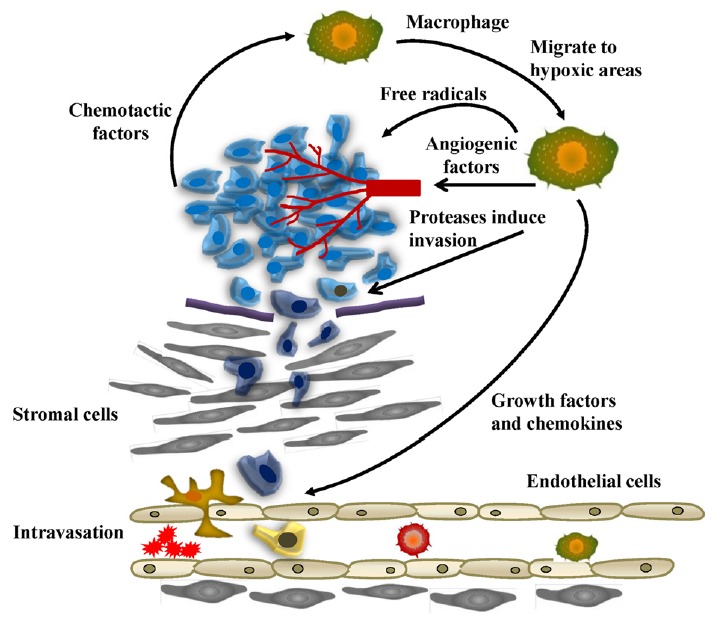
Functions of tumor associated macrophages during tumor cell migration and invasion. Macrophages migrate to hypoxic areas and in turn stimulate angiogenesis with the help of various angiogenic factors. TAMs also promote invasion through the secretion of proteases. Several growth factors and chemokines aid in promoting migration of tumor cells to the vessels, and TAMs can break down the basement membrane as well to promote intravasation.

References

    1. Akaogi J, Yamada H, Kuroda Y, Nacionales DC, Reeves WH, Satoh M. Prostaglandin E2 receptors EP2 and EP4 are up-regulated in peritoneal macrophages and joints of pristane-treated mice and modulate TNF-alpha and IL-6 production. J Leukoc Biol. 2004;76:227–236. - PubMed
    1. Allavena P, Sica A, Solinas G, Porta C, Mantovani A. The inflammatory micro-environment in tumor progression: the role of tumor-associated macrophages. Crit Rev Oncol Hematol. 2008;66:1–9. - PubMed
    1. Bayne LJ, Beatty GL, Jhala N, Clark CE, Rhim AD, Stanger BZ, Vonderheide RH. Tumor-derived granulocyte-macrophage colony-stimulating factor regulates myeloid inflammation and T cell immunity in pancreatic cancer. Cancer Cell. 2012;21:822–835. - PMC - PubMed
    1. Beatty GL, Chiorean EG, Fishman MP, Saboury B, Teitelbaum UR, Sun W, Huhn RD, Song W, Li D, Sharp LL, et al. CD40 agonists alter tumor stroma and show efficacy against pancreatic carcinoma in mice and humans. Science. 2011;331:1612–1616. - PMC - PubMed
    1. Biswas SK, Mantovani A. Macrophage plasticity and interaction with lymphocyte subsets: cancer as a paradigm. Nat Immunol. 2010;11:889–896. - PubMed

Publication types

Substances

LinkOut - more resources