


Recurrent Lower Urinary Tract Infections Have a Detrimental Effect on Patient Quality of Life: a Prospective, Observational Study
- PMID: 25519161
- PMCID: PMC4363217
- DOI: 10.1007/s40121-014-0054-6
Recurrent Lower Urinary Tract Infections Have a Detrimental Effect on Patient Quality of Life: a Prospective, Observational Study
Abstract
Introduction: This study investigated the effects of recurrent urinary tract infections (rUTI) and the impact of prophylaxis on rUTI and patients' quality of life (QoL).
Methods: Altogether, 575 patients affected by rUTI were included in a 6-month observational study. QoL was assessed using the Hospital Anxiety and Depression (HAD) and the Leicester scales. Statistical analyses were performed using SAS® Version 8.2 software (SAS Institute Inc., Cary, NC, USA). The significance level was set at 5%. Spearman correlation was used to assess the degree of correlation between infectious episodes and HAD and Leicester scores. For each parameter, the comparison between Day 0 and Day 180 was performed using Wilcoxon signed-rank test for quantitative data.
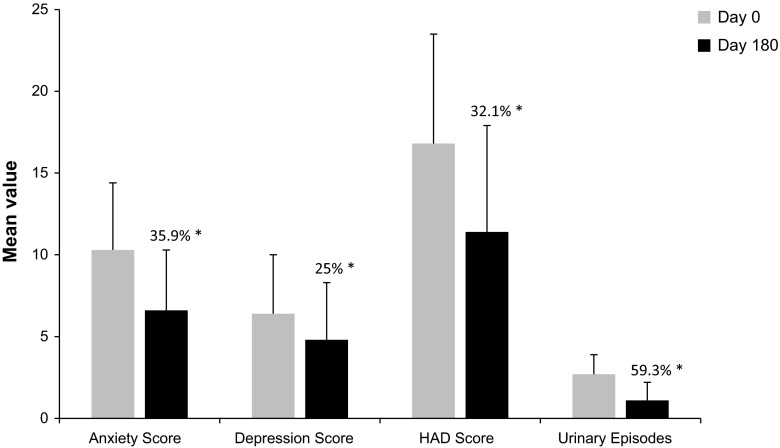
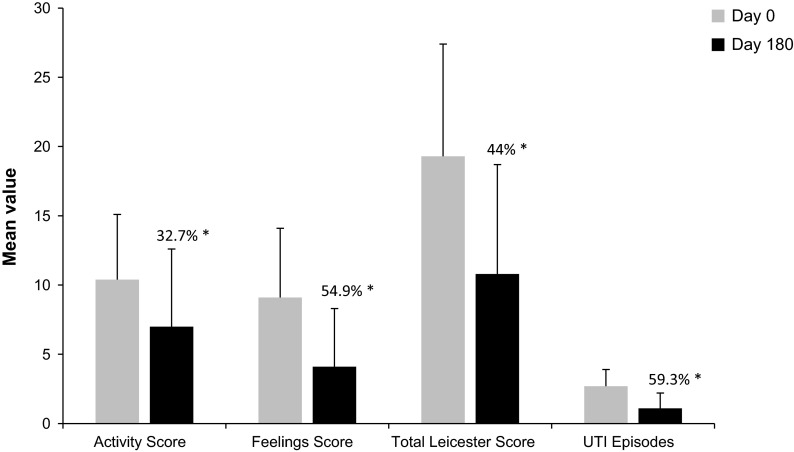
Results: In total, 61.9% of patients suffering from rUTI exhibited some degree of depression at baseline (Day 0). Alternative oral non-antimicrobial prophylactic treatment for rUTI [Escherichia coli lyophilized bacterial lysate (OM-89)] was administered to 94.4% of patients (1 capsule a day for 90 days), followed by a 3-month treatment-free period. At the end of the study (Day 180), the mean number of UTI decreased by 59.3% (P ≤ 0.0001), the total HAD score decreased by 32.1% (P ≤ 0.0001), and the mean Leicester score decreased by 44.0% (P ≤ 0.0001) from baseline. There was a correlation trend between the reduction in the numbers of UTI at the end of the study compared to the 6 months prior to study entry and the reduction in the anxiety, depression, total HAD scores, activity, feeling, and total Leicester scores registered from Day 0 to Day 180, suggesting a lessening of emotional problems, and social and functional handicaps with decreasing UTI incidence.
Conclusions: This study showed that rUTI had a negative impact on patients' QoL and that effective alternative prophylaxis significantly improved their QoL.
Figures
References
-
- Grabe M, Bjerklund-Johansen TE, Botto H, et al. European Association of Urology guidelines on urological infections. 2010. http://www.uroweb.org. Accessed April 1, 2010.
-
- McCue JD. UTIs in at-risk patients: are they ‘complicated’? Infect Med. 1999;16:533–540.
LinkOut - more resources
Full Text Sources
Other Literature Sources
