


Relationship between circulating tumor cells and tumor response in colorectal cancer patients treated with chemotherapy: a meta-analysis
- PMID: 25519477
- PMCID: PMC4302148
- DOI: 10.1186/1471-2407-14-976
Relationship between circulating tumor cells and tumor response in colorectal cancer patients treated with chemotherapy: a meta-analysis
Abstract
Background: The prognostic value of circulating tumor cells (CTCs) in colorectal cancer (CRC) patients and their value in predicting tumor response to chemotherapy are controversial. The aim of this meta-analysis was to assess the prognostic and predictive value of CTCs in CRC patients treated with chemotherapy.
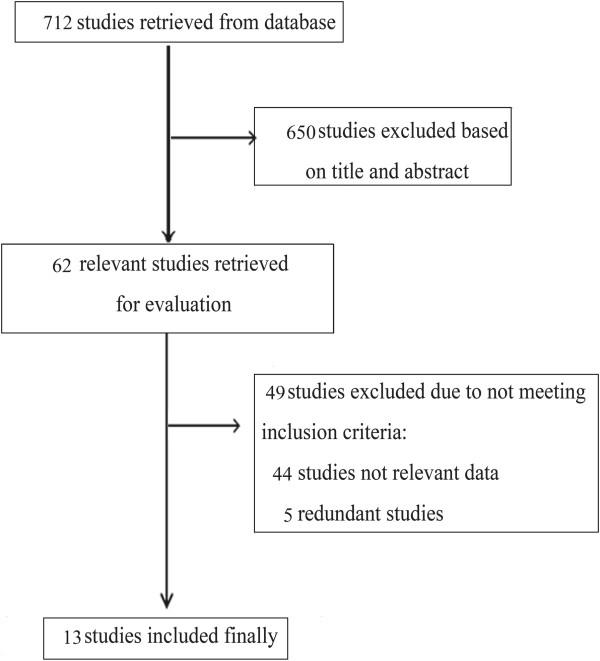
Methods: A comprehensive literature search for relevant studies was conducted in PubMed, Embase, the Cochrane Database, the Science Citation Index and the Ovid Database, and the reference lists of relevant studies were also perused for other relevant studies (up to April, 2014). Using the random-effects model in Stata software, version 12.0, the meta-analysis was performed using odds ratios (ORs), risk ratios (RRs), hazard ratios (HRs) and 95% confidence intervals (CIs) as effect measures. Subgroup and sensitivity analyses were also performed.
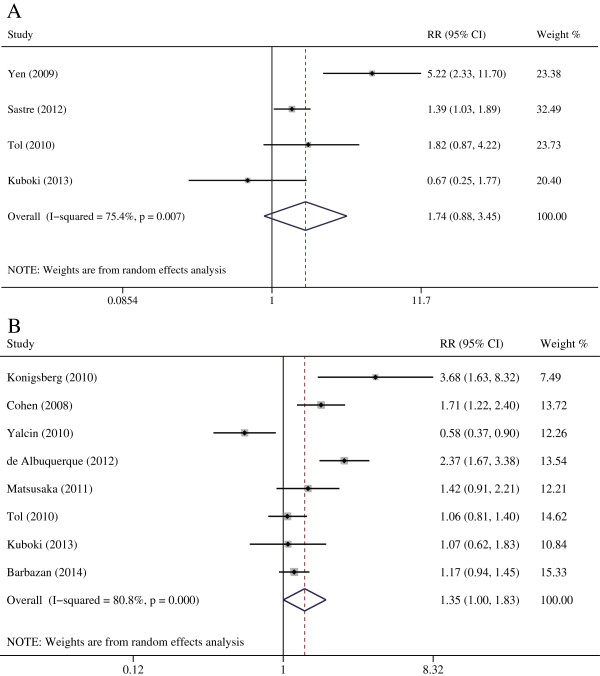
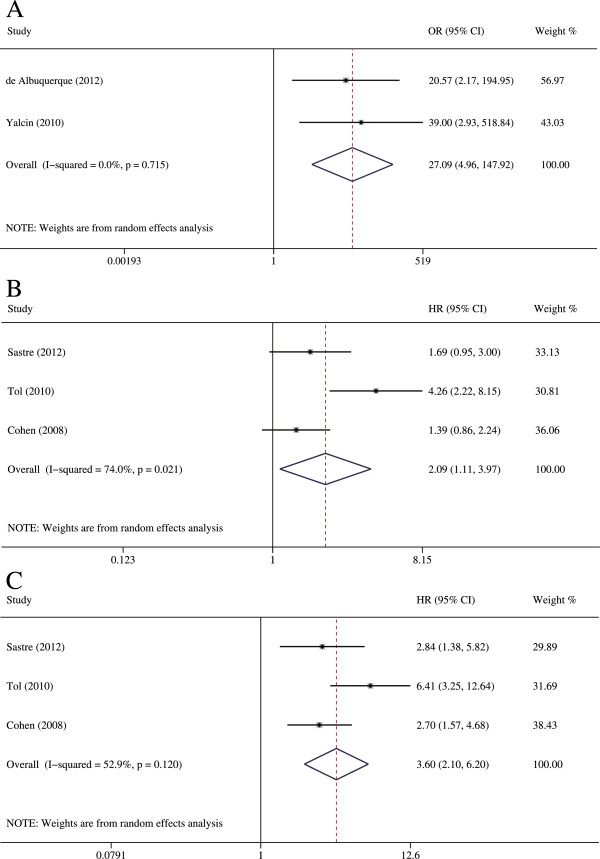
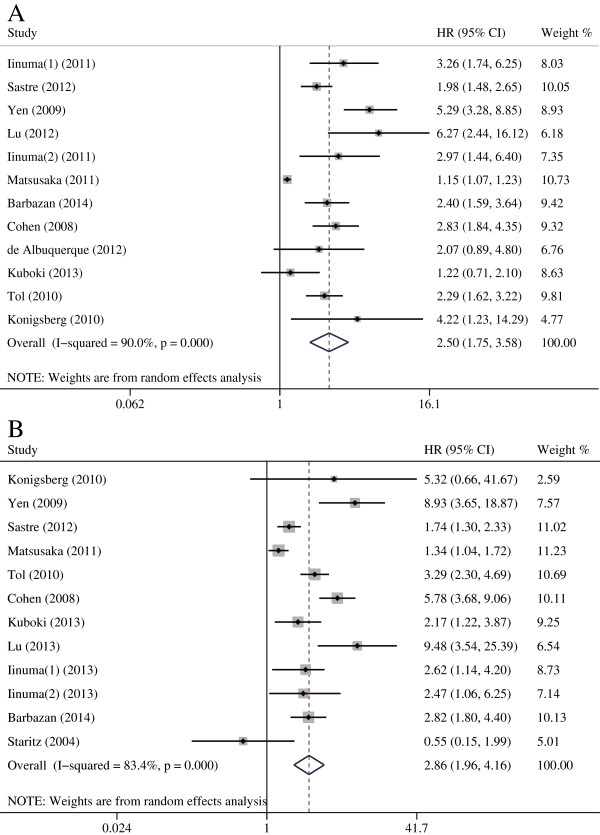
Results: Thirteen eligible studies were included. Our meta-analysis indicated that the disease control rate was significantly higher in CRC patients with CTC-low compared with CTC-high (RR = 1.354, 95% CI [1.002-1.830], p = 0.048). CRC patients in the CTC-high group were significantly associated with poor progression-free survival (PFS; HR = 2.500, 95% CI [1.746-3.580], p < 0.001) and poor overall survival (OS; HR = 2.856, 95% CI [1.959-4.164], p < 0.001). Patients who converted from CTC-low to CTC-high or who were persistently CTC-high had a worse disease progression (OR = 27.088, 95% CI [4.960-147.919], p < 0.001), PFS (HR = 2.095, 95% CI [1.105-3.969], p = 0.023) and OS (HR = 3.604, 95% CI [2.096-6.197], p < 0.001) than patients who converted from CTC-high to CTC-low.
Conclusions: Our meta-analysis indicates that CTCs are associated with prognosis in CRC patients treated with chemotherapy. Moreover, CTCs could provide additional prognostic information to tumor radiographic imaging and might be used as a surrogate and novel predictive marker for the response to chemotherapy.
Figures
References
-
- Koopman M, Antonini NF, Douma J, Wals J, Honkoop AH, Erdkamp FL, de Jong RS, Rodenburg CJ, Vreugdenhil G, Loosveld OJ, van Bochove A, Sinnige HA, Creemers GJ, Tesselaar ME, Slee PH, Werter MJ, Mol L, Dalesio O, Punt CJ. Sequential versus combination chemotherapy with capecitabine, irinotecan, and oxaliplatin in advanced colorectal cancer (CAIRO): a phase III randomised controlled trial. Lancet. 2007;370(9582):135–142. doi: 10.1016/S0140-6736(07)61086-1. - DOI - PubMed
-
- Seymour MT, Maughan TS, Ledermann JA, Topham C, James R, Gwyther SJ, Smith DB, Shepherd S, Maraveyas A, Ferry DR, Meade AM, Thompson L, Griffiths GO, Parmar MK, Stephens RJ. Different strategies of sequential and combination chemotherapy for patients with poor prognosis advanced colorectal cancer (MRC FOCUS): a randomised controlled trial. Lancet. 2007;370(9582):143–152. doi: 10.1016/S0140-6736(07)61087-3. - DOI - PubMed
-
- Sobrero AF, Maurel J, Fehrenbacher L, Scheithauer W, Abubakr YA, Lutz MP, Vega-Villegas ME, Eng C, Steinhauer EU, Prausova J, Lenz HJ, Borg C, Middleton G, Kröning H, Luppi G, Kisker O, Zubel A, Langer C, Kopit J, Burris HA., 3rd EPIC: phase III trial of cetuximab plus irinotecan after fluoropyrimidine and oxaliplatin failure in patients with metastatic colorectal cancer. J Clin Oncol. 2008;26(14):2311–2319. doi: 10.1200/JCO.2007.13.1193. - DOI - PubMed
-
- Zinser-Sierra JW, Rodriguez-Ramirez S, Villalobos-Valencia R, Ramirez-Marquez M. Use of bevacizumab in metastatic colorectal cancer: report from the Mexican opinion and analysis forum on colorectal cancer treatment with bevacizumab (September 2009) Drugs R&D. 2011;11(2):101–111. doi: 10.2165/11590440-000000000-00000. - DOI - PMC - PubMed
Pre-publication history
-
- The pre-publication history for this paper can be accessed here:http://www.biomedcentral.com/1471-2407/14/976/prepub
Publication types
MeSH terms
Substances
LinkOut - more resources
Full Text Sources
Other Literature Sources
Medical
Miscellaneous
