


Smoothened goes molecular: new pieces in the hedgehog signaling puzzle
- PMID: 25519909
- PMCID: PMC4319017
- DOI: 10.1074/jbc.R114.617936
Smoothened goes molecular: new pieces in the hedgehog signaling puzzle
Abstract
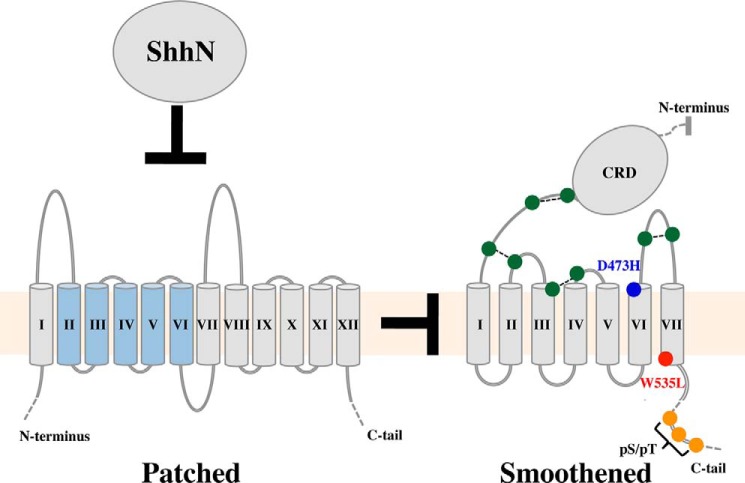
A general aim of studies of signal transduction is to identify mediators of specific signals, order them into pathways, and understand the nature of interactions between individual components and how these interactions alter pathway behavior. Despite years of intensive study and its central importance to animal development and human health, our understanding of the Hedgehog (Hh) signaling pathway remains riddled with gaps, question marks, assumptions, and poorly understood connections. In particular, understanding how interactions between Hh and Patched (Ptc), a 12-pass integral membrane protein, lead to modulation of the function of Smoothened (Smo), a 7-pass integral membrane protein, has defied standard biochemical characterization. Recent structural and biochemical characterizations of Smoothened domains have begun to unlock this riddle, however, and lay the groundwork for improved cancer therapies.
Keywords: Cancer; Cell Signaling; Cholesterol; Development; G Protein-coupled Receptor (GPCR); Hedgehog Signaling Pathway; Patched (Ptc); Smoothened (Smo); Sonic Hedgehog (Shh); Sterol.
© 2015 by The American Society for Biochemistry and Molecular Biology, Inc.
Figures
References
-
- Nüsslein-Volhard C., Wieschaus E. (1980) Mutations affecting segment number and polarity in Drosophila. Nature 287, 795–801 - PubMed
-
- Ingham P. W., Nakano Y., Seger C. (2011) Mechanisms and functions of Hedgehog signalling across the metazoa. Nat. Rev. Genet. 12, 393–406 - PubMed
-
- Briscoe J., Thérond P. P. (2013) The mechanisms of Hedgehog signalling and its roles in development and disease. Nat. Rev. Mol. Cell Biol. 14, 416–429 - PubMed
-
- Arwert E. N., Hoste E., Watt F. M. (2012) Epithelial stem cells, wound healing and cancer. Nat. Rev. Cancer 12, 170–180 - PubMed
-
- Heemskerk J., DiNardo S. (1994) Drosophila hedgehog acts as a morphogen in cellular patterning. Cell 76, 449–460 - PubMed
Publication types
MeSH terms
Substances
Associated data
- Actions
- Actions
- Actions
- Actions
- Actions
- Actions
- Actions
- Actions
Grants and funding
LinkOut - more resources
Full Text Sources
Miscellaneous
