


Spatial Situation Models and Text Comprehension
- PMID: 25520531
- PMCID: PMC4266476
- DOI: 10.1080/01638539509544913
Spatial Situation Models and Text Comprehension
Abstract
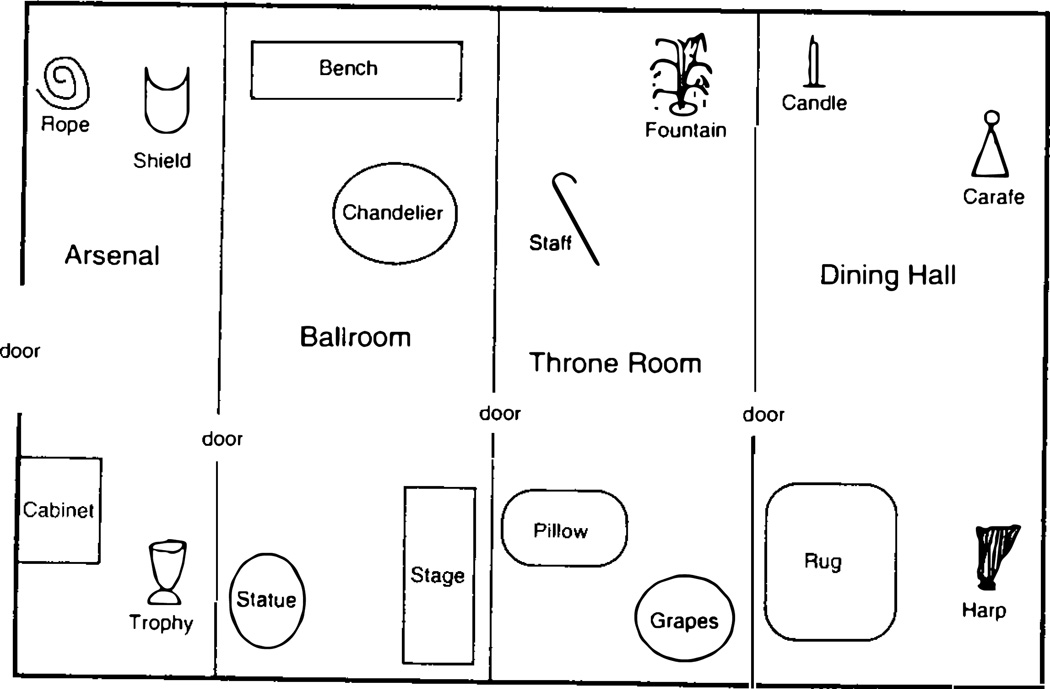
Three experiments examined how readers inferred spatial information that was relevant to a story character's movements through a previously memorized layout of a fictional building relative to various tasks. This study also examined how inference measures were related to spatial imagery and reading comprehension ability. Replicating the spatial separation effect reported by Morrow, Greenspan, and Bower (1987), probed objects were responded to faster when they were located in the same room of a building as the main character of a narrative than when the objects were located in different rooms. Experiment 2 ruled out a simple name-based priming explanation of the spatial separation effect, and Experiment 3 demonstrated a facilitation for objects from the character's target room even when readers were provided with a spatially indeterminate list description of the building. The construction-integration model of text comprehension accounted for the spatial separation effect in terms of variations in the knowledge-integration process. It was concluded that the integration of an enriched knowledge network can facilitate the process of mapping text information onto a developing mental representation of a discourse situation, a process that gains further support from spatial imagery and reading comprehension ability.
Figures


References
-
- Carpenter PA, Just MA. Spatial ability: An information processing approach to psychometrics. In: Sternberg RJ, editor. Advances in the psychology of human intelligence. Vol. 3. Hillsdale, NJ: Erlbaum; 1986. pp. 221–253.
-
- Cunningham AE, Stanovich KE, Wilson MR. Cognitive variation in adult college students differing in reading ability. In: Carr TH, Levy BA, editors. Reading and its development: Component skill approaches. New York: Academic; 1990. pp. 129–159.
-
- Daneman M, Carpenter PA. Individual differences in working memory and reading. Journal of Verbal Learning and Verbal Behavior. 1980;19:450–466.
-
- French JW, Ekstrom RB, Price LA. Kit of reference tests for cognitive factors. Princeton, NJ: Educational Testing Service; 1963.
-
- Gernsbacher MA. Language comprehension as structure building. Hillsdale, NJ: Erlbaum; 1990.
Grants and funding
LinkOut - more resources
Full Text Sources