Systematic literature review of integrated community case management and the private sector in Africa: Relevant experiences and potential next steps
- PMID: 25520804
- PMCID: PMC4267082
- DOI: 10.7189/jogh.04.020414
Systematic literature review of integrated community case management and the private sector in Africa: Relevant experiences and potential next steps
Abstract
Background: Despite substantial investments made over the past 40 years in low income countries, governments cannot be viewed as the principal health care provider in many countries. Evidence on the role of the private sector in the delivery of health services is becoming increasingly available. In this study, we set out to determine the extent to which the private sector has been utilized in providing integrated care for sick children under 5 years of age with community-acquired malaria, pneumonia or diarrhoea.
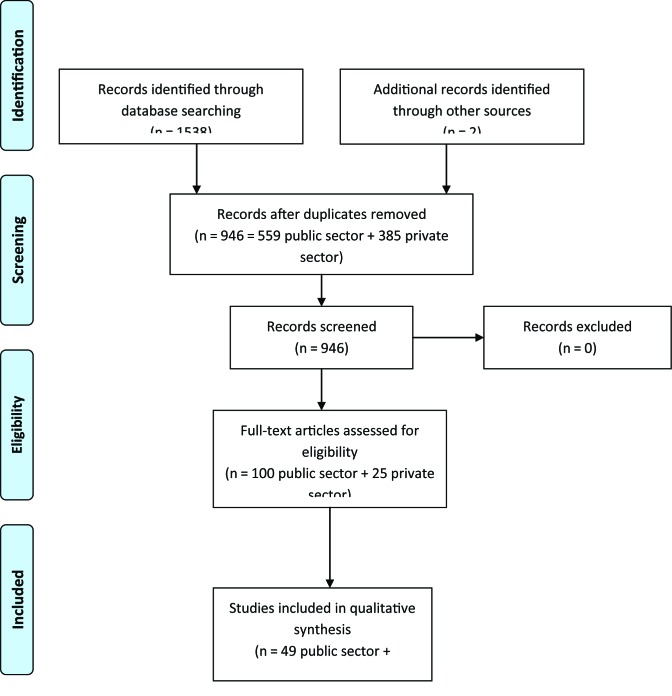
Methods: We reviewed the published literature for integrated community case management (iCCM) related experiences within both the public and private sector. We searched PubMed and Google/Google Scholar for all relevant literature until July 2014. The search terms used were "malaria", "pneumonia", "diarrhoea", "private sector" and "community case management".
Results: A total of 383 articles referred to malaria, pneumonia or diarrhoea in the private sector. The large majority of these studies (290) were only malaria related. Most of the iCCM-related studies evaluated introduction of only malaria drugs and/or diagnostics into the private sector. Only one study evaluated the introduction of drugs and diagnostics for malaria, pneumonia and diarrhoea in the private sector. In contrast, most iCCM-related studies in the public sector directly reported on community case management of 2 or more of the illnesses.
Conclusions: While the private sector is an important source of care for children in low income countries, little has been done to harness the potential of this sector in improving access to care for non-malaria-associated fever in children within the community. It would be logical for iCCM programs to expand their activities to include the private sector to achieve higher population coverage. An implementation research agenda for private sector integrated care of febrile childhood illness needs to be developed and implemented in conjunction with private sector intervention programs.
Figures
References
-
- Walker D, Champion C, Hossain S, Wahed T, Gazi R, Koehlmoos T, et al. Establishing non–state sector research priorities in developing countries using a participatory methodology. Geneva: Alliance for Health Policy and Systems Research and WHO, 2009. Available at: http://www.who.int/alliance-hpsr/projects/alliancehpsr-nonstatepaper.pdf. Accessed: 1 October 2014.
-
- Young M, Wolfheim C, Marsh DR, Hammamy D. World Health Organization/United Nations Children's Fund joint statement on integrated community case management: An equity–focused strategy to improve access to essential treatment services for children. Am J Trop Med Hyg. 2012;87(5) Suppl:6–10. doi: 10.4269/ajtmh.2012.12-0221. - DOI - PMC - PubMed
-
- Littrell M, Gatakaa H, Evance I, Poyer S, Njogu J, Solomon T, et al. Monitoring fever treatment behaviour and equitable access to effective medicines in the context of initiatives to improve ACT access: baseline results and implications for programming in six African countries. Malar J. 2011;10:327. doi: 10.1186/1475-2875-10-327. - DOI - PMC - PubMed
LinkOut - more resources
Full Text Sources
Other Literature Sources
Miscellaneous