


Resilience, Positive Coping, and Quality of Life Among Women Newly Diagnosed With Gynecological Cancers
- PMID: 25521911
- PMCID: PMC4470889
- DOI: 10.1097/NCC.0000000000000215
Resilience, Positive Coping, and Quality of Life Among Women Newly Diagnosed With Gynecological Cancers
Abstract
Background: Resilience has been linked to psychological adaptation to many challenging life events.
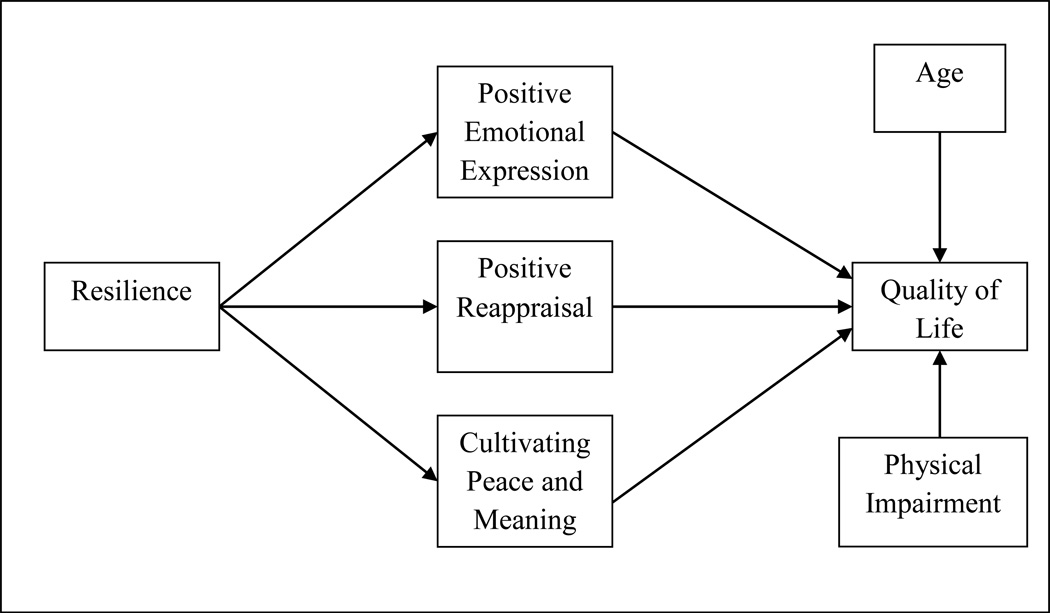
Objective: The goal was to examine 3 coping strategies--expressing positive emotions, positive reframing of the cancer experience, and cultivating a sense of peace and meaning in life--as potential mechanisms by which resilience translates to quality of life among women recently diagnosed with gynecological cancer.
Methods: This cross-sectional study utilized baseline data from women diagnosed with gynecological cancer participating in an ongoing randomized clinical trial (n = 281; mean age, 55 years; 80% were white). Participants completed measures of resilience, positive emotional expression, positive reappraisal, cultivating a sense of peace and meaning, and quality of life. Univariate and multiple mediation analyses were conducted.
Results: Greater resilience was related to higher quality of life (P < .001). Multiple mediation analyses indicated that the coping strategies, as a set, accounted for 62.6% of the relationship between resilience and quality of life. When considered as a set, cultivating a sense of peace and meaning had the strongest indirect effect (b = 0.281, SE = 0.073, P < .05).
Conclusion: The findings suggested that resilient women may report higher quality of life during gynecological cancer diagnosis because they are more likely to express positive emotions, reframe the experience positively, and cultivate a sense of peace and meaning in their lives.
Implications for practice: Interventions promoting a sense of purpose in one's life and facilitating expression of positive emotions may prove beneficial, particularly for women reporting higher levels of resilience.
Conflict of interest statement
The authors have no funding or conflicts of interest to disclose.
Figures
References
-
- Block J, Kremen AM. IQ and ego-resiliency: conceptual and empirical connections and separateness. J Pers Social Psych. 1996;70(2):349–361. - PubMed
-
- Masten AS. Ordinary magic. Resilience processes in development. Am Psych. 2001;56(3):227–238. - PubMed
-
- Richardson GE. The metatheory of resilience and resiliency. J Clin Psych. 2002;58(3):307–321. - PubMed
Publication types
MeSH terms
Grants and funding
LinkOut - more resources
Full Text Sources
