Field evaluation of picaridin repellents reveals differences in repellent sensitivity between Southeast Asian vectors of malaria and arboviruses
- PMID: 25522134
- PMCID: PMC4270489
- DOI: 10.1371/journal.pntd.0003326
Field evaluation of picaridin repellents reveals differences in repellent sensitivity between Southeast Asian vectors of malaria and arboviruses
Abstract
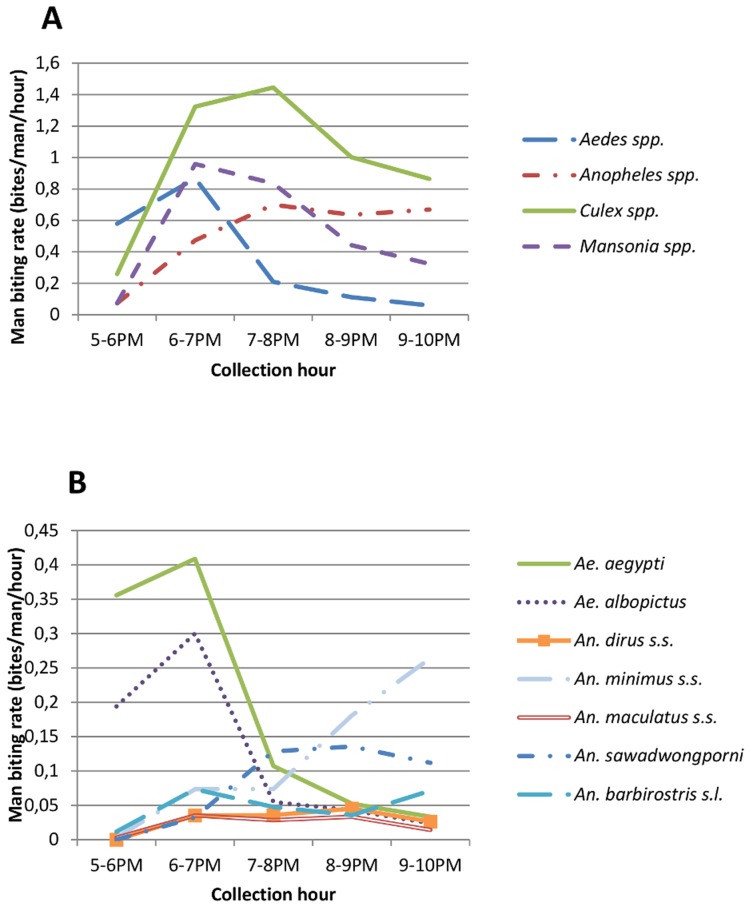
Scaling up of insecticide treated nets has contributed to a substantial malaria decline. However, some malaria vectors, and most arbovirus vectors, bite outdoors and in the early evening. Therefore, topically applied insect repellents may provide crucial additional protection against mosquito-borne pathogens. Among topical repellents, DEET is the most commonly used, followed by others such as picaridin. The protective efficacy of two formulated picaridin repellents against mosquito bites, including arbovirus and malaria vectors, was evaluated in a field study in Cambodia. Over a period of two years, human landing collections were performed on repellent treated persons, with rotation to account for the effect of collection place, time and individual collector. Based on a total of 4996 mosquitoes collected on negative control persons, the overall five hour protection rate was 97.4% [95%CI: 97.1-97.8%], not decreasing over time. Picaridin 20% performed equally well as DEET 20% and better than picaridin 10%. Repellents performed better against Mansonia and Culex spp. as compared to aedines and anophelines. A lower performance was observed against Aedes albopictus as compared to Aedes aegypti, and against Anopheles barbirostris as compared to several vector species. Parity rates were higher in vectors collected on repellent treated person as compared to control persons. As such, field evaluation shows that repellents can provide additional personal protection against early and outdoor biting malaria and arbovirus vectors, with excellent protection up to five hours after application. The heterogeneity in repellent sensitivity between mosquito genera and vector species could however impact the efficacy of repellents in public health programs. Considering its excellent performance and potential to protect against early and outdoor biting vectors, as well as its higher acceptability as compared to DEET, picaridin is an appropriate product to evaluate the epidemiological impact of large scale use of topical repellents on arthropod borne diseases.
Conflict of interest statement
The authors have declared that no competing interests exist.
Figures
References
-
- McGraw EA, O'Neill SL (2013) Beyond insecticides: new thinking on an ancient problem. Nat Rev Microbiol 11: 181–193. - PubMed
-
- Tolle MA (2009) Mosquito-borne diseases. Curr Probl Pediatr Adolesc Health Care 39: 97–140. - PubMed
-
- Gubler DJ (2002) The global emergence/resurgence of arboviral diseases as public health problems. Arch Med Res 33: 330–342. - PubMed
-
- Durnez L, Coosemans M (2013) Residual Transmission of Malaria: An Old Issue for New Approaches. In: Manguin S, editor. Anopheles mosquitoes - New insights into malaria vectors.Intech.pp. 671–704. Available: http://www.intechopen.com/books/anopheles-mosquitoes-new-insights-into-m....
-
- WHO (2013) World Malaria Report 2013. Geneva. Available: http://www.who.int/malaria/publications/world_malaria_report_2013/en/.
Publication types
MeSH terms
Substances
LinkOut - more resources
Full Text Sources
Other Literature Sources
Medical
Research Materials
Miscellaneous