


Evaluation of the individual safe correction of antipsychotic agent polypharmacy in Japanese patients with chronic schizophrenia: validation of safe corrections for antipsychotic polypharmacy and the high-dose method
- PMID: 25522380
- PMCID: PMC4376537
- DOI: 10.1093/ijnp/pyu016
Evaluation of the individual safe correction of antipsychotic agent polypharmacy in Japanese patients with chronic schizophrenia: validation of safe corrections for antipsychotic polypharmacy and the high-dose method
Abstract
Background: Polypharmacy for schizophrenia treatment is not justified by the available clinical evidence. We evaluated a treatment reduction approach that reduces the dose and number of antipsychotic medications simultaneously prescribed to patients.
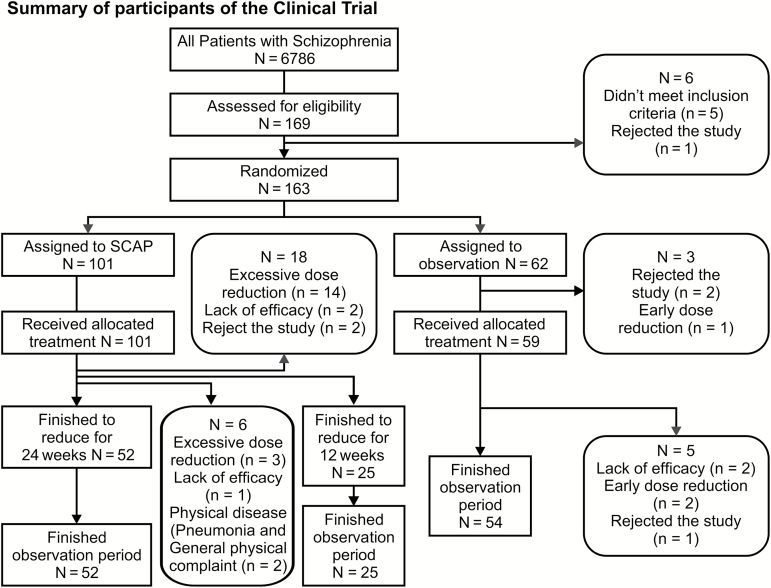
Methods: In a randomized open study of the Safe Correction of Antipsychotic Polypharmacy and High-Dose Prescriptions program funded by the Japanese Ministry of Health, Labour, and Welfare, we evaluated a drug reduction method consisting of a dose reduction intervention performed on 163 patients with schizophrenia for twelve or 24 weeks. One antipsychotic medication was removed each week from each patient's treatment regimen by reducing the dose by 0 to 50 chlorpromazine equivalents. Data on health-related indices of quality of life, clinical symptoms, and risk of side effects were analyzed using a two-way repeated-measures mixed linear model.
Results: Despite a 23% reduction in antipsychotic dose, no differences in outcomes were observed between the dose reduction and observation groups (effect size = 0.001 - 0.085, P = .24-.97), despite high statistical power (1-β = 0.48-0.97). The findings are limited by the nonuniformity of the participants' treatment history, duration, and dose reduction amount. Dose reduction protocol patients exhibited no difference in psychotic symptoms or adverse events compared with the observation group.
Conclusions: Importantly, the low dropout rate in our study (6.9% of participants withdrew because of patient factors and 23.8% for all secondary reasons) indicates that our "slowly" method is well tolerated. We hope that this approach will result in therapeutic improvements.
Keywords: antipsychotics; clinical trial; polypharmacy; psychopharmacology; schizophrenia.
© The Author 2015. Published by Oxford University Press on behalf of CINP.
Figures
Comment in
-
Use of a Spin Strategy Can Result in Unreliable Research Findings.Int J Neuropsychopharmacol. 2017 Jul 1;20(7):546-547. doi: 10.1093/ijnp/pyx013. Int J Neuropsychopharmacol. 2017. PMID: 28199677 Free PMC article. No abstract available.
-
Response to Dr. Okumura.Int J Neuropsychopharmacol. 2017 Jul 1;20(7):548-549. doi: 10.1093/ijnp/pyx020. Int J Neuropsychopharmacol. 2017. PMID: 28371917 Free PMC article. No abstract available.
References
-
- American Psychiatric Association (2000). Diagnostic and statistical manual of mental disorders. 4th ed text rev (DSM-IV-TR). Washington: American Psychiatric Association.
-
- Atkinson M, Zibin S, Chuang H. (1997). Characterizing quality of life among patients with chronic mental illness: a critical examination of the self-report methodology. Am J Psychiatry 154:99–105. - PubMed
-
- Barnes TRE, Paton C. (2011). Antipsychotic polypharmacy in schizophrenia: benefits and risks. CNS Drugs 25:383–399. - PubMed
Publication types
MeSH terms
Substances
LinkOut - more resources
Full Text Sources
Other Literature Sources
Medical
