


A randomized controlled trial of brief and ultrabrief pulse right unilateral electroconvulsive therapy
- PMID: 25522389
- PMCID: PMC4368876
- DOI: 10.1093/ijnp/pyu045
A randomized controlled trial of brief and ultrabrief pulse right unilateral electroconvulsive therapy
Erratum in
-
Erratum.Int J Neuropsychopharmacol. 2016 Apr 27;19(10):pyw031. doi: 10.1093/ijnp/pyw031. Int J Neuropsychopharmacol. 2016. PMID: 27207904 Free PMC article. No abstract available.
Abstract
Background: Some studies suggest better overall outcomes when right unilateral electroconvulsive therapy (RUL ECT) is given with an ultrabrief, rather than brief, pulse width.
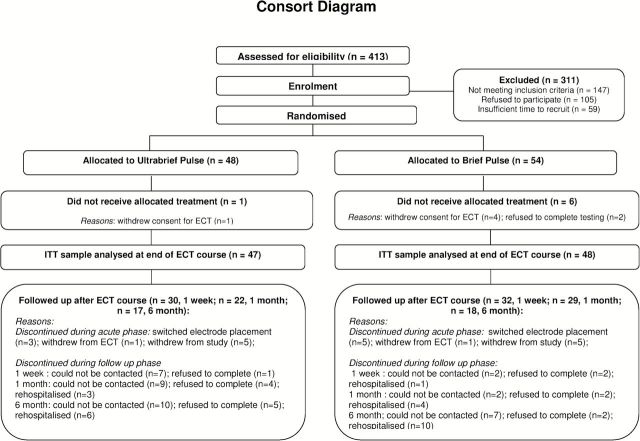
Methods: The aim of the study was to test if ultrabrief-pulse RUL ECT results in less cognitive side effects than brief- pulse RUL ECT, when given at doses which achieve comparable efficacy. One hundred and two participants were assigned to receive ultrabrief (at 8 times seizure threshold) or brief (at 5 times seizure threshold) pulse RUL ECT in a double-blind, randomized controlled trial. Blinded raters assessed mood and cognitive functioning over the ECT course.
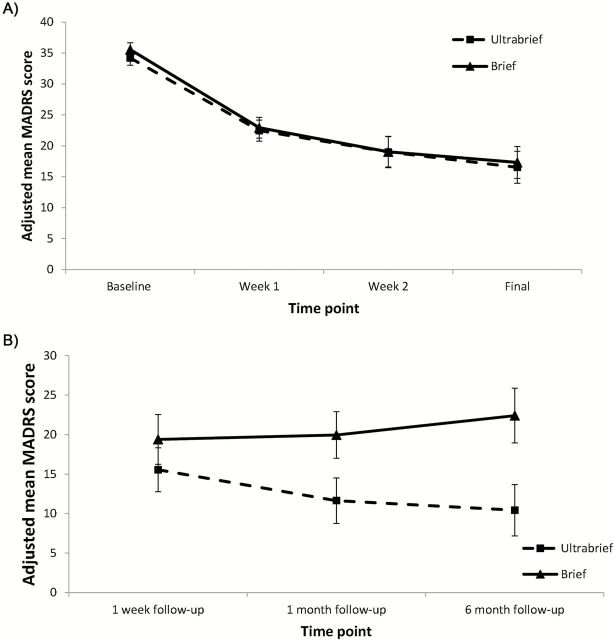
Results: Efficacy outcomes were not found to be significantly different. The ultrabrief group showed less cognitive impairment immediately after a single session of ECT, and over the treatment course (autobiographical memory, orientation).
Conclusions: In summary, when ultrabrief RUL ECT was given at a higher dosage than brief RUL ECT (8 versus 5 times seizure threshold), efficacy was comparable while cognitive impairment was less.
Trial registration: ClinicalTrials.gov NCT00870805.
Keywords: cognitive; depression; electroconvulsive therapy; pulse width; randomized controlled trial.
© The Author 2014. Published by Oxford University Press on behalf of CINP.
Figures
References
-
- Benedict RHB, Schretlen D, Groninger L, Brandt J. (1998). Hopkins Verbal Learning Test revised: normative data and analysis of inter-form and test-retest reliability. Clin Neuropsychol 12: 43–55.
-
- Dubovsky S, Buzan R, THomas M, Kassner C, Cullum C. (2004). Nicardipine improves the antidepressant action of ECT but does not improve cognition. J ECT 17:3–10. - PubMed
-
- Enders CK. (2011). Missing not at random models for latent growth curve analyses. Psychol Methods 16:1–16. - PubMed
-
- Fekadu A, Wooderson SC, Markopoulou K, Cleare AJ. (2009). The Maudsley Staging Method for treatment-resistant depression: prediction of longer-term outcome and persistence of symptoms. J Clin Psychiatry 70:952–957. - PubMed
Publication types
MeSH terms
Associated data
LinkOut - more resources
Full Text Sources
Other Literature Sources
Medical
