. 2015 Feb:41:26-36.
doi: 10.1016/j.biomaterials.2014.11.026. Epub 2014 Dec 2.

Linking the foreign body response and protein adsorption to PEG-based hydrogels using proteomics

Affiliations

Linking the foreign body response and protein adsorption to PEG-based hydrogels using proteomics

Mark D Swartzlander et al. Biomaterials. 2015 Feb.

Abstract

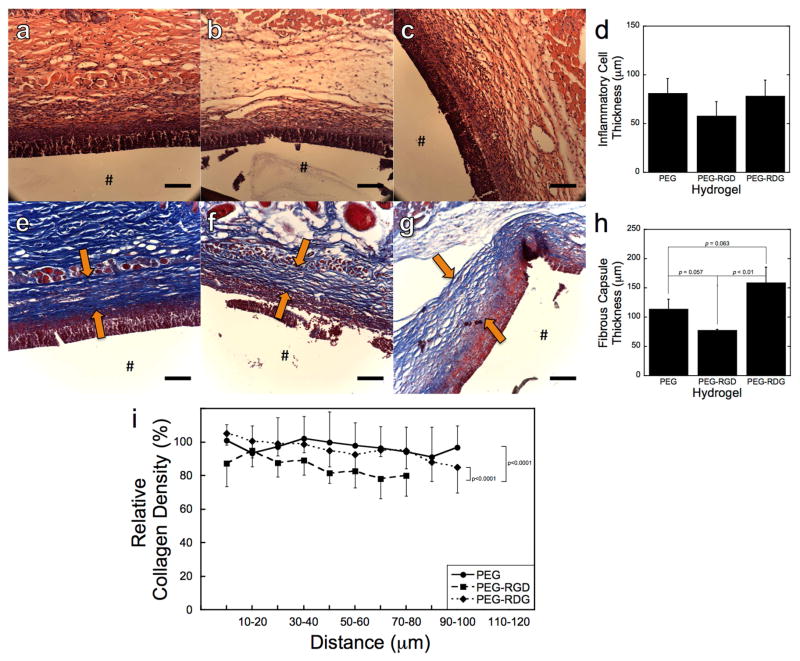
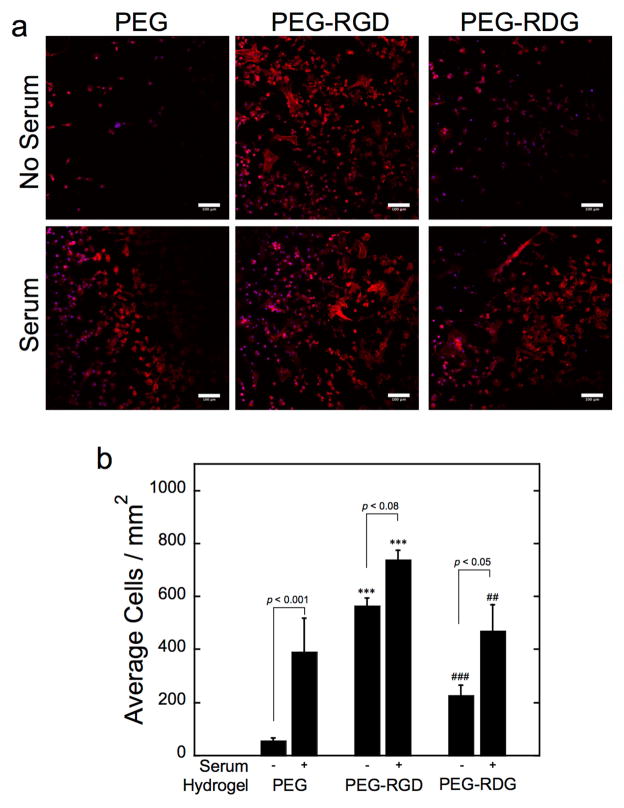
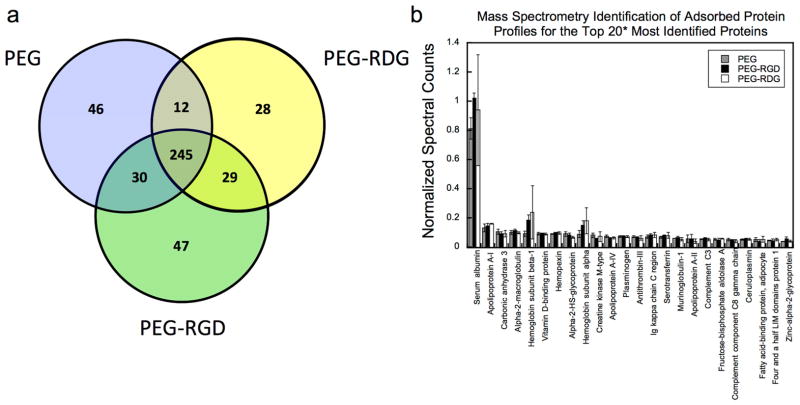
Poly(ethylene glycol) (PEG) hydrogels with their highly tunable properties are promising implantable materials, but as with all non-biological materials, they elicit a foreign body response (FBR). Recent studies, however, have shown that incorporating the oligopeptide RGD into PEG hydrogels reduces the FBR. To better understand the mechanisms involved and the role of RGD in mediating the FBR, PEG, PEG-RGD and PEG-RDG hydrogels were investigated. After a 28-day subcutaneous implantation in mice, a thinner and less dense fibrous capsule formed around PEG-RGD hydrogels, while PEG and PEG-RDG hydrogels exhibited stronger, but similar FBRs. Protein adsorption to the hydrogels, which is considered the first step in the FBR, was also characterized. In vitro experiments confirmed that serum proteins adsorbed to PEG-based hydrogels and were necessary to promote macrophage adhesion to PEG and PEG-RDG, but not PEG-RGD hydrogels. Proteins adsorbed to the hydrogels in vivo were identified using liquid chromatography-tandem mass spectrometry. The majority (245) of the total proteins (≥300) that were identified was present on all hydrogels with many proteins being associated with wounding and acute inflammation. These findings suggest that the FBR to PEG hydrogels may be mediated by the presence of inflammatory-related proteins adsorbed to the surface, but that macrophages appear to sense the underlying chemistry, which for RGD improves the FBR.

Keywords: Foreign body response; Hydrogel; Macrophage; Mass spectrometry; Poly(ethylene glycol); Protein adsorption.


Figures

Figure 1
Figure 1
Representative histological images of the in vivo response to PEG (a, e), PEG-RGD (b, f), and PEG-RDG (c, g) hydrogels 28 days post-implantation in subcutaneous pockets of C57BL/6 mice. The images show H&E (a–c), and Massons Trichrome (e–g) and stained dorsal tissue sections. The # denotes the location of the implant, which was lost during processing. Arrows mark the location of the fibrous capsule. The scale bar is 100μm. Thickness of the inflammatory cell layer (d), thickness of the fibrous capsule (h), and relative collagen density in the fibrous capsule, where intensity was normalized to the intensity of the fibrous capsule surrounding the PEG hydrogel at the location closest to the implant (i.e., 0–10 microns) (i) were measured on the dorsal side of the implanted hydrogels. Data are presented as mean with standard deviation as error bars for n=5 biological replicates per hydrogel condition.
Figure 2
Figure 2
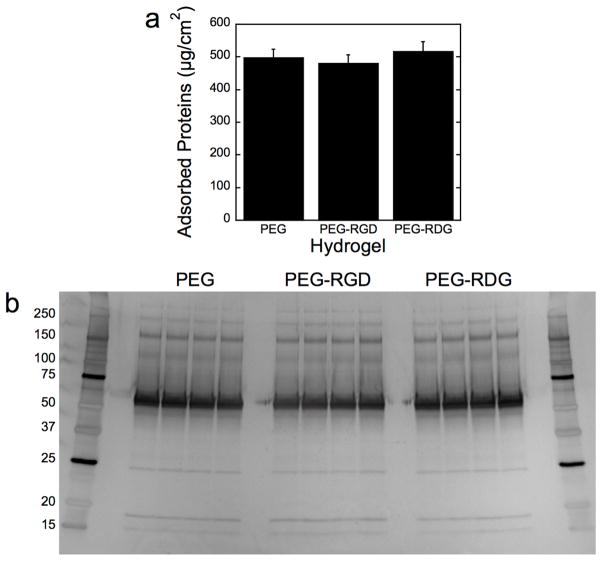
In vitro protein adsorption to PEG, PEG-RGD, and PEG-RDG hydrogels following a two-hour incubation in fetal bovine serum assessed by total protein mass (a) and protein signature (b). The latter is visualized via silver stained SDS-PAGE. Molecular weight ladders were run on both sides of the gel. Data are presented as mean with standard deviation as error bars (n=3).
Figure 3
Figure 3
Representative confocal microscopy images (a) and semi-quantitative analysis (b) of macrophages attachment to PEG, PEG-RGD, and PEG-RDG hydrogels in the absence and presence of pre-adsorbed serum proteins. Scale bar is 100 μm. Data are presented as mean with standard deviation as error bars (n=4). Symbols represent significance compared to PEG (*) and PEG-RGD (#), where two symbols represent p<0.01 and three symbols represent p<0.001.
Figure 4
Figure 4
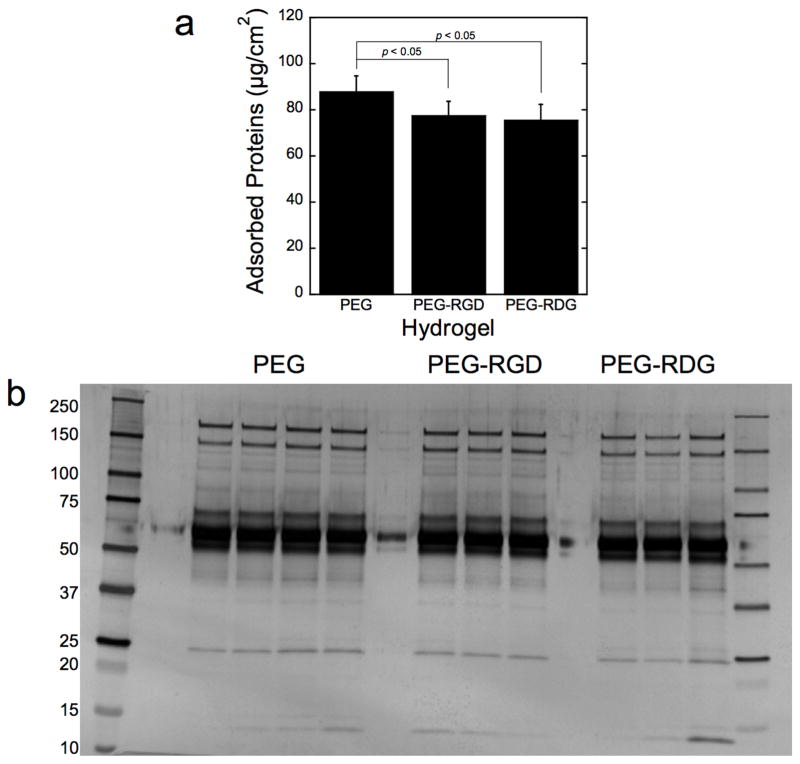
In vivo protein adsorption to PEG, PEG-RGD, and PEG-RDG hydrogels following a 30 minute subcutaneous implantation into C57BL/6 mice by total protein mass (a) and protein signature (b). The latter is visualized via silver stained SDS-PAGE. Molecular weight ladders were run on both sides of the gel. Data are presented as mean with standard deviation as error bars for n=3–4 biological replicates per hydrogel condition.
Figure 5
Figure 5
A Venn diagram depicting the overlap of the top 90% of proteins that were identified adsorbed to PEG, PEG-RGD and PEG-RDG hydrogels (a). The top 20 most identified proteins for each PEG, PEG-RGD, and PEG-RDG hydrogel, which were quantified by normalizing spectral counts to protein length (i.e., number of amino acids) (b). The asterisks indicates the top 20 are presented for each hydrogel resulting in a total of 24 proteins that are presented. Data are presented as mean with standard deviation as error bars for n=3 biological replicates per hydrogel condition.

References

    1. Bridges AW, Garcia AJ. Anti-inflammatory polymeric coatings for implantable biomaterials and devices. J Diabetes Sci Technol. 2008;2:984–94. - PMC - PubMed
    1. Nicodemus GD, Bryant SJ. Cell Encapsulation in Biodegradable Hydrogels for Tissue Engineering Applications. Tissue Engineering Part B. 2008;14:149–65. - PMC - PubMed
    1. Hern DL, Hubbell JA. Incorporation of adhesion peptides into nonadhesive hydrogels useful for tissue resurfacing. J Biomed Mater Res. 1998;39:266–76. - PubMed
    1. Hersel U, Dahmen C, Kessler H. RGD modified polymers: biomaterials for stimulated cell adhesion and beyond. Biomaterials. 2003;24:4385–415. - PubMed
    1. Huebsch N, Arany PR, Mao AS, Shvartsman D, Ali OA, Bencherif SA, et al. Harnessing traction-mediated manipulation of the cell/matrix interface to control stem-cell fate. Nat Mater. 2010;9:518–26. - PMC - PubMed

Publication types

LinkOut - more resources