


Barriers to mental health care in Japan: Results from the World Mental Health Japan Survey
- PMID: 25523280
- PMCID: PMC4472610
- DOI: 10.1111/pcn.12267
Barriers to mental health care in Japan: Results from the World Mental Health Japan Survey
Abstract
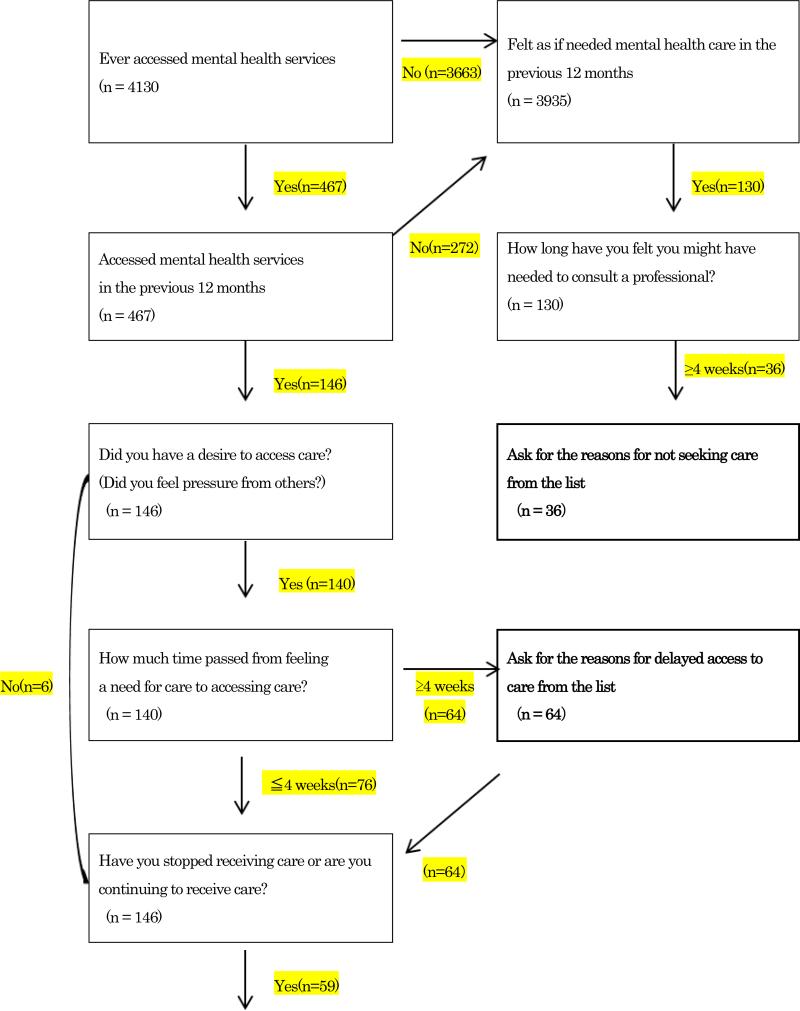
Aims: The reasons for accessing and maintaining access to mental health services in Japan may be different to those in other countries. Using the World Health Organization World Mental Health Japan survey data, this study investigated the prevalence of sociodemographic correlates of barriers for the use of, reasons for delayed access to, and reasons for dropping out from mental health care in a Japanese community-based sample.
Methods: An interview survey was conducted with a random sample of residents living in 11 communities across Japan during the years 2002-2006. Data from 4130 participants were analyzed.
Results: The most frequently reported reason for not seeking mental health care was a low perceived need (63.9%). The most common reason for delaying access to help was the wish to handle the problem on one's own (68.8%), while the most common reason for dropping out of care was also a low perceived need (54.2%). Being a woman and of younger age were key sociodemographic barriers to the use of mental health services.
Conclusions: Low perceived need was a major reason for not seeking, delay in using, and dropout from mental health services in Japan. In addition, low perceived need and structural barriers were more frequently reported than attitudinal barriers, with the exception of a desire to handle the problem on one's own. These findings suggest that improving therapist-patient communication and quality of mental health care, as well as mental health literacy education in the community, might improve access to care in Japan.
Keywords: barriers to mental health care; epidemiologic study; mental health service use; sociodemographic correlates; stigma.
© 2014 The Authors. Psychiatry and Clinical Neurosciences © 2014 Japanese Society of Psychiatry and Neurology.
Figures

References
-
- Kisely S, Scott A, Denney J, Simon G. Duration of untreated symptoms in common mental disorders: association with outcomes: International study. Br J Psychiatry. 2006;189:79–80. - PubMed
-
- Wang J. Mental health treatment dropout and its correlates in a general population. Med. Care. 2007;45:224–229. - PubMed
-
- Wang PS, Gilman SE, Guardino M, et al. Initiation of and adherence to treatment for mental disorders: examination of patient advocate group members in 11 countries. Med. Care. 2000;38:926–936. - PubMed
Publication types
MeSH terms
Grants and funding
LinkOut - more resources
Full Text Sources
Other Literature Sources
