Review
. 2014 Dec 18:9:59.
doi: 10.1186/1750-1326-9-59.

Structural biology of presenilin 1 complexes

Affiliations
Review

Structural biology of presenilin 1 complexes

Yi Li et al. Mol Neurodegener. .

Abstract

The presenilin genes were first identified as the site of missense mutations causing early onset autosomal dominant familial Alzheimer's disease. Subsequent work has shown that the presenilin proteins are the catalytic subunits of a hetero-tetrameric complex containing APH1, nicastrin and PEN-2. This complex (variously termed presenilin complex or gamma-secretase complex) performs an unusual type of proteolysis in which the transmembrane domains of Type I proteins are cleaved within the hydrophobic compartment of the membrane. This review describes some of the molecular and structural biology of this unusual enzyme complex. The presenilin complex is a bilobed structure. The head domain contains the ectodomain of nicastrin. The base domain contains a central cavity with a lateral cleft that likely provides the route for access of the substrate to the catalytic cavity within the centre of the base domain. There are reciprocal allosteric interactions between various sites in the complex that affect its function. For instance, binding of Compound E, a peptidomimetic inhibitor to the PS1 N-terminus, induces significant conformational changes that reduces substrate binding at the initial substrate docking site, and thus inhibits substrate cleavage. However, there is a reciprocal allosteric interaction between these sites such that prior binding of the substrate to the initial docking site paradoxically increases the binding of the Compound E peptidomimetic inhibitor. Such reciprocal interactions are likely to form the basis of a gating mechanism that underlies access of substrate to the catalytic site. An increasingly detailed understanding of the structural biology of the presenilin complex is an essential step towards rational design of substrate- and/or cleavage site-specific modulators of presenilin complex function.


Figures
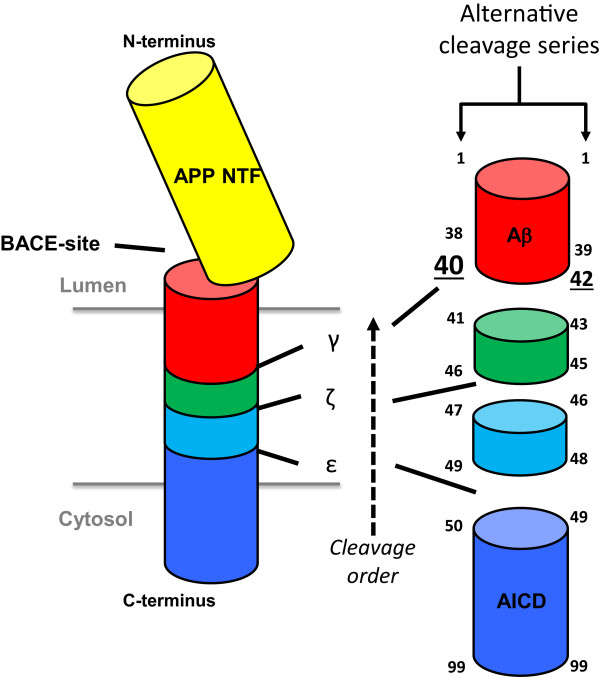
Figure 1
Figure 1
Sequential cleavage sites on APP involved in the β-amyloid producing pathway. Multiple species of Aβ can be produced. The most prevalent species end at residue 40, but species ending at residue 42, 38 etc. are also generated. Species ending at residue 42 are particularly prone to oligomerization.
Figure 2
Figure 2
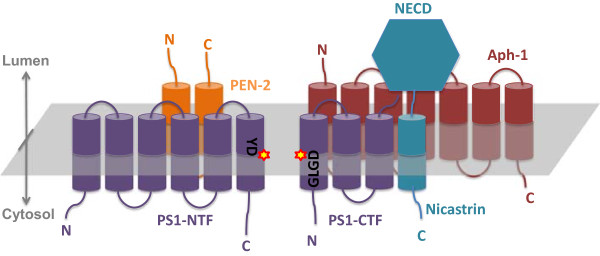
Topology view of presenilin 1 complex subunits: presenilin (purple), nicastrin (blue), Aph1 (red) and PEN-2 (orange). The highly conserved sequence in the catalytic pocket, YD287 and GLGD385 (presenilin 1 numbering), has been specified with stars.
Figure 3
Figure 3
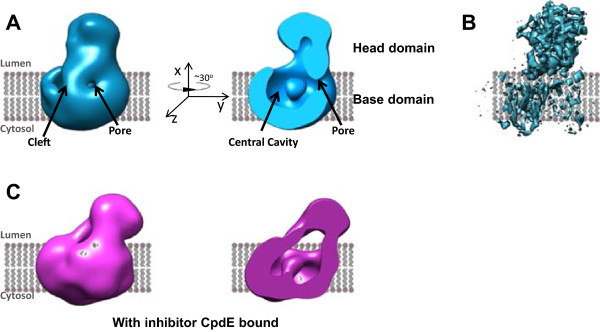
Bi-lobed models of presenilin 1 complex by electron microscopy. (A) The first bi-lobed structure model of PS1 complex, 14.7 using negative stain EM (EMD-2477). (B) The 4.5 Å model of PS1 complex by cryo-EM (EMD-2677), confirming its bi-lobed shape. (C) 14.7 Å model of PS1 complex bound with its non-transition state inhibitor Compound E (CpdE) (EMD-2478). This model revealed a conformational change induced by the inhibitor.
Figure 4
Figure 4
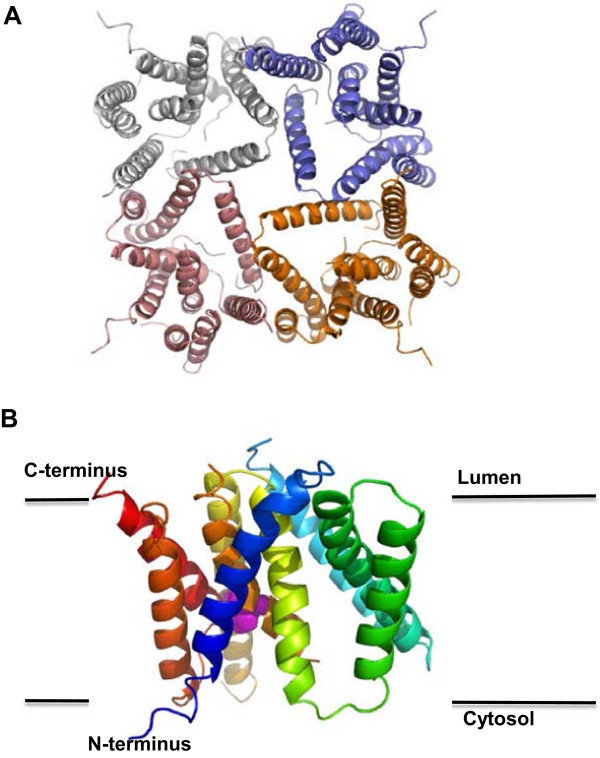
Structure of presenilin protein homologue, SPP. (A) Crystallographic tetramer of MCMJR1 (PDB 4hyc). The image is generated by PyMOL and coloured to emphasize different domains. (B) Rainbow coloured (The PyMOL Molecular Graphics System, LLC) MCMJR1 monomer structure (PDB 4hyc, chain A). The active site (magenta) is buried within a hydrophilic pocket between TM domains.

References

    1. De Strooper B, Iwatsubo T, Wolfe MS. Presenilins and gamma-secretase: structure, function, and role in Alzheimer disease. Cold Spring Harb Perspect Med. 2012;2:a006304. doi: 10.1101/cshperspect.a006304. - DOI - PMC - PubMed
    1. Li H, Wolfe MS, Selkoe DJ. Toward structural elucidation of the gamma-secretase complex. Structure. 2009;17:326–334. doi: 10.1016/j.str.2009.01.007. - DOI - PMC - PubMed
    1. Haass C, Kaether C, Thinakaran G, Sisodia S. Trafficking and proteolytic processing of APP. Cold Spring Harb Perspect Med. 2012;2:a006270. doi: 10.1101/cshperspect.a006270. - DOI - PMC - PubMed
    1. Wolfe MS. Processive proteolysis by gamma-secretase and the mechanism of Alzheimer's disease. Biol Chem. 2012;393:899–905. doi: 10.1515/hsz-2012-0140. - DOI - PubMed
    1. Chow VW, Mattson MP, Wong PC, Gleichmann M. An overview of APP processing enzymes and products. Neuromolecular Med. 2010;12:1–12. doi: 10.1007/s12017-009-8104-z. - DOI - PMC - PubMed

Publication types

Substances