


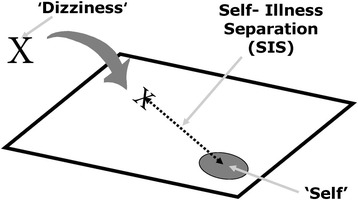
Graphic representation of the burden of suffering in dizziness patients
- PMID: 25524259
- PMCID: PMC4302589
- DOI: 10.1186/s12955-014-0184-2
Graphic representation of the burden of suffering in dizziness patients
Abstract
Background: Dizziness adversely affects an individual's well-being. However, its impact is not only influenced by its physical manifestations, but also by its subjective importance to the patient. Appropriately assessing the subjective burden of dizziness is difficult. The Pictorial-Representation of Illness- and Self-Measure (PRISM), on which patients illustrate the distance between their 'self' and their illness, has been documented to indicate the perception of suffering in several different illnesses. Our study objectives were (1) to assess how useful the PRISM is in patients with dizziness; and (2) to determine which clinical, emotional and sociodemographic factors contribute to their burden of suffering.
Methods: A total of 177 outpatients with dizziness completed this cross-sectional study, in which the following measures were assessed of suffering rated using the PRISM tool; dizziness-related variables, like emotional distress (Hospital Anxiety and Depression-Scale, HADS); self-perceived severity of dizziness (Dizziness Handicap Inventory, DHI); and sociodemographic variables.
Results: Regression analyses identified the strongest association between PRISM-rated suffering and DHI (p < 0.001), explaining 34% of the variance in PRISM-rated suffering. The HADS score and having continuous dizziness versus transient attacks each explained roughly 2% of the variance in suffering. No significant associations with PRISM-rated suffering were found for sociodemographic variables or other dizziness characteristics.
Conclusions: The PRISM is applicable to patients suffering from dizziness, demonstrating a significant association with the severity of dizziness and reliably distinguishing between those with low and high intensities of dizziness. The PRISM also reflects the multi-factorial aspects of suffering. Due to its immediate, timesaving and economical use, the PRISM could enable clinicians to identify vulnerable patients at risk for chronic symptoms and distress. Whether the PRISM can detect improvements and worsening of symptoms during treatment warrants further research.
Figures
References
-
- Weidt S, Bruehl AB, Straumann D, Hegemann SCA, Krautstrunk G, Rufer M. Health-related quality of life and emotional distress in patients with dizziness: a cross-sectional approach to disentangle their relationship. BMC Health Serv Res. 2014;14:317–317. doi: 10.1186/1472-6963-14-317. - DOI - PMC - PubMed
MeSH terms
LinkOut - more resources
Full Text Sources
Other Literature Sources
Medical
