Comparative Study
. 2014 Dec 19:11:111.
doi: 10.1186/s12977-014-0111-y.

Kinetic variations between reverse transcriptases of viral protein X coding and noncoding lentiviruses

Affiliations
Comparative Study

Kinetic variations between reverse transcriptases of viral protein X coding and noncoding lentiviruses

Gina M Lenzi et al. Retrovirology. .

Abstract

Background: Host SAM domain and HD domain-containing protein 1 (SAMHD1) suppresses reverse transcription kinetics of HIV-1 in nondividing cells such as macrophages by hydrolyzing and nearly depleting cellular dNTPs, which are the substrates of viral reverse transcriptase (RT). However, unlike HIV-1, HIV-2 and SIVsm encode viral protein X (Vpx), which counteracts the dNTPase activity of SAMHD1 and elevates dNTP concentration, allowing the viruses to replicate under abundant dNTP conditions even in nondividing cells.

Findings: Here we tested whether RTs of these Vpx coding and noncoding lentiviruses display different enzyme kinetic profiles in response to dNTP concentrations. For this test, we characterized an extensive collection of RTs from 7 HIV-1 strains, 4 HIV-2 strains and 7 SIV strains, and determined their steady-state kinetic parameters. The K m values of all HIV-1 RTs were consistently low and close to the low dNTP concentrations found in macrophages. However, the K m values of SIV and HIV-2 RTs were not only higher than those of HIV-1 RTs but also varied significantly, indicating that HIV-2/SIV RTs require higher dNTP concentrations for efficient DNA synthesis, compared to HIV-1 RT. However, the k cat values of all eighteen lentiviral RTs were very similar.

Conclusions: Our biochemical analysis supports the hypothesis that the enzymological properties, particularly, K m values, of lentivirus RTs, are mechanistically tied with the cellular dNTP availability in nondividing target cells, which is controlled by SAMHD1 and Vpx.


Figures
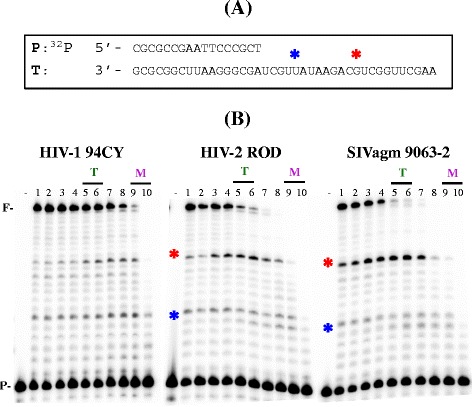
Figure 1
Figure 1
Effect of dNTP concentration on RNA-dependent DNA polymerization activity for lentiviral RT proteins. (A) 5’ 32P-labeled 17-mer primer (P) annealed to 40-mer RNA template. (B) The T/P was extended by 18 purified RT proteins under the condition described in Experimental Procedures at different dNTP concentrations (lanes 1–10: 50 μM, 25 μM, 10 μM, 5 μM, 1 μM, 500 nM, 250 nM, 100, nM, 50 nM, 25 nM). HIV-1 strains used were HXB2, NL4-3, 94CY, 92RW, 93IN, 94UG, and 93BR. HIV-2 strains used were Ghana1, ST1, ROD, and ROD10. SIV stains used were Mac239, Mne CL8, Mne 170, Agm155-4, Agm Gri-1, Agm 9063–2, and Agm Tan-1. RT activity used in this assay generated approximately 50% primer extension as determined by 40 bp fully extended product (F) at the highest dNTP concentration (lane 1). Among 18 RT proteins, the reactions with HIV-1 94CY, HIV-2 ROD, and SIVagm 9063–2 are shown in this figure, “*” indicates pause sites produced by kinetic delays of dNTP incorporations at lower dNTP concentrations. (−) no RT control. T: dNTP concentrations found in activated CD4+ T cells, M: dNTP concentrations found in macrophages.
Figure 2
Figure 2
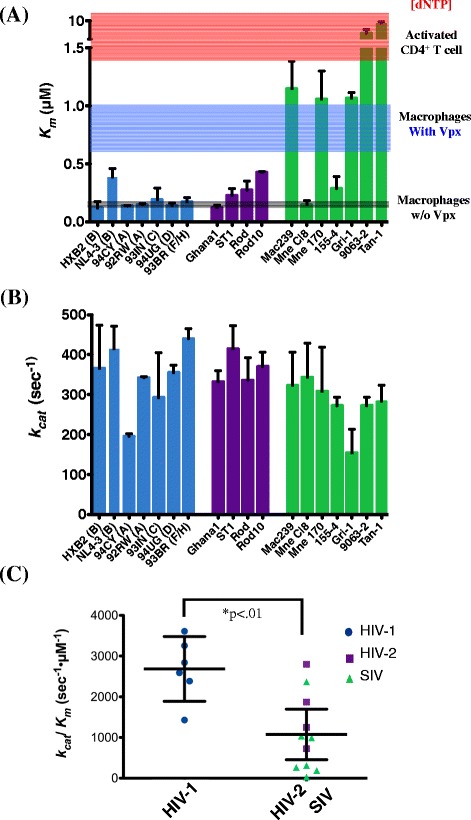
Comparison of the steady-state kinetic parameters for 18 lentiviral RT proteins. The K m (A) and k cat (B) values of the 18 different RT enzymes (blue bars, HIV-1 RTs; purple bars, HIV-2 RTs; green bars, SIV RTs) were determined from the reactions described in Figure 1. dNTP concentrations found in macrophages (grey), activated CD4+ T cells (pink), and macrophages exposed to Vpx (blue) were marked in (A) [17]. (C) The overall catalytic efficiency values (k cat / K m) were plotted with a 95% confidence interval and the efficiency difference between RTs of Vpx coding and noncoding viruses were compared. The V max and K m values were determined by fitting the data to the Michaelis-Menten equation using nonlinear regression with Kaleidagraph (Synergy Software). k cat was determined by dividing V max by molar enzyme concentration. Values reported represent means and standard deviations of HIV-1 and the group HIV-2/ SIV. Two-tailed Student’s t tests were used for the two group comparisons (Vpx + vs Vpx: p < 0.01; HIV-1 vs SIV: p < 0.01; HIV-1 vs HIV-2: p < 0.1; HIV-2 vs SIV: p = 0.12).
Figure 3
Figure 3
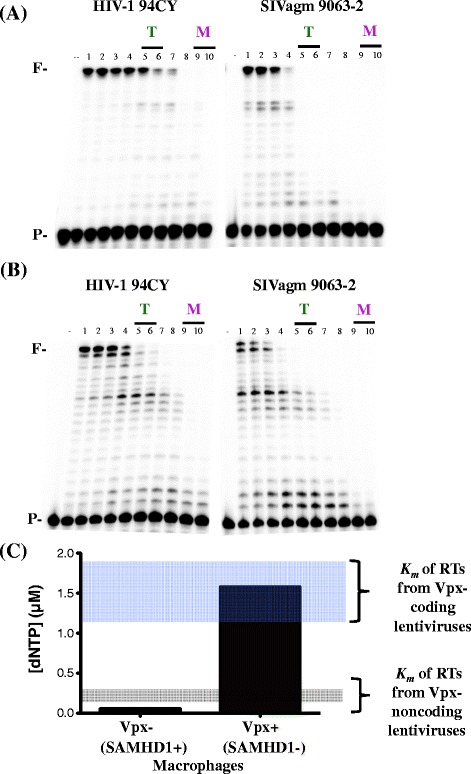
Effect of dNTP concentration on DNA-dependent DNA polymerization activity for lentiviral RT proteins. The primer extension reactions were conducted with the RT enzymes described except (A) 40-mer DNA template encoding the same sequence as the RNA template used in Figure 1 and (B) 48-mer DNA template encoding conserved HIV-1 PBS under the same reaction condition described in Figure 1. (C) Scheme explaining potential mechanistic ties between K m values of RT enzymes from lentiviruses encoding or non-encoding Vpx and cellular dNTP pools modulated by SAMHD1 and Vpx in macrophages.

References

    1. Jamburuthugoda VK, Chugh P, Kim B. Modification of human immunodeficiency virus type 1 reverse transcriptase to target cells with elevated cellular dNTP concentrations. J Biol Chem. 2006;281:13388–13395. doi: 10.1074/jbc.M600291200. - DOI - PubMed
    1. Diamond TL, Roshal M, Jamburuthugoda VK, Reynolds HM, Merriam AR, Lee KY, Balakrishnan M, Bambara RA, Planelles V, Dewhurst S, Kim B. Macrophage tropism of HIV-1 depends on efficient cellular dNTP utilization by reverse transcriptase. J Biol Chem. 2004;279:51545–51553. doi: 10.1074/jbc.M408573200. - DOI - PMC - PubMed
    1. Amie SM, Noble E, Kim B. Intracellular nucleotide levels and the control of retroviral infections. Virology. 2013;436:247–254. doi: 10.1016/j.virol.2012.11.010. - DOI - PMC - PubMed
    1. Traut TW. Physiological concentrations of purines and pyrimidines. Mol Cell Biochem. 1994;140:1–22. doi: 10.1007/BF00928361. - DOI - PubMed
    1. Gavegnano C, Kennedy EM, Kim B, Schinazi RF. The impact of macrophage nucleotide pools on HIV-1 reverse transcription, viral replication, and the development of novel antiviral agents. Mol Biol Int. 2012;2012:625983. doi: 10.1155/2012/625983. - DOI - PMC - PubMed

Publication types

MeSH terms