


Cognitive functioning differentially predicts different dimensions of older drivers' on-road safety
- PMID: 25525974
- PMCID: PMC4386614
- DOI: 10.1016/j.aap.2014.12.007
Cognitive functioning differentially predicts different dimensions of older drivers' on-road safety
Abstract
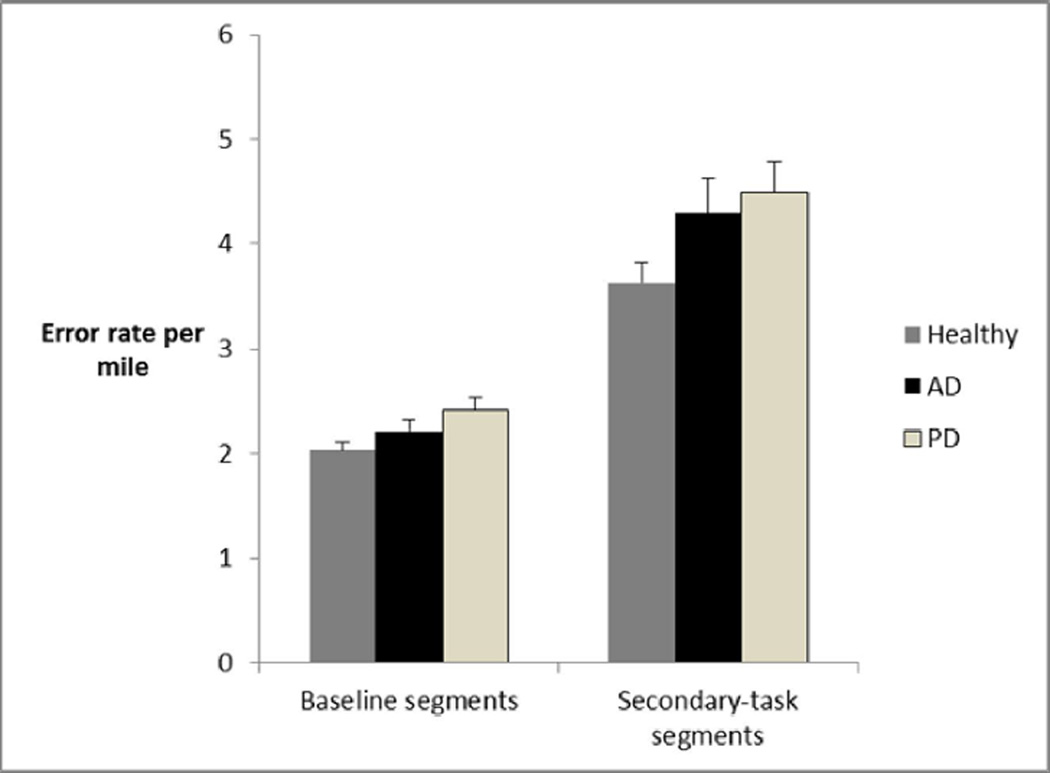
The extent to which deficits in specific cognitive domains contribute to older drivers' safety risk in complex real-world driving tasks is not well understood. We selected 148 drivers older than 70 years of age both with and without neurodegenerative diseases (Alzheimer disease-AD and Parkinson disease-PD) from an existing driving database of older adults. Participant assessments included on-road driving safety and cognitive functioning in visuospatial construction, speed of processing, memory, and executive functioning. The standardized on-road drive test was designed to examine multiple facets of older driver safety including navigation performance (e.g., following a route, identifying landmarks), safety errors while concurrently performing secondary navigation tasks ("on-task" safety errors), and safety errors in the absence of any secondary navigation tasks ("baseline" safety errors). The inter-correlations of these outcome measures were fair to moderate supporting their distinctiveness. Participants with diseases performed worse than the healthy aging group on all driving measures and differences between those with AD and PD were minimal. In multivariate analyses, different domains of cognitive functioning predicted distinct facets of driver safety on road. Memory and set-shifting predicted performance in navigation-related secondary tasks, speed of processing predicted on-task safety errors, and visuospatial construction predicted baseline safety errors. These findings support broad assessments of cognitive functioning to inform decisions regarding older driver safety on the road and suggest navigation performance may be useful in evaluating older driver fitness and restrictions in licensing.
Keywords: Aging; Alzheimer’s disease; Cognitive function; Driving safety; On-road test; Parkinson’s disease.
Copyright © 2014 Elsevier Ltd. All rights reserved.
Figures
References
-
- Anstey KJ, Wood J, Lord S, Walker JG. Cognitive, sensory and physical factors enabling driver safety in older adults. Clinical Psychology Review. 2005;25:45–65. - PubMed
-
- Anstey KJ, Woods J. Chronological Age and Age-Related Cognitive Deficits Are Associated With an Increase in Multiple Types of Driving Errors in Late Life. Neurospychology. 2011;25:613–621. - PubMed
Publication types
MeSH terms
Grants and funding
LinkOut - more resources
Full Text Sources
Other Literature Sources
Medical
