


Does early PET/CT assesment of response to chemotherapy predicts survival in patients with advanced stage non-small-cell lung cancer?
- PMID: 25526475
- PMCID: PMC4603106
- DOI: 10.1097/MD.0000000000000299
Does early PET/CT assesment of response to chemotherapy predicts survival in patients with advanced stage non-small-cell lung cancer?
Abstract
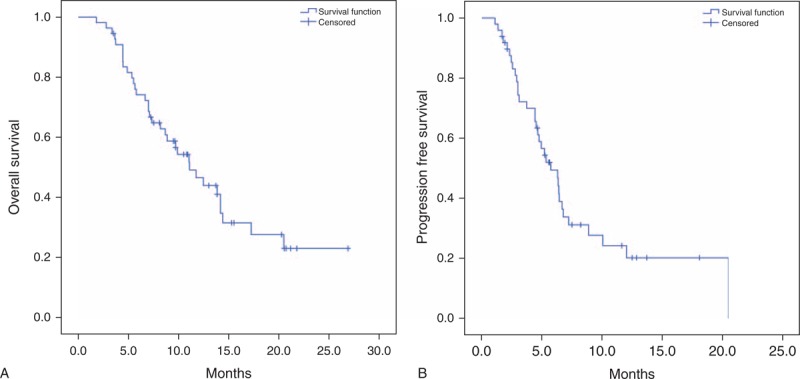
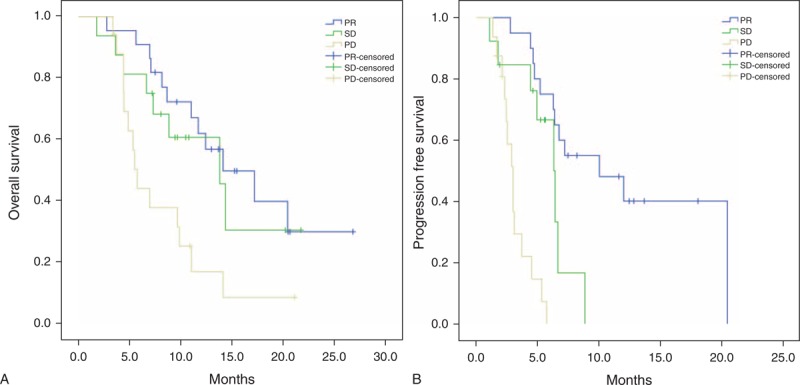
The aim of this study is to determine the prognostic role and the timing of metabolic response to chemotherapy, based on F-fluorodeoxyglucose positron emission tomography (F-FDG-PET), in patients with metastatic non-small-cell lung cancer (NSCLC). The study included 55 patients with metastatic NSCLC that were analyzed in terms of prognostic factors and survival. F-FDG-PET/CT findings were evaluated in patients separated into 3 groups, before and after 1st, 2nd, 3rd cycle of the first line chemotherapy. Metabolic response was assessed according to PET Response Criteria in Solid Tumors (PERCIST 1.0). Among the 55 patients, 34 (62%) died, and 21 (38%) remained alive during a mean follow-up of 13.5 months. Median overall survival (OS) was 11.69 months (range 2-26.80 months) and median progression-free survival (PFS) was 6.27 months (range 1.37-20.43 months). Univariate analysis showed that the only favorable prognostic factor for OS in all the patients was the achievement of metabolic response. Metabolic response according to PERCIST, and weight lose ≤ 5% were also independent favorable prognostic factors predictive of survival in all patients based on multivariet analysis (metabolic response: P=0.002, OR; 1.90, 95% CI 1.26-2.89, and weight lose ≤5%: P=0.022, OR; 2.24, 95% CI 1.12-4.47). Median OS in all patients with partial response (PR)-according to the PERCIST 1.0- was significantly longer than in those with progressive disease (PD) (16.36 months vs 8.14 months, P=0.008). Median OS in the patients with PR was significantly longer than in those with PD based on PET/CT performed after 2nd and 3rd cycles of chemotherapy (18.35 months vs 7.54 months, P=0.012 and 18.04 months vs 7.43 months, P<0.001, respectively), whereas, median OS did not differ significantly between patients with PR and those with PD based on PET/CT performed after the 1st cycle of chemotherapy (8.01 months vs 5.08 months, P=0.290). Metabolic response according to PERCIST and weight loss are independent factors predictive of OS. PET/CT performed after second cycle of chemotherapy may be the earliest predictor of treatment response in patients with advanced stage NSCLC.
Conflict of interest statement
The authors declare they have no conflicts of interest- financial or otherwise- related to the materials presented herein.
Figures
References
-
- Jemal A, Bray F, Center MM. Global cancer statistics. CA Cancer J Clin 2011; 61:69–90. - PubMed
-
- Martin J, Ginsberg RJ, Venkatraman ES, et al. Long-term results of combined-modality therapy in resectable non-small-cell lung cancer. J Clin Oncol 2002; 20:1989–1995. - PubMed
-
- Hicks RJ. Role of 18F-FDG PET in assessment of response in non-small cell lung cancer. J Nucl Med 2009; 50:31–42. - PubMed
-
- Mac Manus MP, Hicks RJ, Matthews JP, et al. Positron emission tomography is superior to computed tomography scanning for response-assessment after radical radiotherapy or chemoradiotherapy in patients with non-small-cell lung cancer. J Clin Oncol 2003; 21:1285–1292. - PubMed
-
- Breathnach OS, Freidlin B, Conley B, et al. Twenty-two years of phase III trials for patients with advanced non-small-cell lung cancer: sobering results. J Clin Oncol 2001; 19:1734–1742. - PubMed
MeSH terms
Substances
LinkOut - more resources
Full Text Sources
Other Literature Sources
Medical
Research Materials
