


Interventions for melanoma in situ, including lentigo maligna
- PMID: 25526608
- PMCID: PMC11005944
- DOI: 10.1002/14651858.CD010308.pub2
Interventions for melanoma in situ, including lentigo maligna
Abstract
Background: Malignant melanoma is a form of skin cancer associated with significant mortality once it has spread beyond the skin. Melanoma in situ (MIS) is the earliest histologically recognisable stage of malignant melanoma and represents a precursor of invasive melanoma. Lentigo maligna (LM) represents a subtype of pre-invasive intraepidermal melanoma associated specifically with chronic exposure to ultraviolet (UV) radiation. Over the past two decades, the incidence of MIS has increased significantly, even more than the invasive counterpart. There are several treatment options for MIS, but no consensus exists on the best therapeutic management of this condition.
Objectives: To assess the effects of all available interventions, surgical and non-surgical, for the treatment of melanoma in situ, including LM.
Search methods: We searched the following databases up to November 2014: the Cochrane Skin Group Specialised Register, CENTRAL in The Cochrane Library (2014, Issue 10), MEDLINE (from 1946), Embase (from 1974), LILACS (from 1982), African Index Medicus (from inception), IndeMED of India (from inception), and Index Medicus for the South-East Asia Region (IMSEAR) (from inception). We scanned the references of included and excluded studies for further references to relevant trials and searched five trials registries. We checked the abstracts of major dermatology and oncology conference proceedings, and we shared our lists of included and excluded studies with industry contacts and other experts in the field of melanoma to try to identify further relevant trials.
Selection criteria: We included randomised controlled trials (RCT) on the management of MIS, including LM, that compared any intervention to placebo or active treatment. We included individuals, irrespective of age and sex, diagnosed with MIS, including LM, based on histological examination.
Data collection and analysis: Two authors independently evaluated possible studies for inclusion; extracted data from the included study using a standard data extraction form modified for our review; assessed risk of bias; and analysed data on efficacy, safety, and tolerability. They resolved any disagreements by discussion with a third author. We collected adverse effects information from included studies.
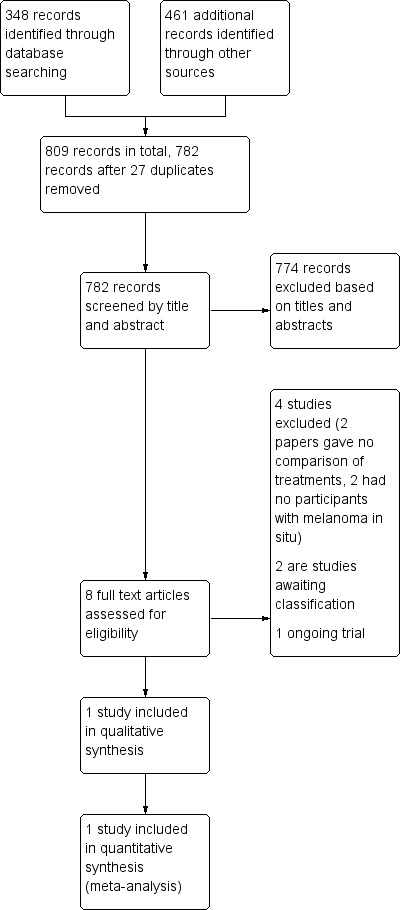
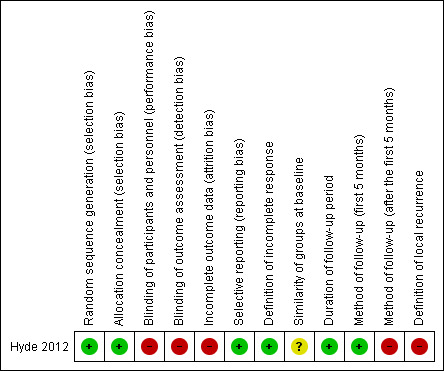
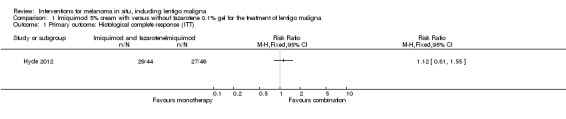
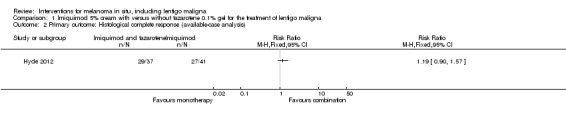
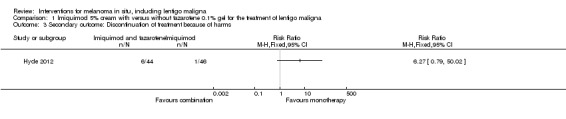
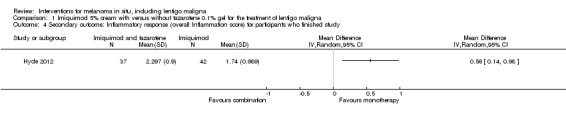
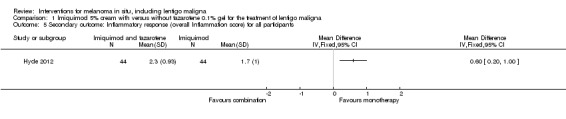
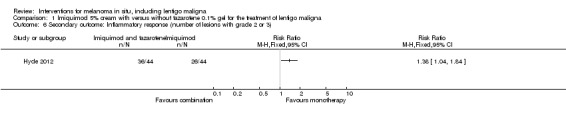
Main results: Our search identified only 1 study eligible for inclusion (and 1 ongoing study in active recruitment stage), which was a single centre, open label, parallel group, 2-arm RCT with 90 participants, who had 91 histologically proven LM lesions.Forty-four participants, with 44 LM lesions, were treated with imiquimod 5% cream 5 days per week plus tazarotene 0.1% gel 2 days/week for 3 months, and 46 participants, with 47 LM lesions, were treated with imiquimod 5% cream 5 days per week for 3 months. Two months after cessation of topical treatment, the initial tumour footprint was excised using 2 mm margins via a staged excision. This study was open label, and analysis was not intention-to-treat, leading to a high risk of incomplete outcome data.Our primary outcome 'Histological or clinical complete response' was measured at 5 months in 29/44 participants (66%) treated with imiquimod plus tazarotene (combination therapy) and 27/46 participants (59%) treated with imiquimod (monotherapy). The difference was not statistically significant (risk ratio (RR) 1.12, 95% confidence interval (CI) 0.81 to 1.55, P value = 0.48).With regard to our secondary outcomes on recurrence and inflammation, after a mean follow up of 42 months, no local recurrences were observed among complete responders. Difference in overall inflammation score between the 2 groups was significant (mean difference (MD) 0.6, 95% CI 0.2 to 1, P value = 0.004), with the mean overall inflammation score being significantly higher in the combination group.The study authors did not clearly report on side-effects. Because of adverse effects, there was a dropout rate of 6/44 participants (13.7%) in the combination group compared with 1/46 (2.2%) in the imiquimod monotherapy group (due to excessive inflammation) before the cessation of topical treatment (first 3 months), but this was not statistically significant (RR 6.27, 95% CI 0.79 to 50.02, P value = 0.08).
Authors' conclusions: There is a lack of high-quality evidence for the treatment of MIS and LM.For the treatment of MIS, we found no RCTs of surgical interventions aiming to optimise margin control (square method, perimeter technique, 'slow Mohs', staged radial sections, staged "mapped" excisions, or Mohs micrographic surgery), which are the most widely used interventions recommended as first-line therapy. The use of non-surgical interventions in selected cases (patients with contraindications to surgical interventions) may be effective and may be considered preferable for experienced providers and under close and adequate follow up.For the treatment of LM, we found no RCTs of surgical interventions, which remain the most widely used and recommended available treatment. The use of non-surgical interventions, such as imiquimod, as monotherapy may be effective and may be considered in selected cases where surgical procedures are contraindicated and used preferentially by experienced providers under close and adequate follow up. The use of topical therapies, such as 5-fluorouracil and imiquimod, as neoadjuvant therapies warrants further investigation. There is insufficient evidence to support or refute the addition of tazarotene to imiquimod as adjuvant therapy; the current evidence suggests that it can increase topical inflammatory response and withdrawal of participants because of treatment-related side-effects.
Conflict of interest statement
Thrasivoulos Tzellos: Nothing to declare. Athanassios Kyrgidis: Nothing to declare. Simone Mocellin: Nothing to declare. An‐Wen Chan: Nothing to declare. Pierluigi Pilati: Nothing to declare. Zoe Apalla: Nothing to declare.
Figures
Comment in
-
From the Cochrane library: Interventions for melanoma in situ, including lentigo maligna.J Am Acad Dermatol. 2022 Sep;87(3):e115-e116. doi: 10.1016/j.jaad.2022.05.046. Epub 2022 May 28. J Am Acad Dermatol. 2022. PMID: 35640801 No abstract available.
References
References to studies included in this review
Hyde 2012 {published and unpublished data}
-
- Hyde MA, Hadley ML, Tristani‐Firouzi P, Goldgar D, Bowen GM. A Randomized Trial of the Off‐Label Use of Imiquimod, 5%, Cream with vs without Tazarotene, 0.1%, Gel for the Treatment of Lentigo Maligna, Followed by Conservative Staged Excisions. Archives of Dermatology 2012;148(5):592‐6. [MEDLINE: ] - PubMed
References to studies excluded from this review
Chagpar 2007 {published data only}
-
- Chagpar RB, Ross MI, Reintgen DS, Edwards MJ, Scoggins CR, Martin RC, et al. Factors associated with improved survival among young adult melanoma patients despite a greater incidence of sentinel lymph node metastasis. Journal of Surgical Research 2007;143(1):164‐8. [MEDLINE: ] - PubMed
Khayat 2003 {published data only}
-
- Khayat D, Rixe O, Martin G, Soubrane C, Banzet M, Bazex JA, et al. Surgical margins in cutaneous melanoma (2 cm versus 5 cm for lesions measuring less than 2.1‐mm thick): Long‐term results of a large European multicentric phase III study. Cancer 2003;97(8):1941‐6. [EMBASE: 2003143819] - PubMed
Kim 2008 {published data only}
Morganroth 2009 {published data only}
-
- Morganroth PA, Gelfand JM, Jambusaria A, Margolis DJ, Miller CJ. A randomized, double‐blind comparison of the total dose of 1.0% lidocaine with 1:100,000 epinephrine versus 0.5% lidocaine with 1:200,000 epinephrine required for effective local anesthesia during Mohs micrographic surgery for skin cancers. Journal of the American Academy of Dermatology 2009;60(3):444‐52. [EMBASE: 2009076713] - PubMed
References to studies awaiting assessment
Amatetti 1994 {published data only}
-
- Amatetti M, Proietto G, Paolini A, Feliciani C, Cazzato C, Amerio P. Adjuvant therapy with recombinant alpha‐interferon in non metastatic melanoma [TERAPIA ADIUVANTE CON INTERFERON‐ALFA RICOMBINANTE NEL MELANOMA CUTANEO]. Giornale Italiano di Dermatologia e Venereologia 1994;129(6):31‐6. [EMBASE: 1994345755]
Foster 2007 {published data only}
-
- Foster W, Esser A, Monheit G, Harmon C. A Prospective Randomized Study Comparing the Efficacy of Horizontal Mohs Tissue Processing to Vertical Breadloaf Tissue Processing in the Surgical Management of Superficial Melanoma. Journal of the American Academy of Dermatology 2007;56(2 Suppl 2):AB145. [DOI: 10.1016/j.jaad.2006.10.672] - DOI
References to ongoing studies
NCT01720407 {unpublished data only}
-
- NCT01720407. Relevance of Imiquimod as Neo‐adjuvant Treatment to Reduce Excision Size and the Risk of Intralesional Excision in Lentigo Malignant of the Face (ImiReduc). clinicaltrials.gov/show/NCT01720407 (accessed 20 March 2014).
Additional references
Addo‐Boadu 1996
-
- Addo‐Boadu K, Wojta J, Christ G, Hufnagl P, Pehamberger H, Binder BR. Azelaic acid decreases the fibrinolytic potential of cultured human melanoma cells in vitro. Cancer Letters 1996;103(2):125‐9. [MEDLINE: ] - PubMed
Agarwal‐Antal 2002
-
- Agarwal‐Antal N, Bowen GM, Gerwels JW. Histologic evaluation of lentigo maligna with permanent sections: implications regarding current guidelines. Journal of American Academy of Dermatology 2002;47(5):743‐8. [MEDLINE: ] - PubMed
Beddingfield 2003
-
- Beddingfield FC. The melanoma epidemic: res ipsa loquitur. Oncologist 2003;8(5):459‐65. [MEDLINE: ] - PubMed
Bichakjian 2011
-
- Bichakjian CK, Halpern AC, Johnson TM, Foote Hood A, Grichnik JM, Swetter SM, et al. Guidelines of care for the management of primary cutaneous melanoma. American Academy of Dermatology. Journal of American Academy of Dermatology 2011;65(5):1032‐47. [MEDLINE: ] - PubMed
Brochez 2002
-
- Brochez L, Verhaeghe E, Grosshans E, Haneke E, Piérard G, Ruiter D, et al. Inter‐observer variation in the histopathological diagnosis of clinically suspicious pigmented skin lesions. Journal of Pathology 2002;196(4):459‐66. [MEDLINE: ] - PubMed
Bub 2004
-
- Bub JL, Berg D, Slee A, Odland PB. Management of lentigo maligna and lentigo maligna melanoma with staged excision: a 5‐year follow‐up. Archives of Dermatology 2004;140(5):552‐8. [MEDLINE: ] - PubMed
Charles 2005
-
- Charles CA, Yee VS, Dusza SW, Marghoob AA, Oliveria SA, Kopf A, et al. Variation in the diagnosis, treatment, and management of melanoma in situ: a survey of US dermatologists. Archives of Dermatology 2005;141(6):723‐9. [MEDLINE: ] - PubMed
Clark 1986
-
- Clark WH, Elder DE, Horn M. The biologic forms of malignant melanoma. Human Pathology 1986;17(5):443‐50. [MEDLINE: ] - PubMed
Clark 2008
-
- Clark GS, Pappas‐Politis EC, Cherpelis BS, Messina JL, Möller MG, Cruse CW, et al. Surgical management of melanoma in situ on chronically sun damaged skin. Cancer Control 2008;15(3):216‐24. [MEDLINE: ] - PubMed
Cognetta 2001
-
- Cognetta AB, Stolz W, Katz B, Tullos J, Gossain S. Dermatoscopy of lentigo maligna. Dermatologic Clinics 2001;19(2):307‐18. [MEDLINE: ] - PubMed
Cohen 1995
-
- Cohen LM. Lentigo maligna and lentigo maligna melanoma. Journal of American Academy of Dermatology 1995;33(6):923‐36. [MEDLINE: ] - PubMed
Cohen 1998
-
- Cohen LM, McCall MW, Zax RH. Mohs micrographic surgery for lentigo maligna and lentigo maligna melanoma. A follow‐up study. Dermatologic Surgery 1998;24(6):673‐7. [MEDLINE: ] - PubMed
Coleman 1980
-
- Coleman WP, Davis RS, Reed RJ, Krementz ET. Treatment of lentigo maligna and lentigo maligna melanoma. Journal of Dermatologic Surgery & Oncology 1980;6(6):476‐9. [MEDLINE: ] - PubMed
Collins 1991
-
- Collins P, Rogers S, Goggin M, Manning W. Cryotherapy for lentigo maligna. Clinical & Experimental Dermatology 1991;16(6):433‐5. - PubMed
Coory 2006
-
- Coory M, Baade P, Aitken J, Smithers M, McLeod GR, Ring I. Trends for in situ and invasive melanoma in Queensland, Australia, 1982‐2002. Cancer Causes & Control 2006;17(1):21‐7. [MEDLINE: ] - PubMed
Dawn 2007
-
- Dawn ME, Dawn AG, Miller SJ. Mohs surgery for the treatment of melanoma in situ: a review. Dermatologic Surgery 2007;33(4):395‐402. [MEDLINE: ] - PubMed
Desai 2012
-
- Desai T, Chen CL, Desai A, Kirby W. Basic pharmacology of topical imiquimod, 5‐fluorouracil, and diclofenac for the dermatologic surgeon. Dermatological Surgery 2012;38(1):97‐103. [PUBMED: 22092926] - PubMed
Egger 1997
Erickson 2010
-
- Erickson C, Miller SJ. Treatment options in melanoma in situ: topical and radiation therapy, excision and Mohs surgery. International Journal of Dermatology 2010;49(5):482‐91. [MEDLINE: ] - PubMed
Farmer 1996
-
- Farmer ER, Gonin R, Hanna MP. Discordance in the histopathologic diagnosis of melanoma and melanocytic nevi between expert pathologists. Human Pathology 1996;27(6):528‐31. [MEDLINE: ] - PubMed
Farshad 2002
-
- Farshad A, Burg G, Panizzon R, Dummer R. A retrospective study of 150 patients with lentigo maligna and lentigo maligna melanoma and the efficacy of radiotherapy using Grenz or soft X‐rays. British Journal of Dermatology 2002;146(6):1042‐6. [MEDLINE: ] - PubMed
Field 1995
-
- Field LM. Cryosurgery for lentigo maligna. Journal of American Academy of Dermatology 1995;32(4):686‐7. [MEDLINE: ] - PubMed
Fogarty 2014
-
- Fogarty GB, Hong A, Scolyer RA, Lin E, Haydu L, Guitera P, et al. Radiotherapy for lentigo maligna: a literature review and recommendations for treatment. British Journal of Dermatology 2014;170(1):52‐8. [MEDLINE: ] - PubMed
Gage 1979
-
- Gage AA, Meenaghan MA, Natiella JR, Greene GW. Sensitivity of pigmented mucosa and skin to freezing injury. Cryobiology 1979;16(4):348‐61. [PUBMED: 487851] - PubMed
Garbe 2008
-
- Garbe C, Hauschild A, Volkenandt M, Schadendorf D, Stolz W, Reinhold U, et al. Evidence and interdisciplinary consensus‐based German guidelines: surgical treatment and radiotherapy of melanoma. Melanoma Research 2008;18(1):61‐7. [MEDLINE: ] - PubMed
Gaspar 1997
-
- Gaspar ZS, Dawber RP. Treatment of lentigo maligna. Australasian Journal of Dermatology 1997;38(1):1‐8. [MEDLINE: ] - PubMed
Gupta 2004
-
- Gupta AK, Cherman AM, Tyring SK. Viral and nonviral uses of imiquimod: a review. Journal of Cutaneous Medicine & Surgery 2004;8(5):338‐52. [MEDLINE: ] - PubMed
Hemminki 2003
-
- Hemminki K, Zhang H, Czene K. Incidence trends and familial risks in invasive and in situ cutaneous melanoma by sun‐exposed body sites. International Journal of Cancer 2003;104(6):764‐71. [MEDLINE: ] - PubMed
Higgins 2011
-
- Higgins JPT, Green S (editors). Cochrane Handbook for Systematic Reviews of Interventions Version 5.1.0 [updated March 2011]. The Cochrane Collaboration, 2011. Available from www.cochrane‐handbook.org.
Hill 1999
-
- Hill DC, Gramp AA. Surgical treatment of lentigo maligna and lentigo maligna melanoma. Australasian Journal of Dermatology 1999;40(1):25‐30. [MEDLINE: ] - PubMed
Jejurikar 2007
-
- Jejurikar SS, Borschel GH, Johnson TM, Lowe L, Brown DL. Immediate, optimal reconstruction of facial lentigo maligna and melanoma following total peripheral margin control. Plastic & Reconstructive Surgery 2007;120(5):1249‐55. [MEDLINE: ] - PubMed
Johnson 1997
-
- Johnson TM, Headington JT, Baker SR, Lowe L. Usefulness of the staged excision for lentigo maligna and lentigo maligna melanoma: the “square” procedure. Journal of American Academy of Dermatology 1997;37(5 Pt 1):758‐64. [MEDLINE: ] - PubMed
Kang 2009
-
- Kang HY, Park TJ, Jin SH. Imiquimod, a Toll‐like receptor 7 agonist, inhibits melanogenesis and proliferation of human melanocytes. Journal of Investigative Dermatology 2009;129(1):243‐6. [MEDLINE: ] - PubMed
King 2005
-
- King R, Page RN, Googe PB, Mihm MC. Lentiginous melanoma: a histologic pattern of melanoma to be distinguished from lentiginous nevus. Modern Pathology 2005;18(10):1397‐401. [MEDLINE: ] - PubMed
Koehler 2011
-
- Koehler MJ, Speicher M, Lange‐Asschenfeldt S, Stockfleth E, Metz S, Elsner P, et al. Clinical application of multiphoton tomography in combination with confocal laser scanning microscopy for in vivo evaluation of skin diseases. Experimental Dermatology 2011;20(7):589‐94. [MEDLINE: ] - PubMed
Kopera 1995
-
- Kopera D. Treatment of lentigo maligna with the carbon dioxide laser. Archives of Dermatology 1995;131(6):735‐6. [MEDLINE: ] - PubMed
Kuflik 1994
-
- Kuflik EG, Gage AA. Cryosurgery for lentigo maligna. Journal of American Academy of Dermatology 1994;31(1):75‐8. [MEDLINE: ] - PubMed
Kunishige 2011
-
- Kunishige JH, Brodland DG, Zitelli JA. Surgical margins for melanoma in situ. Journal of American Academy of Dermatology 2012;66(3):438‐44. [MEDLINE: ] - PubMed
Kvaskoff 2011
-
- Kvaskoff M, Siskind V, Green AC. Risk Factors for Lentigo Maligna Melanoma Compared With Superficial Spreading Melanoma: A Case‐Control Study in Australia. Archives of Dermatology 2012;148(2):164‐70. [MEDLINE: ] - PubMed
Lee 2008
-
- Lee MR, Ryman WJ. Treatment of lentigo maligna with total circumferential margin control using vertical and horizontal permanent sections: a retrospective study. Australasian Journal of Dermatology 2008;49(4):196‐201. [MEDLINE: ] - PubMed
Lee 2011
-
- Lee H, Sowerby LJ, Temple CL, Yu E, Moore CC. Carbon dioxide laser treatment for lentigo maligna: a retrospective review comparing 3 different treatment modalities. Archives of Facial Plastic Surgery 2011;13(6):398‐403. [MEDLINE: ] - PubMed
Leibl 1985
-
- Leibl H, Stingl G, Pehamberger H, Korschan H, Konrad K, Wolff K. Inhibition of DNA synthesis of melanoma cells by azelaic acid. Journal of Investigative Dermatology 1985;85(5):417‐22. [MEDLINE: ] - PubMed
Litwin 1975
-
- Litwin MS, Krementz ET, Mansell PW, Reed RJ. Topical chemotherapy of lentigo maligna with 5‐fluorouracil. Cancer 1975;35(3):721‐33. [MEDLINE: ] - PubMed
Madan 2009
-
- Madan V, August PJ. Lentigo maligna‐outcomes of treatment with Q‐switched Nd:YAG and alexandrite lasers. Dermatological Surgery 2009;35(4):607‐11. [MEDLINE: ] - PubMed
Mahoney 2005
-
- Mahoney MH, Joseph M, Temple CL. The perimeter technique for lentigo maligna: an alternative to Mohs micrographic surgery. Journal of Surgical Oncology 2005;91(2):120‐5. [MEDLINE: ] - PubMed
McKenna 2006
-
- McKenna JK, Florell SR, Goldman GD, Bowen GM. Lentigo maligna/lentigo maligna melanoma: current stage of diagnosis and treatment. Dermatological Surgery 2006;32(4):493‐504. [MEDLINE: ] - PubMed
McLeod 2011
-
- McLeod M, Choudhary S, Giannakakis G, Nouri K. Surgical Treatments for Lentigo Maligna: A Review. Dermatologic Surgery 2011; Vol. 37, issue 9:1210‐28. [MEDLINE: ] - PubMed
Megahed 2002
-
- Megahed M, Schön M, Selimovic D, Schön MP. Reliability of diagnosis of melanoma in situ. Lancet 2002;359(9321):1921‐2. [MEDLINE: ] - PubMed
Mirzoyev 2014
Mocellin 2011
Mohs 1941
-
- Mohs FE. Chemosurgery: a microscopically controlled method of cancer excision. Archives of Surgery 1941;42(2):279‐95.
National Comprehensive Cancer Network 2009
-
- National Comprehensive Cancer Network. NCCN Clinical Practice Guidelines in Oncology: Melanoma. www.nccn.org/professionals/physician_gls/PDF/melanoma.pdf (accessed 12 January 2011).
National Institutes of Health 1993
-
- National Institutes of Health. National Institutes of Health Consensus Development Conference Statement on Diagnosis and Treatment of Early Melanoma, January 27‐29, 1992. American Journal of Dermatopathology 1993;15(1):34‐43. [MEDLINE: ]
Osborne 2002
-
- Osborne JE, Hutchinson PE. A follow‐up study to investigate the efficacy of initial treatment of lentigo maligna with surgical excision. British Journal of Plastic Surgery 2002;55(8):611‐5. [MEDLINE: ] - PubMed
Rajpar 2006
-
- Rajpar SF, Marsden JR. Imiquimod in the treatment of lentigo maligna. British Journal of Dermatology 2006;155(4):653‐6. [MEDLINE: ] - PubMed
Ray 2005
-
- Ray CM, Kluk M, Grin CM, Grant‐Kels JM. Successful treatment of malignant melanoma in situ with topical 5% imiquimod cream. International Journal of Dermatology 2005;44(5):428‐34. [MEDLINE: ] - PubMed
Review Manager 2014 [Computer program]
-
- The Nordic Cochrane Centre, The Cochrane Collaboration. Review Manager (RevMan). Version 5.3. Copenhagen: The Nordic Cochrane Centre, The Cochrane Collaboration, 2014.
Rodriguez Prieto 1993
-
- Rodriguez Prieto MA, Manchado Lopez P, Ruiz Gonzalez I, Suarez D. Treatment of lentigo maligna with azelaic acid. International Journal of Dermatology 1993;32(5):363‐4. [MEDLINE: ] - PubMed
Ryan 1988
-
- Ryan RF, Krementz ET, Litwin MS. A role for topical 5‐fluorouracil therapy in melanoma. Journal of Surgical Oncology 1988;38(4):250‐6. [MEDLINE: ] - PubMed
Schiffner 2000
-
- Schiffner R, Schiffner‐Rohe J, Vogt T, Landthaler M, Wlotzke U, Cognetta AB, et al. Improvement of early recognition of lentigo maligna using dermatoscopy. Journal of the American Academy of Dermatology 2000;42(1 Pt 1):25‐32. [MEDLINE: ] - PubMed
Schmid‐Wendtner 2000
-
- Schmid‐Wendtner MH, Brunner B, Konz B, Kaudewitz P, Wendtner CM, Peter RU, et al. Fractionated radiotherapy of lentigo maligna and lentigo maligna melanoma in 64 patients. Journal of American Academy of Dermatology 2000;43(3):477‐82. [MEDLINE: ] - PubMed
Shriner 1998
-
- Shriner DL, McCoy DK, Goldberg DJ, Wagner RF. Mohs micrographic surgery. Journal of American Academy of Dermatology 1998;39(1):79‐97. [MEDLINE: ] - PubMed
Sladden 2009
Stevenson 2005
-
- Stevenson O, Ahmed I. Lentigo maligna: prognosis and treatment options. American Journal of Clinical Dermatology 2005;6(3):151‐64. [MEDLINE: ] - PubMed
Swetter 2005
-
- Swetter SM, Boldrick JC, Jung SY, Egbert BM, Harvell JD. Increasing incidence of lentigo maligna melanoma subtypes: northern California and national trends 1990‐2000. Journal of Investigative Dermatology 2005;125(4):685‐91. [MEDLINE: ] - PubMed
Tannous 2000
-
- Tannous ZS, Lerner LH, Duncan LM, Mihm MC, Flotte TJ. Progression to invasive melanoma from malignant melanoma in situ, lentigo maligna type. Human Pathology 2000;31(6):705‐8. [MEDLINE: ] - PubMed
Tsang 1994
-
- Tsang RW, Liu FF, Wells W, Payne DG. Lentigo maligna of the head and neck: results of treatment by radiotherapy. Archives of Dermatology 1994;130(8):1008‐12. [MEDLINE: ] - PubMed
Vereecken 2002
-
- Vereecken P, Heenen M. Recurrent lentigo maligna melanoma: regression associated with local azelaic acid 20%. International Journal of Clinical Practice 2002;56(1):68‐9. [MEDLINE: ] - PubMed
Walling 2007
-
- Walling HW, Scupham RK, Bean AK, Ceilley RI. Staged excision versus Mohs micrographic surgery for lentigo maligna and lentigo maligna melanoma. Journal of the American Academy of Dermatology 2007;57(4):659‐64. [MEDLINE: ] - PubMed
Weinstock 1987
-
- Weinstock MA, Sober AJ. The risk of progression of lentigo maligna to lentigo maligna melanoma. British Journal of Dermatology 1987;116(3):303‐10. [MEDLINE: ] - PubMed
Woodmansee 2009
-
- Woodmansee CS, McCall MW. Recurrence of lentigo maligna and development of invasive melanoma after treatment of lentigo maligna with imiquimod. Dermatologic Surgery 2009;35(8):1286‐9. [MEDLINE: ] - PubMed
Zitelli 1997
-
- Zitelli JA, Brown C, Hanusa BH. Mohs micrographic surgery for the treatment of primary cutaneous melanoma. Journal of American Academy of Dermatology 1997;37(2 Pt 1):236‐45. [MEDLINE: ] - PubMed
References to other published versions of this review
Publication types
MeSH terms
Substances
LinkOut - more resources
Full Text Sources
Other Literature Sources
Medical
Miscellaneous
