


What changes in cognitive therapy for depression? An examination of cognitive therapy skills and maladaptive beliefs
- PMID: 25526838
- PMCID: PMC4405148
- DOI: 10.1016/j.beth.2014.09.001
What changes in cognitive therapy for depression? An examination of cognitive therapy skills and maladaptive beliefs
Abstract
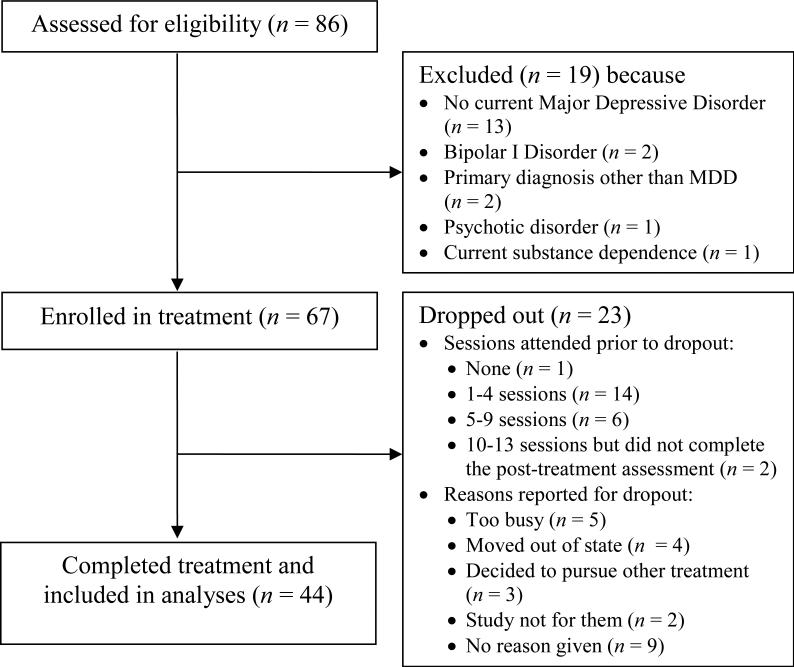
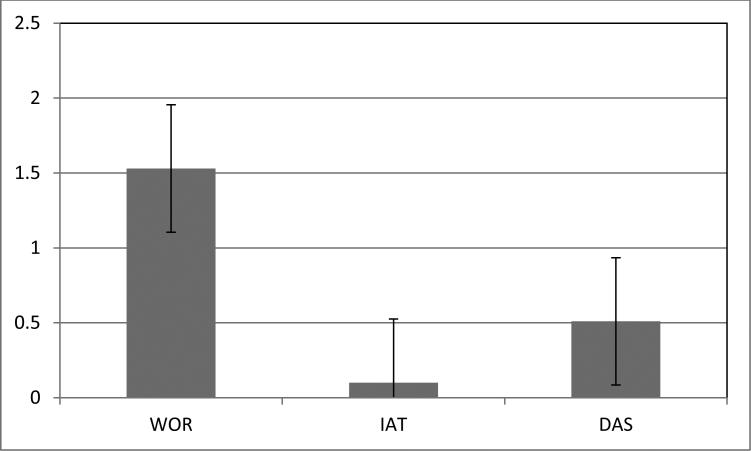
This study examined effortful cognitive skills and underlying maladaptive beliefs among patients treated with cognitive therapy (CT) for depression. Depressed patients (n=44) completed cognitive measures before and after 16 weeks of CT. Measures included an assessment of CT skills (Ways of Responding Scale; WOR), an implicit test of maladaptive beliefs (Implicit Association Test; IAT), and a self-report questionnaire of maladaptive beliefs (Dysfunctional Attitude Scale; DAS). A matched sample of never-depressed participants (n=44) also completed study measures. Prior to treatment, depressed patients endorsed significantly more undesirable cognitions on the WOR, IAT, and DAS compared with never-depressed participants. Patients displayed improvement on the WOR and DAS over the course of treatment, but showed no change on the IAT. Additionally, improvements on the WOR and DAS were each related to greater reductions in depressive symptoms. Results suggest that the degree of symptom reduction among patients participating in CT is related to changes in patients' acquisition of coping skills requiring deliberate efforts and reflective thought, but not related to reduced endorsement of implicitly assessed maladaptive beliefs.
Keywords: cognitive therapy; depression; maladaptive beliefs; skills.
Copyright © 2014. Published by Elsevier Ltd.
Figures
References
-
- Academy of Cognitive Therapy [August 17, 2013];Certification in cognitive therapy. (n.d.) from http://www.academyofct.org/files/documentlibrary/CTRS_Manual.pdf.
-
- Barber JP, DeRubeis RJ. On second thought: Where the action is in cognitive therapy for depression. Cognitive Therapy and Research. 1989;13:441–457. http://dx.doi.org/10.1007/bf01173905. - DOI
-
- Barber JP, DeRubeis RJ. The ways of responding: A scale to assess compensatory skills taught in cognitive therapy. Behavioral Assessment. 1992;14:93–115.
-
- Bardi A, Schwartz SH. Values and Behavior: Strength and Structure of Relations. Personality and Social Psychology Bulletin. 2003;29:1207–1220. http://dx.doi.org/10.1177/0146167203254602. - DOI - PubMed
Publication types
MeSH terms
Grants and funding
LinkOut - more resources
Full Text Sources
Other Literature Sources
