


Hepatitis C seroconversion in methadone maintenance treatment programs in Wuhan, China
- PMID: 25529103
- PMCID: PMC4598328
- DOI: 10.1111/add.12836
Hepatitis C seroconversion in methadone maintenance treatment programs in Wuhan, China
Abstract
Background and aims: To decrease infectious disease transmission, China is expanding methadone maintenance treatment (MMT). This study evaluated the prevalence of hepatitis C virus (HCV) infection at MMT entry, seroconversion rates after admission and potential risk factors for HCV seroconversion during MMT in Wuhan, China.
Design: Cross-sectional survey of all patients entering MMT and prospective follow-up of patients HCV seronegative at admission.
Setting: All MMT clinics in Wuhan, China.
Participants: A total of 12 755 opiate-dependent individuals entering MMT between May 2006 and June 2011; 1200 participants HCV seronegative at admission were followed.
Measurements: Serological tests for HCV and self-report data on risk behaviors at MMT admission; urine toxicology results and repeated assessments of serological status and risk behaviors during treatment on patients HCV seronegative at admission.
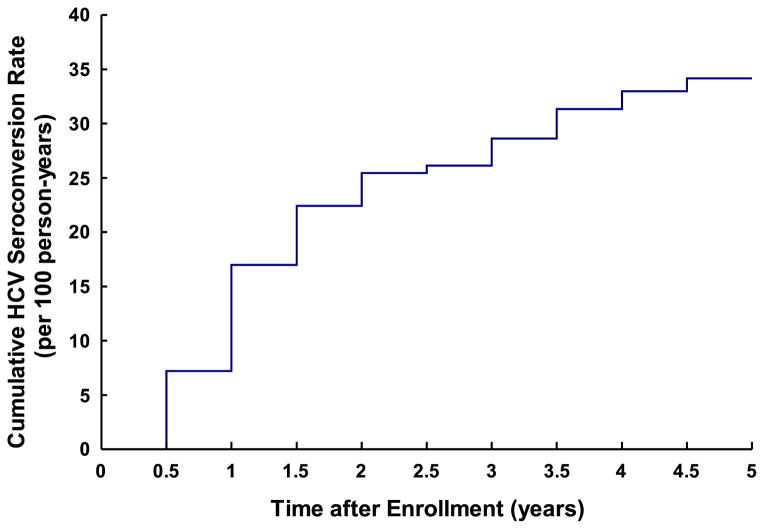
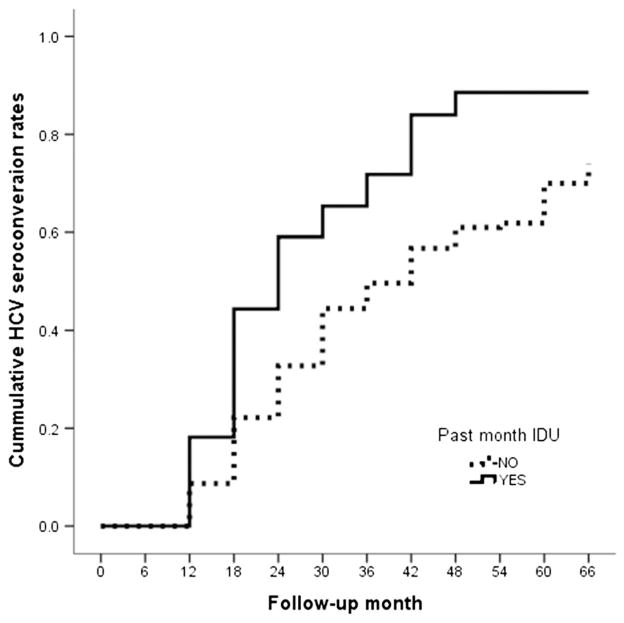
Findings: HCV seroprevalence at admission was 72.1% [95% confidence interval (CI) = 71.3-72.9%] and 555/1200 (46.3%, 95% CI = 43.5-49.1%) patients seroconverted to HCV during MMT. The mean time to HCV seroconversion was 3 (95% CI = 2.84-3.07) years with a cumulative seroconversion rate of 34.5 (95% CI = 31.5-36.9) per 100 person-years. Significant predictors of HCV conversion included injection drug use in the past 30 days [relative hazard (RH) 2.0, 95% CI: 1.6 - 2.4, P=0.002] and the rate of opiate-positive urine tests during MMT (RH 2.0, 95% CI = 1.3-3.1, P<0.001).
Conclusions: Methadone maintenance treatment patients in Wuhan, China show a high prevalence of hepatitis C virus at admission (72.1%) and a high rate of seroconversion during treatment (46.3%). Seroconversion is associated with continuing injection drug use.
Keywords: Behavioral risks; hepatitis C virus; injection drug use; methadone maintenance treatment; opiate dependence; seroconversion.
© 2015 Society for the Study of Addiction.
Conflict of interest statement
None.
Figures
Comment in
-
Commentary on Zhou et al. (2015): Research on methadone maintenance treatment (MMT) as prevention for HCV infection--MMT is not a single variable.Addiction. 2015 May;110(5):803-4. doi: 10.1111/add.12861. Addiction. 2015. PMID: 25868543 No abstract available.
References
-
- World Health Organization. [accessed 17 June 2014];Guidance on prevention of viral hepatitis B and C among people who inject drugs. Available at: http://apps.who.int/iris/bitstream/10665/75192/1/WHO_HIV_2012.18_eng.pdf. (Archived by WebCite® at http://www.webcitation.org/6QP7PVFIz) - PubMed
-
- Aceijas C, Rhodes T. Global estimates of prevalence of HCV infection among injecting drug users. Int J Drug Policy. 2007;18:362–358. - PubMed
-
- Shepard CW, Finelli L, Alter MJ. Global epidemiology of hepatitis C virus infection. Lancet Infect Dis. 2005;5:558–67. - PubMed
-
- Xia X, Luo J, Bai J, Yu R. Epidemiology of hepatitis C virus infection among injection drug users in China: systematic review and meta-analysis. Public Health. 2008;122:990–1003. - PubMed
-
- Garten RJ, Lai S, Zhang J, Liu W, Chen J, Vlahov D, et al. Rapid transmission of hepatitis C virus among young injecting heroin users in Southern China. Int J Epidemiol. 2004;33:182–8. - PubMed
Publication types
MeSH terms
Substances
Grants and funding
LinkOut - more resources
Full Text Sources
Other Literature Sources
Medical
Miscellaneous
