Review
. 2014;8(4):360-5.
doi: 10.4161/19336918.2014.971684.

Homotypic receptor-receptor interactions regulating Eph signaling

Affiliations
Review

Homotypic receptor-receptor interactions regulating Eph signaling

Dimitar B Nikolov et al. Cell Adh Migr. 2014.

Abstract

The Eph receptor tyrosine kinases and their ephrin ligands direct axon pathfinding and neuronal cell migration, and mediate many other cell-cell communication events. The Ephs and ephrins both localize to the plasma membrane and, upon cell-cell contact, form extensive signaling assemblies at the contact sites. Recent structural, biochemical and cell-biological studies revealed that these assemblies are generated not only via Eph-ephrin interactions, but also via homotypic interactions between neighboring receptor molecules. In addition, Eph-Eph interactions mediate receptor pre-clustering, which ensures fast and efficient activation once ligands come into contact range. Here we summarize the current knowledge about the homotypic Eph-Eph interactions and discuss how they could modulate the initiation of Eph/ephrin signaling.

Keywords: Eph receptors; cell-cell signaling; ephrins; receptor tyrosine kinases.


Figures
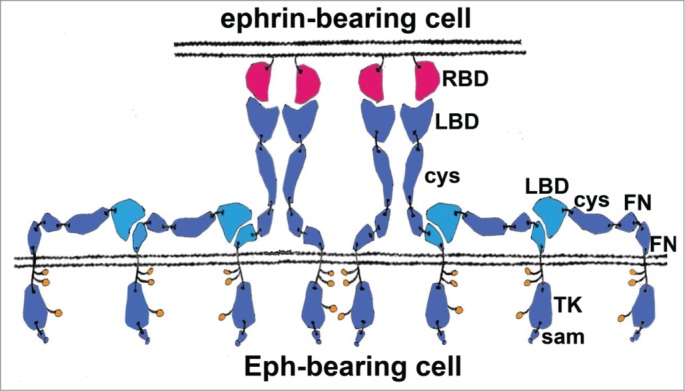
Figure 1.
Figure 1.
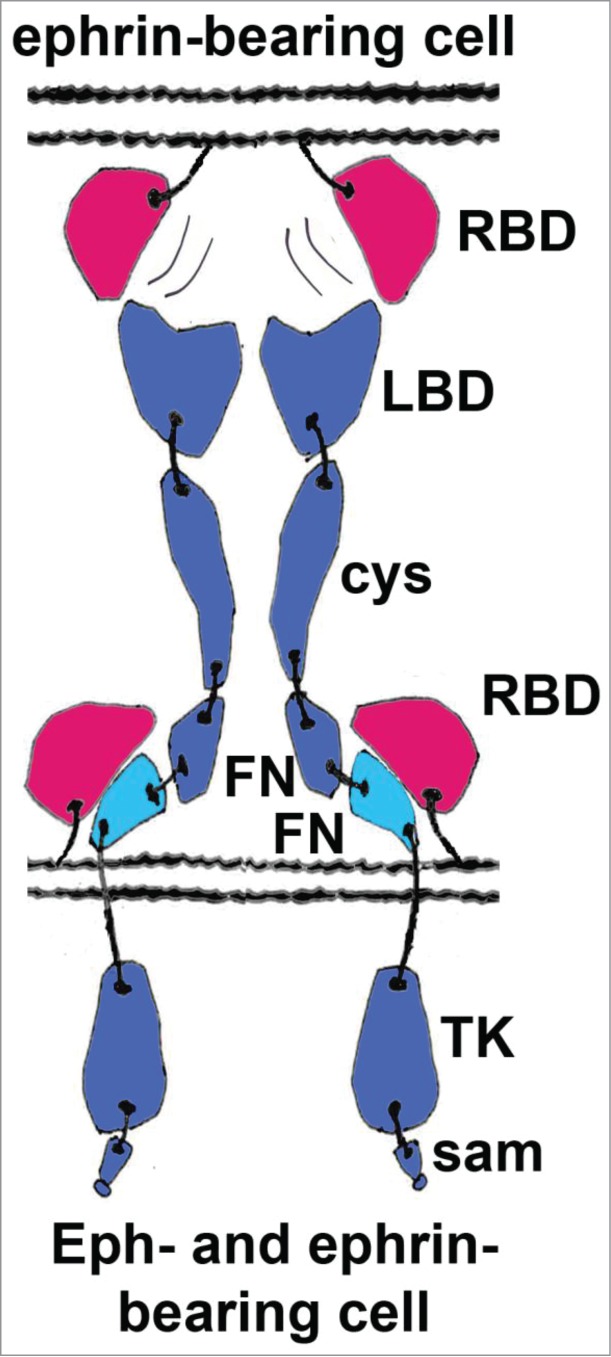
Schematic representation of an Eph/ephrin signaling assembly formed between 2 interacting cells. There are several types of protein-protein interactions stabilizing these assemblies: (i) hetero-dimerization and hetero-tetramerization interactions involving the Eph LBDs and the ephrin ectodomains; (ii) “clustering” Eph-Eph interactions involving the Eph Cys-rich regions; and iii) Eph-Eph LBD-FNIII interactions that are likely important for receptor pre-clustering (prior to contact with ligand) and for subsequent ligand-independent recruitment of unliganded Ephs to the signaling Eph/ephrin assemblies. Eph pre-clustering ensures a fast and efficient activation once ligands come within a contact distance. The ligand-independent recruitment of Ephs to Eph/ephrin assemblies modulates the Eph signal by allowing the size of the receptor clusters to exceed the size of the juxtaposed ephrin clusters, as well as by allowing recruitment of different receptor subtypes within the same signaling assemblies. The interacting FNIII and LBD regions are shown in cyan, other Eph domains are in blue; ephrins are shown in red. RBD, Receptor-Binding Domain; LBD, Ligand-Binding Domain; cys, Cysteine-Rich Domain (CDR); FN, Fibronectin type III Domain; TK, Tyrosine Kinase Domain; sam, Sterile Alpha Motive. Phosphorylated intracellular tyrosines are shown as small orange circles.
Figure 2.
Figure 2.
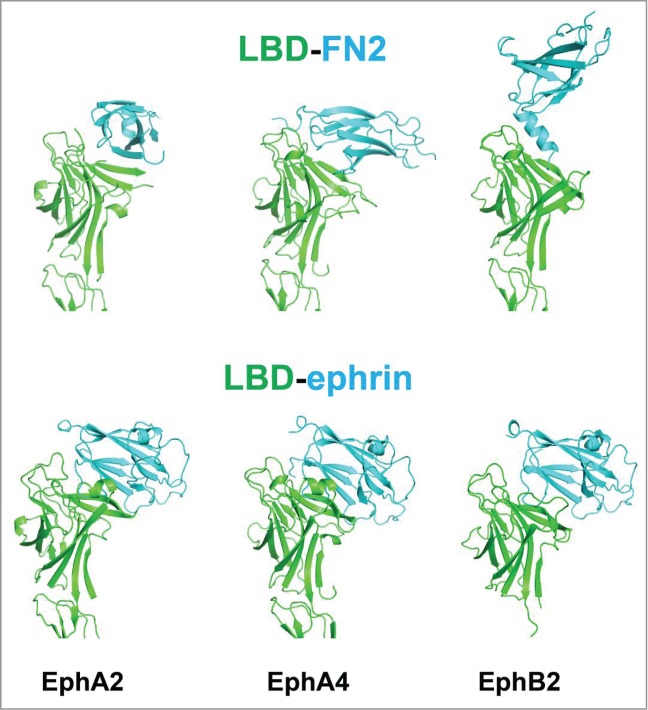
LBD-FNIII Eph-Eph interactions. Top: The interacting LBD-FNIII regions of unliganded Ephs from the crystal structures of EphA2 (left), EphA4 (middle) and EphB2 (right). The LBDs are in green and the second FNIII repeats (FN2), in cyan. Bottom: The LBDs of the same Ephs bound to their ephrin ligands from the crystal structures of the Eph/ephrin complexes EphA2/ephrin-A1 (left), EphA4/ephrin-A5 (middle) and EphB2/ephrin-B2 (right). The LBDs are in green and the ephrins, in cyan.
Figure 3.
Figure 3.
Schematic representation of the in cis vs in trans interactions between Eph receptors and ephrins. In many neurons the expression levels of A-class ephrins are high and they co-localize with Eph receptors to the same membrane patches. Within these patches, they are involved in cis interactions, which are generally inhibitory to the forward Eph signaling. Although the precise molecular mechanism of the inhibition is not well understood, it has been suggested that the in cis interactions prevent the conformational rearrangements normally effected by the in trans Eph/ephrin contacts that are required for the formation of the ordered Eph/ephrin signaling assemblies. The in cis interacting FNIII regions are shown in cyan, other Eph domains are in blue; ephrins are shown in red. RBD, Receptor-Binding Domain; LBD, Ligand-Binding Domain; cys, Cysteine-Rich Domain; FN, Fibronectin type III Domain; TK, Tyrosine Kinase Domain; sam, Sterile Alpha Motive.

References

    1. Flanagan JG, Vanderhaeghen P. The ephrins and Eph receptors in neural development. Annu Rev Neurosci 1998; 21:309-45; PMID:9530499; http://dx.doi.org/10.1146/annurev.neuro.21.1.309 - DOI - PubMed
    1. Frisen J, Holmberg J, Barbacid M. Ephrins and their Eph receptors: multitalented directors of embryonic development. EMBO J 1999; 18:5159-65; PMID:10508149; http://dx.doi.org/10.1093/emboj/18.19.5159 - DOI - PMC - PubMed
    1. Kullander K, Klein R. Mechanisms and functions of EPH and ephrin signalling. Nat Rev Mol Cell Bio 2002; 3:475-86; http://dx.doi.org/10.1038/nrm856 - DOI - PubMed
    1. Wilkinson DG. Multiple roles of EPH receptors and ephrins in neural development. Nat Rev Neurosci 2001; 2:155-64; PMID:11256076; http://dx.doi.org/10.1038/35058515 - DOI - PubMed
    1. Holland SJ, Gale NW, Mbamalu G, Yancopoulos GD, Henkemeyer M, Pawson T. Bidirectional signalling through the EPH-family receptor Nuk and its transmembrane ligands. Nature 1996; 383:722-5; PMID:8878483; http://dx.doi.org/10.1038/383722a0 - DOI - PubMed

Publication types

LinkOut - more resources